

Before you make it · No. 9
Sticky Korean fried chicken for tonight
Two inches of oil, about one inch, or four to five cups? We read four named recipes so you can see the clock, the oil, and what a glaze does to the crust before you start.
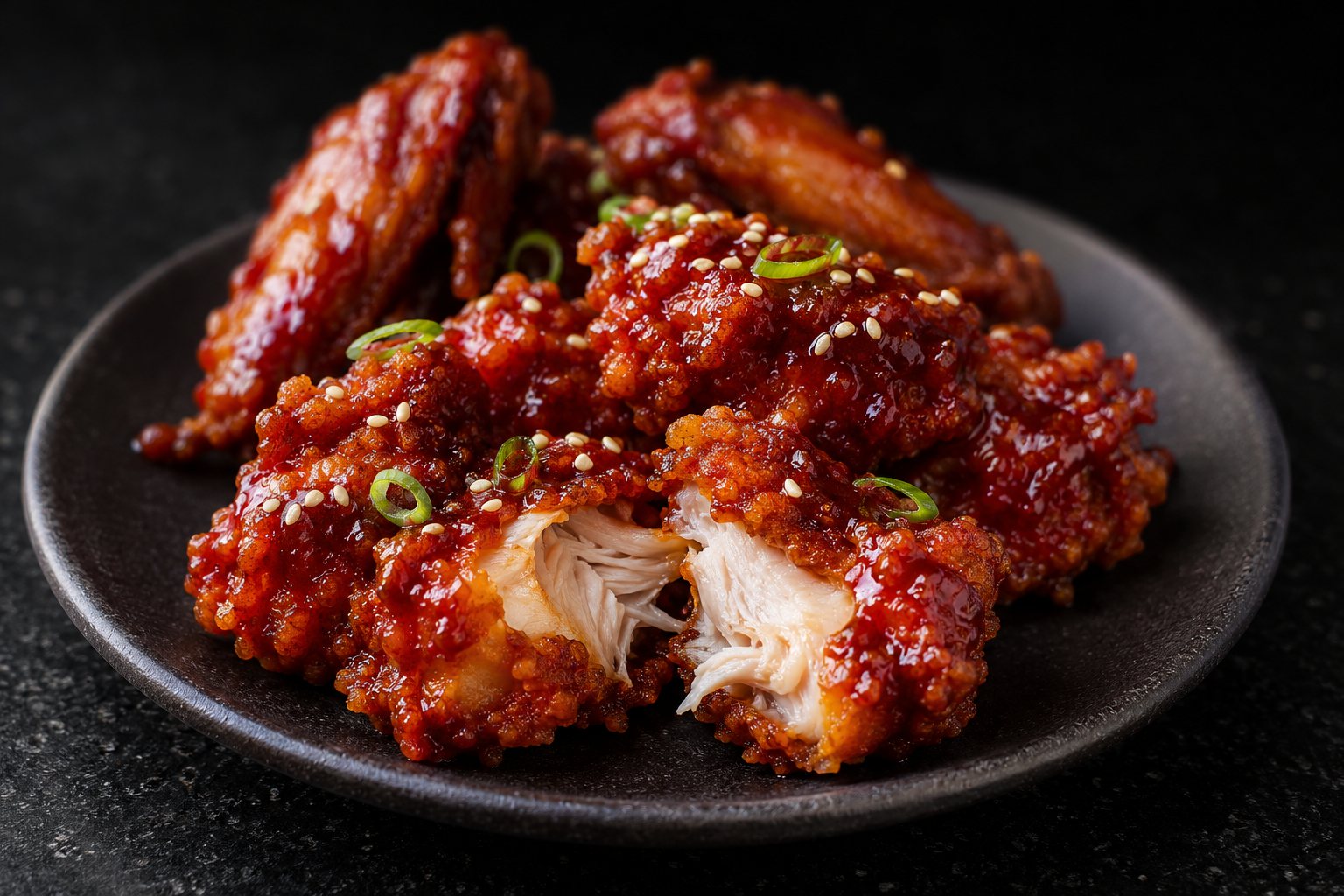
Say it's a weeknight and you want sticky Korean-style fried chicken on the table tonight. You have a home stove. You are deciding before you open a jug of oil. You want the glazed kind, and you want to know how long the cooks' clocks run, how much oil they actually name, and what they say the sauce does to the crust.
We read four named pages and pulled out the fry times, the oil line, and the sauce. We haven't fried these versions. Everything practical below comes from the named page and is linked, so you can check it. Cook from the page you choose. This site already has an interactive crunch guide for a different fried chicken. That guide is linked further down. It is not this decision.
At a glance
How each recipe fits this plan
- No image yet
Maangchi
Two 12-minute fries after a 10 to 12 minute heat-up, in 2 inches of oil. She calls double frying the whole secret. The headnote says the second fry is hotter. The method prints 330-350ºF for both. The sauce goes on all the chicken. No hold.
Plan around this Depth, not cupsSecond fry heat differs Recipe by Maangchi - No image yet
Sue
The card total is 40 minutes. She names a generous amount of oil and no cups or depth. The sauce can coat the chicken or sit beside it as a dip. Leftovers keep a day or two in the fridge and, she writes, will not be as crunchy.
Fits your plan Oil not measured Recipe by Sue, My Korean Kitchen - No image yet
Hyosun
About 1 inch of oil. A first fry of about 3 minutes, in two batches, then a minute or two. She calls it the easiest and says it cooks up quickly in shallow oil. The chicken “stays crispy,” with no duration. The milk soak is a couple of hours in the essay and at least 30 minutes, optional, in the method.
Plan around this Crisp, no clockSoak clocks differ Recipe by Hyosun, Korean Bapsang - No image yet
Bill
The card total is 1 hour 45 minutes. He heats 4 to 5 cups of oil and also says that oil should fill the pot about halfway. The glaze is tossed on, and he says a thin sauce soaks in. An oven path, he writes, will not be quite as crispy.
Risky for this plan 4–5 cups, and halfwayA friend's recipe Recipe by Bill, The Woks of Life
Maangchi
Plan around thisDepth, not cupsSecond fry heat differsFrom Sweet, sour, & spicy Korean fried chicken (Yangnyeom-tongdak) by Maangchi. Posted January 27, 2011. Last updated March 5, 2025.
- Oil
- 2 inches
- Heat-up
- 10–12 min
- Fries
- 12 min, then 12
- Serves
- 3–4, from 2 lb wings
Maangchi's yangnyeom-tongdak page was posted January 27, 2011, and last updated March 5, 2025. She says this version is almost the same as the one in her book Real Korean Cooking, with a tweak to the amount of flour. We did not open the book.
The batch is 2 pounds of chicken wings, which she calls 3 to 4 servings. The oil line is a depth, not a volume: “Heat 2 inches of oil in a large heavy frying pan or pot” for about 10 to 12 minutes, until it reaches 330-350ºF. She used a 12-inch pan. “if your pan is smaller, work by batches.” She does not say how many batches, and she does not give cups. The same sentence spells the burner setting “medium hight” Without a thermometer, she says to dip one piece in the oil, and if it bubbles, it is ready. That dip is her check. It is not an internal temperature.
The first fry is 12 minutes. The oil then heats for 2 minutes, back to 330-350ºF, and the second fry is about another 12 minutes, until very crunchy. The headnote does not match that range. She writes that crispiness comes from double frying. “The first fry cooks the chicken through and the second fry at a higher temperature finishes it off and creates a crispy exterior.” Then: “That double frying is really the whole secret, it makes each chicken piece crispy without being heavy.” The method prints 330-350ºF for both fries. We are not choosing which line governs.
The sauce is a wet coating. She describes the finished chicken as “crispy and crunchy underneath and then spicy, sweet, and a little sour on top.” After the second fry she reheats the sauce and mixes in all the hot chicken. The recipe does not say to serve the sauce on the side. It does not say how long a sauced piece stays crisp, and it does not say what to do with leftovers.
For this plan
Our reading: tonight can cover the heat-up and the two 12-minute fries if you stay at the stove and the pan is the 12-inch one she used. A smaller pan adds batches she does not time. Two inches is not a shopping amount. The glaze goes on the chicken, and the page has no leftover plan.
Sue
Fits your planOil not measuredFrom Korean Fried Chicken by Sue, My Korean Kitchen. Published October 13, 2017. Updated May 13, 2019.
- Card total
- 40 min
- Prep / cook
- 10 + 30
- Oil
- “A generous amount”
- Second fry
- 2–3 min
Sue's card on My Korean Kitchen lists 10 minutes prep, 30 minutes cook, and 40 minutes total, for 4 servings. The chicken is 1.4 kg / 3 pounds. She says to use a cut-up whole chicken, wings, drumsticks, or boneless thigh. The page was published October 13, 2017, and updated May 13, 2019. The byline is Sue. The page does not print a surname.
She describes yangnyeom chicken as “double deep fried chicken that is coated with sticky, spicy and sweet sauce.” The oil line does not measure it: “add a generous amount of oil” in a deep saucepan, and the page spells the other vessel “frier” Heat it to “175 C / 347 F (or boiling).” She prints no cups and no depth. The first fry is between 3 to 5 minutes, depending on the size of the chicken, and she says not to overcrowd the pan. The second fry is shorter, 2 to 3 minutes, until the batter is golden and crisp. She does not say how many batches sit inside the 30-minute cook field.
The sauce is heated until it bubbles, then poured over the chicken. Her alternative is in the same paragraph: “serve the fried chicken and the sauce separately and use the sauce as a dipping sauce.” “Once all the chicken is coated with the sauce, serve it hot immediately.” Then the hold: “Leftover chicken can be refrigerated for a day or two and eaten cold. But it won’t be as crunchy.”
For this plan
Our reading: 40 minutes is the only total on this sheet under an hour, so it is the weeknight card. You still do not know how much oil to pour, and a full 3 pounds may be more than one batch. Pouring the sauce over is her first instruction. The dip is the line she prints when the crunch matters more than a coat. The day-or-two fridge line, eaten cold, is hers. The USDA section does not clear it.
Hyosun
Plan around thisCrisp, no clockSoak clocks differFrom Dakgangjeong (Sweet Crispy Korean Fried Chicken) by Hyosun, Korean Bapsang. Published November 29, 2020. Updated April 24, 2021.
- Oil
- About 1 inch
- First fry
- About 3 min, two batches
- Second fry
- A minute or two
- Serves
- 4, from 1 lb
Hyosun's dakgangjeong page on Korean Bapsang headers itself published November 29, 2020, and updated April 24, 2021. The byline in the page data is Hyosun. The page does not print a surname. The batch is 1 pound of boneless skinless thigh and/or breast, for 4 servings. She says bite-size pieces are why it is quick: “This recipe uses bite-sized boneless chicken pieces, so it cooks up quickly in shallow oil. It’s the easiest Korean fried chicken you can make at home!”
The page does not print a total time. The clocks sit in separate lines. In the essay she soaks the chicken in milk “for a couple of hours, but it’s not absolutely necessary.” The method says at least 30 minutes in the fridge, and “This step is optional.” After that, the pieces sit 20 to 30 minutes. The sauce simmers until it thickens slightly, about 3 to 4 minutes. We are not adding those lines into a total she did not print.
The oil is “about 1 inch” in a heavy bottom pan. A tip says a deep medium pot needs less oil than a large pan, with less splash. She does not give cups. Heat to 330°F. The first fry is two batches, about 3 minutes, until light golden brown. Reheat the oil to 330°F and fry again about a minute or two. The second fry can be one batch. A separate tip on the same page says “Double fry! It’s the Korean way.” Then the chicken goes into the reheated sauce until it is coated.
On a bigger batch she writes: “You can easily double or triple the recipe for a bigger crowd. Great for a potluck or a party. The chicken stays crispy!” She does not say for how long, or whether that is before the sauce or after. The recipe does not give a refrigerator line or an internal temperature.
For this plan
Our reading: the fries are the short ones, in about an inch of oil, if you skip the milk she marks optional. The 20 to 30 minute sit is still in the method. “Stays crispy” is on the page, and it is not a time. A weeknight can fit the fries. It cannot treat that sentence as a promise about tomorrow.
The page header date is November 29, 2020. The structured data timestamp is 2020-11-30 at 04:59 UTC, which is still November 29 in the United States. We cite the header.
Bill
Risky for this plan4–5 cups, and halfwayA friend's recipeFrom Korean Fried Chicken (Dakgangjeong) by Bill, The Woks of Life. Published November 24, 2020. Updated April 5, 2022. Bill writes that the recipe is his friend David's, which David called Bon-Davi chicken. The page does not give David's surname. We read Bill's page, not a separate page by David.
- Card total
- 1 hr 45 min
- Oil
- 4–5 cups, and halfway
- Second fry
- 30 sec or 1 min
- Serves
- 6, from 3 lb
Bill's card lists 45 minutes prep, 1 hour cook, and 1 hour 45 minutes total, for 6 servings. The chicken is 3 pounds, and he says the cut changes the fry time. Wings, tenders, nuggets, drumsticks, and bone-in thighs are all on the page. The method sets the seasoned chicken aside for 15 minutes. We are not deciding whether that 15 minutes is already inside the card's 45 minutes of prep.
He is the only one of the four who names a volume: “Heat 4-5 cups of oil in a deep pot to 325°F/163°C. The oil should ideally fill the pot about halfway, so hot oil won’t overflow or splatter too much while frying.” Those are two instructions. They describe the same pot only if 4 to 5 cups reaches halfway in the pot you own. He does not name the pot's width. He also writes: “It’s very important that the chicken (especially bone-in pieces) is fully submerged in oil, so make sure you have enough oil depth in the pot.” He does not turn that sentence into a second cup amount.
The first fry is in batches, until lightly golden. His times for that fry: 3 to 4 minutes for tenders, 2 to 3 for nuggets, 6 to 8 for whole wings, 4 to 6 for drumettes and flats, 9 to 11 for drumsticks or bone-in thighs. The second fry is a different temperature, 375°F/190°C, for 1 minute if the piece has a bone and 30 seconds if it is boneless. He drains on a cooling rack. We are not adding the cut times into a new total. The card already says 1 hour of cooking.
The glaze is tossed on after the second fry. “While the sauce might seem thin, that’s the way it should be. When you toss the freshly fried chicken in the glaze, it soaks up the glaze evenly. A thicker sauce won’t coat the chicken as easily.” He does not say how long that crust stays crisp, and he does not give a refrigerator line for the chicken. If you would rather not deep-fry, he gives an oven and an air-fryer path and writes “It won’t be quite as crispy.” For the oven he says a thermometer should read 160-165°F/71-74°C. That number is his. It is not the USDA line below.
For this plan
Our reading: 1 hour 45 minutes is the long card for a weeknight that starts when you get home. The flag is the clock and the oil, not a verdict that the chicken fails. He is also the only page here that names the oil in cups. The glaze goes on the chicken. The halfway line and the 4 to 5 cups are both his, and he does not show the pot where they match.
Bill's page also has a section on leftover frying oil, including a suggestion about pouring some on campfire logs, which he marks as your own risk. That suggestion is not repeated here. The USDA page linked below is the disposal and reuse guidance we are pointing to.
The short version
For sticky Korean-style chicken on the table tonight, Sue’s card is the only total under an hour: 40 minutes. She is also the only one who says the sauce can stay on the side. She does not say how much oil to pour. Hyosun’s fries are the short ones, in about 1 inch of oil, and she says the chicken stays crispy without saying for how long. Maangchi’s page is two 12-minute fries in 2 inches of oil, sauce on all the chicken, and no hold. Bill’s card is 1 hour 45 minutes, and he is the only one who names a volume: 4 to 5 cups, which he also wants halfway up the pot.
All four double-fry, and all four can end with sauce on the chicken. They do not share a clock, a pot, or a sentence about how long the crust survives that sauce. We have not fried any of them. Follow one page. Do not borrow Maangchi’s 12 minutes and Bill’s 4 cups for the same batch.
Where the clocks and the oil disagree
The totals are the first split. Sue prints 40 minutes. Bill prints 1 hour 45 minutes. Maangchi and Hyosun do not print a total. Maangchi’s oil clocks, written separately, are about 10 to 12 minutes to heat, 12 minutes to fry, 2 minutes to reheat, and about another 12 minutes. Hyosun’s fry lines are about 3 minutes, in two batches, then a minute or two, after a 20 to 30 minute sit, with a milk soak she marks optional. We are not summing lines they left apart.
The second fry is not one length. Maangchi’s is about another 12 minutes, and her method returns the oil to the same 330-350ºF range even though the headnote says the second fry is hotter. Sue’s is 2 to 3 minutes, at the same 175 C / 347 F line as the first, with “(or boiling)” still in the sentence. Hyosun’s is about a minute or two, back at 330°F. Bill’s is 30 seconds for boneless pieces and 1 minute for bone-in pieces, and he raises the oil from 325°F/163°C to 375°F/190°C. The first-fry times on his page depend on the cut. Sue’s first fry is 3 to 5 minutes and depends on size. A wing and a boneless bite are not the same clock.
The oil is the third split, and it is the shopping question. Maangchi names 2 inches in the 12-inch pan she used, and batches if the pan is smaller. Hyosun names about 1 inch, and says a deep medium pot uses less oil than a large pan. Neither gives cups. Sue names “a generous amount” and stops. Bill names 4 to 5 cups and, in the next sentence, halfway up the pot. This page does not convert inches into cups, and it does not tell you which pot makes 4 to 5 cups halfway.
Sauce on the chicken, or crunch that holds
Maangchi coats every piece. Her finished-chicken line is crunchy underneath, with the sauce on top. She does not say the coat softens, and she does not say when to eat it.
Sue pours the sauce over, and she also tells you the sauce can be a dip instead. Serve it hot immediately if it is coated. The leftover line is a day or two in the refrigerator, eaten cold, and not as crunchy. She is the only page here that says the crunch does not hold.
Hyosun coats the chicken too, then writes that it stays crispy, in a sentence about doubling the recipe for a party. There is no hour attached to that sentence. Bill tosses the chicken in a glaze he calls thin on purpose, because it soaks in evenly and a thicker sauce will not coat as easily. He does not say the crust survives the night. His oven and air-fryer alternative is the one he says will not be quite as crispy, and the 160-165°F/71-74°C on that path is his oven sentence.
If the glaze is the point, Maangchi, Hyosun, and Bill all put it on the chicken, and Sue does too unless you take her dip. If a crust you can still hear is the point, Sue is the page that offers the sauce on the side, and she is also the page that says the coated leftovers lose it. Hyosun’s “stays crispy” and Sue’s “won’t be as crunchy” are both on the pages. They are not a measurement we made.
This is not the crunch guide
The interactive guide on this site, Fried chicken: crunch you can hear, is a different chicken. It walks a brine, a shaggy flour coat, a deep pot, a temperature taken out of the oil, and a rack instead of a plate. One line there says to fry twice if you want it crunchier still. The numbers on that page come from America’s Test Kitchen recipes and from USDA’s deep-frying page. It does not compare these four Korean-style recipes, choose a glaze, or decide a weeknight.
This page does not repeat those steps, and it does not move that guide’s oil temperatures onto yangnyeom chicken or dakgangjeong. If you already chose the chicken on that guide, stay there. If you are still deciding whether the sticky kind is tonight’s project, stay here.
Hot oil, from the official pages
The four recipes tell you to heat a pot of oil. They are not a fire sheet, and this page does not add one. Maangchi’s bubble test, dipping a piece to see if the oil is ready, is her sentence. It is not a stand-in for the thermometer lines below.
The National Fire Protection Association’s cooking-safety page says: “Stay in the kitchen while you are frying, grilling, boiling, or broiling food.” Under cooking with oil, the same page says: “Always stay in the kitchen when frying on the stovetop.” It says: “If you see wisps of smoke or the oil smells, immediately turn off the burner and/or carefully remove the pan from the burner. Smoke is a danger sign that the oil is too hot.” It says to heat the oil slowly, and to add food gently so the oil does not splatter. If the oil catches fire, that page says to slide the lid over the pan and turn off the burner, not to remove the cover, and to let the pan cool for a long time. The same bullet says: “Never throw water on the fire.” If the fire does not go out, or you don’t feel comfortable sliding a lid over the pan, the page says to get everyone out and call the fire department from outside. The page’s own description says cooking fires are the number one cause of home fires and home injuries, and that the leading cause of fires in the kitchen is unattended cooking. No date was printed on the page. Checked October 26, 2026.
For a burn, this page does not add treatment. The U.S. Fire Administration’s Burn Prevention, First Aid and Calling 911 page, last reviewed April 1, 2023, and checked October 26, 2026, says: “Treat a burn right away by putting it in cool water for 3 to 5 minutes.” It says: “Cover the burn with a clean, dry cloth. Do not apply creams, ointments, sprays or other home remedies.” It says: “Remove all clothing, diapers, jewelry and metal from the burned area.” It says: “See your doctor or call 911 if the burn is larger than your palm.” It also says: “When in doubt, call 911.”
The USDA Food Safety and Inspection Service’s Deep Fat Frying and Food Safety page says poultry’s safe minimum internal temperature is 165°F, and: “Do not test the internal temperature of the food while it is submerged in the hot oil.” It says water meeting oil at about 350°F vaporizes and can splatter, and not to let water into the hot fat or use water to cool or clean the fryer while food is frying. On a grease fire it says: “never use water to put out the fire.” It says: “A kitchen fire extinguisher or covering the fryer with a metal lid is the best way to put out a grease fire. Call 911 immediately if a grease fire occurs.” It says: “It is important never to leave your fryer unattended.” Its approximate table lists chicken pieces at 13 to 20 minutes in 375°F oil, and chicken fingers at 6 to 8 minutes in 350°F oil. None of the four recipes is that row. Maangchi’s 12 minutes at 330-350ºF, Sue’s 3 to 5 minutes at 175 C / 347 F, Hyosun’s 3 minutes at 330°F, and Bill’s cut-by-cut times are their clocks. This page does not decide whether any of those clocks meets the USDA table. The copy we read did not show a last-updated line. Checked October 26, 2026.
Bill’s oven sentence, 160-165°F/71-74°C, sits next to the USDA’s 165°F for poultry. This page does not decide whether 160 meets 165. His page is the recipe. The USDA page is the official temperature.
Leftovers, from the USDA
Sue is the only one of the four who prints a hold for the cooked chicken: a day or two in the refrigerator, eaten cold, and not as crunchy. Maangchi prints none. Hyosun’s “stays crispy” has no refrigerator and no hour. Bill prints none for the chicken. His leftover-oil section is a different subject, and the campfire line on that page is not repeated here.
The same USDA deep-frying page says to refrigerate leftovers within 2 hours of frying, or 1 hour if the temperature is above 90°F. It says not to pour oil down the sink. If the oil will be reused, it says to strain it and store it in a sealed, light-proof container for up to 3 months, and to refrigerate used frying oil for best quality. If the oil is clouded, foams, or smells foul, it says to discard it. The disposal method it names is a sealable metal container or a gallon milk jug in the trash, or a local recycling drop-off if one accepts it.
The USDA’s Leftovers and Food Safety page, last updated July 31, 2020, and checked October 26, 2026, says to cook all poultry to 165°F. It says: “Within 2 hours of cooking food or after it is removed from an appliance keeping it warm, leftovers must be refrigerated.” It says to throw away perishable food left at room temperature more than 2 hours, or 1 hour if the temperature is over 90°F. It says leftovers can be kept in the refrigerator for 3 to 4 days or frozen for 3 to 4 months. Reheating, on that page, means 165°F. The refrigerator temperature it names is 40°F or below.
That leftovers page does not mention Korean fried chicken, a glaze, or a crust. This page does not decide whether Sue’s day or two, eaten cold, meets the 3 to 4 days, the 2-hour rule, or the 165°F reheating line. The official pages are the links. The recipe you cook is the clock you followed to get there.
“That double frying is really the whole secret, it makes each chicken piece crispy without being heavy.”
Maangchi
“Leftover chicken can be refrigerated for a day or two and eaten cold. But it won’t be as crunchy.”
Sue, My Korean Kitchen
“The chicken stays crispy!”
Hyosun, Korean Bapsang
“The oil should ideally fill the pot about halfway, so hot oil won’t overflow or splatter too much while frying.”
Bill, The Woks of Life