

Before you make it · No. 27
Tonkotsu ramen this weekend
Scrubbed bones at a hard, steady boil all day, a soy tare, and marinated eggs. Our recipe, assembled from named cooks. We have not cooked it.
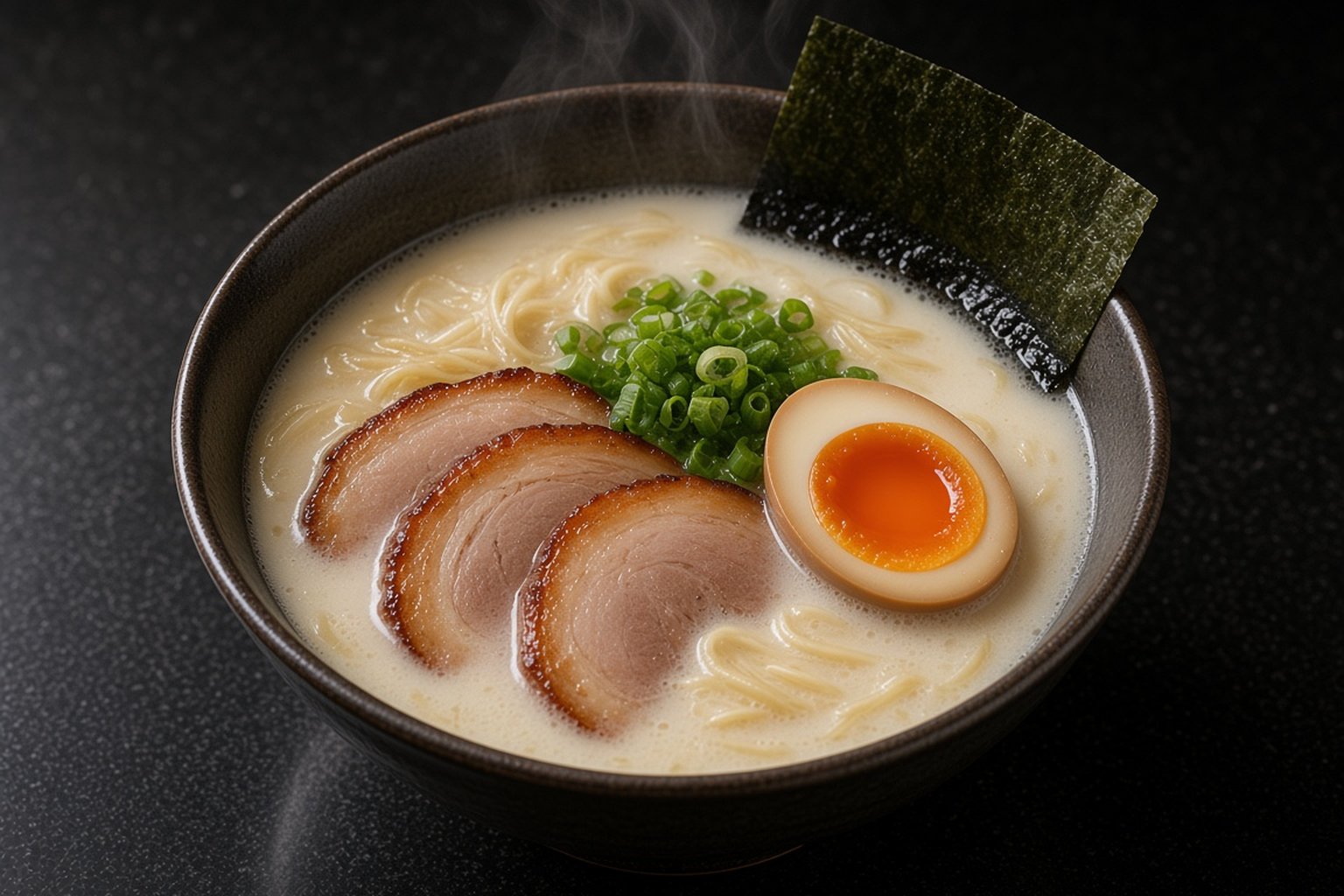
This is our tonkotsu ramen. We assembled it from the cooks linked at the bottom. We checked Namiko Hirasawa Chen’s and Marc Matsumoto’s ramen pages and Chen’s egg page on November 16, 2026, and the others on November 10. We have not cooked it. Nothing below is a tasting or a test.
It is a stovetop broth, boiled hard for most of a day. Plan it across a weekend: the broth and eggs on the first day, the bowls that evening or the next.
The recipe
Four bowls, with broth left over to freeze. The broth needs your largest stockpot.
Broth
- 1.4 kg (3 pounds) pig trotters, split lengthwise by the butcher
- 900 g (2 pounds) chicken backs or carcasses
- 450 g (1 pound) pork fatback
- 1 head garlic, halved crosswise
- a 2 inch (5 cm) piece fresh ginger, sliced
- 1 onion, halved, skin on
- water
Shoyu tare
- 2 tablespoons sake
- 2 tablespoons mirin
- 4 tablespoons light (usukuchi) soy sauce
- 2 tablespoons water
- a 2 1/2 inch (6 cm) square of kombu
- 25 g Diamond Crystal kosher salt, about 3 tablespoons, or 25 g of another salt by weight
Ramen eggs
- 4 large eggs, cold from the fridge
- 1/4 cup (60 ml) soy sauce
- 1/4 cup (60 ml) mirin
- 1/4 cup (60 ml) sake, or water
- 1 teaspoon sugar
Bowls
- 4 portions fresh ramen noodles
- 8 slices chashu pork, from Chen’s or Matsumoto’s chashu recipe, or bought
- 2 scallions, thinly sliced
- nori sheets, cut in squares
Method
- Clean the bones. Put the trotters and chicken backs in the stockpot, cover them with cold water, and bring it to a boil. As soon as it boils, drain everything into the sink. Scrub any dark scum off the bones under running water, and wash the pot.
- Start the boil. Return the bones to the clean pot with the fatback. Add cold water to cover by about an inch. Bring it to a hard boil and skim off the foam that rises.
- Add the garlic, ginger, and onion. Keep the pot at a steady rolling boil, covered to slow evaporation. The surface should churn, not just tremble. That churning is what turns the broth white.
- After about 4 hours, lift out the fatback once it is tender. Put it in a covered container in the fridge.
- Keep boiling 6 to 8 hours more. Every hour or so, top up with water to keep the bones covered and stir from the bottom so nothing sticks. The broth is ready when it is opaque and about as thick as light cream.
- Make the tare and eggs while the broth boils. For the tare, heat the sake, mirin, soy sauce, water, and kombu in a small pot until it nearly boils, then simmer 3 to 4 minutes on low. Turn off the heat, stir in the salt until it dissolves, and let it cool. Do not reduce it after the salt goes in.
- For the eggs, boil the soy sauce, mirin, sake, and sugar for 1 minute, then cool it completely. Bring a saucepan of water to a full boil. Lower the cold eggs in gently and keep the water at a gentle simmer for 7 minutes. Move them straight to ice water for 15 minutes, then peel. Put them in a small bag with the cooled marinade, press out the air, and refrigerate 8 hours or overnight. Take them out of the marinade within a day.
- Finish the broth. Strain it through a fine sieve into a clean pot, pressing on the solids. If you have much more than about 3 quarts (2.8 liters), boil it down to about that. Chop the chilled fatback finely and whisk it into the hot broth.
- Build the bowls. Bring a large pot of water to a boil for the noodles. Warm four bowls with hot water and empty them. Put 1 tablespoon of tare in each bowl. Cook the noodles as the package says. Just before they are done, ladle about 1 1/2 cups (350 ml) of very hot broth into each bowl and stir. Drain the noodles well and lay them in the broth. Top with chashu, a halved egg, scallions, and nori, and eat at once.
Where cooks agree and differ
The broth is the dish, and every page agrees on how it turns white. J. Kenji López-Alt, Namiko Hirasawa Chen, and Joshua Weissman each say a rolling boil emulsifies the fat and collagen, and that a gentle simmer does not. Kenji tried a pressure cooker alone and got a nearly clear broth.
The clock is where they split. Kenji’s card is about 10 hours of boiling, and Weissman’s is 12. Marc Matsumoto pressure-cooks his broth for 1 hour 45 minutes, or boils it covered for 5 to 6 hours without a cooker. Chen pressure-cooks for 60 minutes, then boils uncovered for an hour to emulsify it. Without a cooker, she simmers 3 to 4 hours before that boil. We wrote the long boil because the title is a weekend, and because two cards print it as the main method. Chen’s pressure-cooker page is the one to follow if you want broth the same afternoon.
Cleaning. Kenji drains the first boil as soon as it starts and scrubs the bones. Matsumoto and Weissman blanch 10 to 15 minutes first. Chen soaks the bones 15 minutes in changing water. We used Kenji’s quick boil and scrub. He writes that cleaning changes the color of the broth from brown to pale.
Bones. Kenji uses trotters and chicken backs. Matsumoto uses trotters, leg bones, and chicken bones, and he writes that ribs or neck bones will not give the same richness or color. Chen uses leg bones and a skin-on hock. Weissman uses skin-on trotters, or spine and neck bones. We took Kenji’s pair.
Fat. Kenji cooks fatback in the broth until tender, then chops it and whisks it back in. Matsumoto whisks minced fatback into each bowl at the end. We followed Kenji.
Seasoning. Kenji seasons at the table and gives no amounts. Matsumoto whisks tahini, chashu liquid, garlic, salt, mirin, and pepper into the broth. Weissman makes a kombu, bonito, soy, and mirin tare. Chen’s shoyu tare is printed with amounts, at 1 tablespoon per 350 ml bowl. We used Chen’s tare and serving ratio because they are measured.
Eggs. Chen boils hers 7 minutes, chills them in ice water, and marinates them 8 hours or overnight. Weissman boils his 6 1/2 to 7 minutes and does not marinate them. We used Chen’s.
What to watch for
Keep the boil hard. A pot that drops to a simmer for hours makes a thinner, clearer broth, on Kenji’s, Chen’s, and Weissman’s accounts.
Keep the bones covered. Kenji and Weissman both top up the water, and Weissman stirs so the pork does not scorch on the bottom. If you leave the pot, Kenji tops it up, turns it to the lowest setting, and brings it back to a boil later.
Do not reduce the tare after the salt goes in. Chen writes that it gets more concentrated.
Serve as soon as the noodles hit the broth. Chen says the noodles soak up the soup.
The eggs are soft-cooked. Chen keeps them in the marinade no longer than 12 to 24 hours, then eats them within 3 to 4 days, and does not reuse the marinade. For egg handling, see the USDA’s Shell Eggs from Farm to Table, last updated November 20, 2024.
The broth is a large batch. Chen refrigerates hers within 2 hours, or 1 hour above 90°F, and keeps it up to 3 days or freezes it up to a month. For general guidance, see the USDA’s Leftovers and Food Safety, last updated July 31, 2020. Those pages are their guidance. We are not reading them as a clearance for this recipe.