

Before you make it · No. 24
Soup dumplings this weekend
Pork jelly the day before, a warm-water dough, and twenty closed pleats on the day. Our recipe, assembled from named cooks. We have not cooked it.
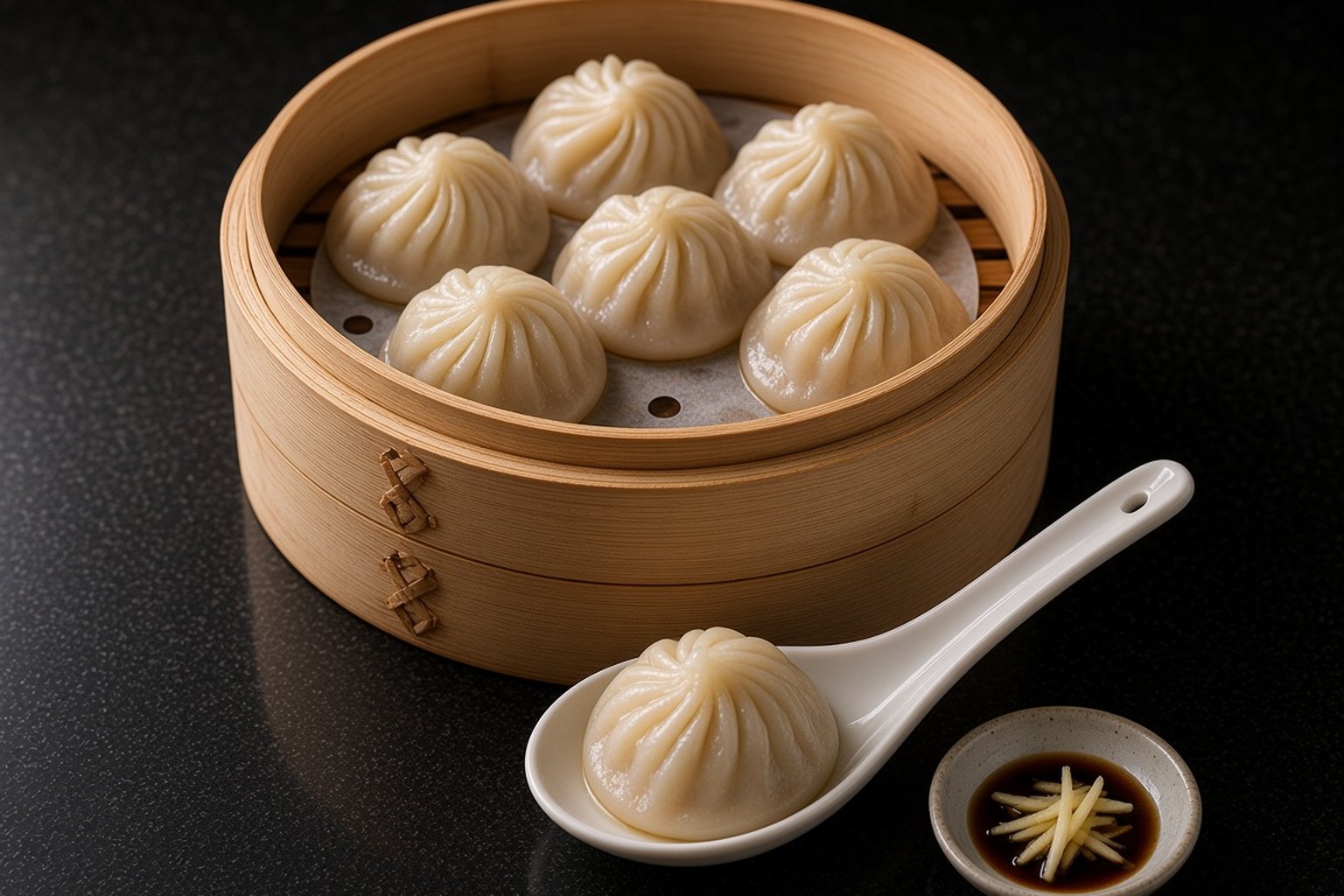
This is our soup dumpling recipe. We assembled it from the cooks linked at the bottom. We checked Judy Leung’s, Maggie Zhu’s, and Elaine’s pages on November 16, 2026, and Naz Deravian’s on November 10. We have not cooked it. Nothing below is a tasting or a test.
It is a two-day recipe. The pork jelly is made the day before and set in the fridge overnight. The dough, the filling, the pleats, and the steam all happen on the day you eat.
The recipe
About 20 dumplings, for 4. Weigh the dough and the filling if you can.
Pork jelly, the day before
- 225 g (1/2 pound) pork skin, cut in 1 inch strips
- 450 g (1 pound) pork neck bones, with some meat on them
- 4 cups (950 ml) water, plus more for blanching
- 2 slices fresh ginger
- 1 scallion, cut in three
- 1 tablespoon Shaoxing wine, or dry sherry
Dough
- 150 g (about 1 cup plus 2 tablespoons) all-purpose flour
- a pinch of salt
- 75 g (5 tablespoons) warm water, plus a teaspoon or two if needed
Filling
- 1 tablespoon finely grated ginger
- 1/4 cup (60 ml) hot water
- 250 g (about 9 oz) ground pork with plenty of fat, around 20 to 30 percent
- 1 tablespoon light soy sauce
- 1 tablespoon Shaoxing wine
- 1/4 teaspoon table salt
- 1/4 teaspoon sugar
- 1/8 teaspoon white pepper
- 1/2 teaspoon toasted sesame oil
- 2 scallions, finely minced
- 150 g (about 2/3 cup) of the set pork jelly, finely chopped
To serve
- Chinese black vinegar
- fresh ginger, cut in very thin matchsticks
You also need a steamer, bamboo if you have one, lined with napa cabbage leaves or parchment.
Method
- The day before. Put the pork skin and bones in a pot, cover with cold water, and bring to a full boil. Drain, rinse the skin and bones, and rinse the pot. Return them to the pot with the 4 cups of water, the ginger, scallion, and wine. Bring to a boil, then cover and keep at a low simmer for 2 hours.
- Strain the liquid into a bowl and let it cool completely. Cover and refrigerate overnight. By morning it should be a firm jelly with a layer of fat on top. Lift off the fat. You will have more jelly than you need.
- On the day. Mix the flour and salt in a bowl. Drizzle in the warm water a little at a time, stirring with chopsticks or a fork, until the flour forms shaggy flakes. Press it together. If dry flour is left in the bowl, add water a teaspoon at a time until it is all taken up. Knead 15 to 20 minutes, until the dough is smooth, soft, and springy, and no longer sticks to your hands. Wrap it and let it rest about 45 minutes.
- While the dough rests, stir the grated ginger into the hot water and leave it to steep. Put the pork in a bowl with the ginger water, soy sauce, wine, salt, sugar, pepper, and sesame oil. Beat it in one direction with a spatula or chopsticks until the liquid has disappeared into the meat and the mixture looks sticky, pale, and a little springy. That takes a few minutes. Fold in the scallions and the chopped jelly without beating them. Cover and refrigerate until you shape.
- Roll the dough into a rope about 1 inch (2.5 cm) thick. Cut it into 20 even pieces, about 11 g each. Keep them under a damp towel. Flatten one piece with your palm, then roll it into a thin round about 4 inches (10 cm) across, turning it as you roll.
- Put a heaped tablespoon of cold filling, about 22 g, in the center. Pinch a small fold at the edge and keep pinching folds around the rim, turning the dumpling as you go, until the top is gathered. Aim for 14 to 18 small pleats. Twist the top closed. Set it in the lined steamer and cover it while you make the rest. Leave about 2 inches (5 cm) between dumplings. If the filling turns soft and wet, put it back in the freezer for 15 minutes.
- Bring water to a full boil in a wok or pot. The water should sit below the steamer floor and never touch the dumplings. Set the steamer over it, cover, and steam over high heat for 8 minutes.
- Serve at once from the basket, with small dishes of black vinegar and ginger. Lift each dumpling onto a spoon, bite a small hole in the side, and let the steam out before you drink the soup.
Where cooks agree and differ
Every page builds the same thing: a cooked meat stock that sets to a jelly, chopped into a seasoned pork filling, wrapped in a thin dough and steamed. When the jelly melts, it becomes the soup. They differ on what the jelly is made from, how long it sets, the wrapper size, and whether the top closes.
The jelly. Judy Leung simmers pork skin and neck bones for 2 hours and chills the stock overnight. Elaine uses pork rind, cleaned and blanched, then cooked 30 minutes in a pressure cooker and set 3 hours or overnight. Maggie Zhu roasts chicken backs for about 50 minutes and chills the broth overnight. Naz Deravian stirs powdered gelatin into reduced chicken stock and sets it in about an hour. We used Judy’s pork stock, because two of the four cards set the soup with pork skin, and her stovetop pot needs no pressure cooker. Naz’s gelatin route is the one to look at if you need everything on one day.
The ratio of jelly to meat runs from about 1 part jelly to 2 parts pork on Maggie’s card (120 g to 8 oz) to 4 parts jelly to 5 on Elaine’s (200 g to 250 g). Judy’s heaping cup of jelly to a pound of pork is less jelly per pound than either. We used 150 g to 250 g, between Maggie and Elaine.
The seasoning is close on the three cards we read today. All three use soy sauce, salt, sugar, pepper, ginger, and scallion. Judy and Maggie add Shaoxing wine. Judy and Elaine add sesame oil. Maggie and Elaine both steep ginger in hot water and beat that water into the pork. Our amounts per 250 g of pork follow Maggie’s card most closely. Elaine adds oyster sauce and Sichuan peppercorn. We left them out.
The dough is flour and warm water, about two parts flour to one part water by weight on Elaine’s card and close to that on Maggie’s, kneaded 15 to 20 minutes on all three cards we read today. The rest is 30 minutes for Judy, 45 for Maggie, and an hour for Elaine. We took the middle. Pieces are about 11 g on Judy’s page and 12 g on Elaine’s. Rolled rounds run from about 8 cm (Judy) to 11 cm (Maggie) and 12 cm (Elaine). We used 10 cm. Judy writes that store-bought dumpling wrappers are not pliable enough for these, so we did not offer them.
The pleats. Judy is the only one who counts: 12 to 20 on her card. Judy, Elaine, and Naz close the top. Maggie leaves a small opening so steam can escape, and calls it very important. We closed it, with three cards, and put Maggie’s opening here so you can choose.
The steam. Judy steams 8 minutes over high heat. Maggie says 8 to 10 over medium-high, depending on how many are in the basket. Elaine’s post says 8 and her card 8 to 10. Naz steams 6 minutes with the lid on. We used 8.
What to watch for
The jelly has to be fully set before you chop it. Loose jelly makes a wet filling that is hard to pleat. Judy’s fix for a soft filling is 15 minutes in the freezer.
Keep the dough covered. The pieces and the rolled rounds dry quickly in open air. Maggie keeps half the dough wrapped in the fridge while she works on the other half.
Roll thin, but not so thin that the round tears when you lift it. A wrapper that splits in the basket loses the soup.
Leave room in the steamer. Judy and Maggie both space dumplings about 2 inches apart, and they stick to a bare basket. Line it.
Timing between steps is not one number on these pages. Judy keeps the finished filling in the fridge up to a day. Maggie says a couple of hours, after which liquid starts to seep out, and she wants shaped dumplings cooked as soon as possible. Freezing raw dumplings splits the cooks too: Judy prints a tray-freeze with a 10-minute steam from frozen, while Maggie says the ones she froze burst. We do not give a freezer method.
The filling is raw ground pork steamed in a wrapper, and none of these cards prints an internal temperature. For the official numbers, see the USDA’s Safe Minimum Internal Temperature Chart, last updated April 14, 2025, and its “Danger Zone” (40°F - 140°F) page, last updated June 28, 2023. Those pages are their guidance. We are not reading them as a clearance for this recipe.
The soup is very hot straight from the steamer. Maggie says to serve them right away, because the wrapper soaks up the soup as they sit.