

Before you make it · No. 12
A s'mores cookie for the party tomorrow
Marshmallow on top, mixed through the dough, or stuffed in the center? We read four named recipes for the melt, the mess, and what can wait until the party.
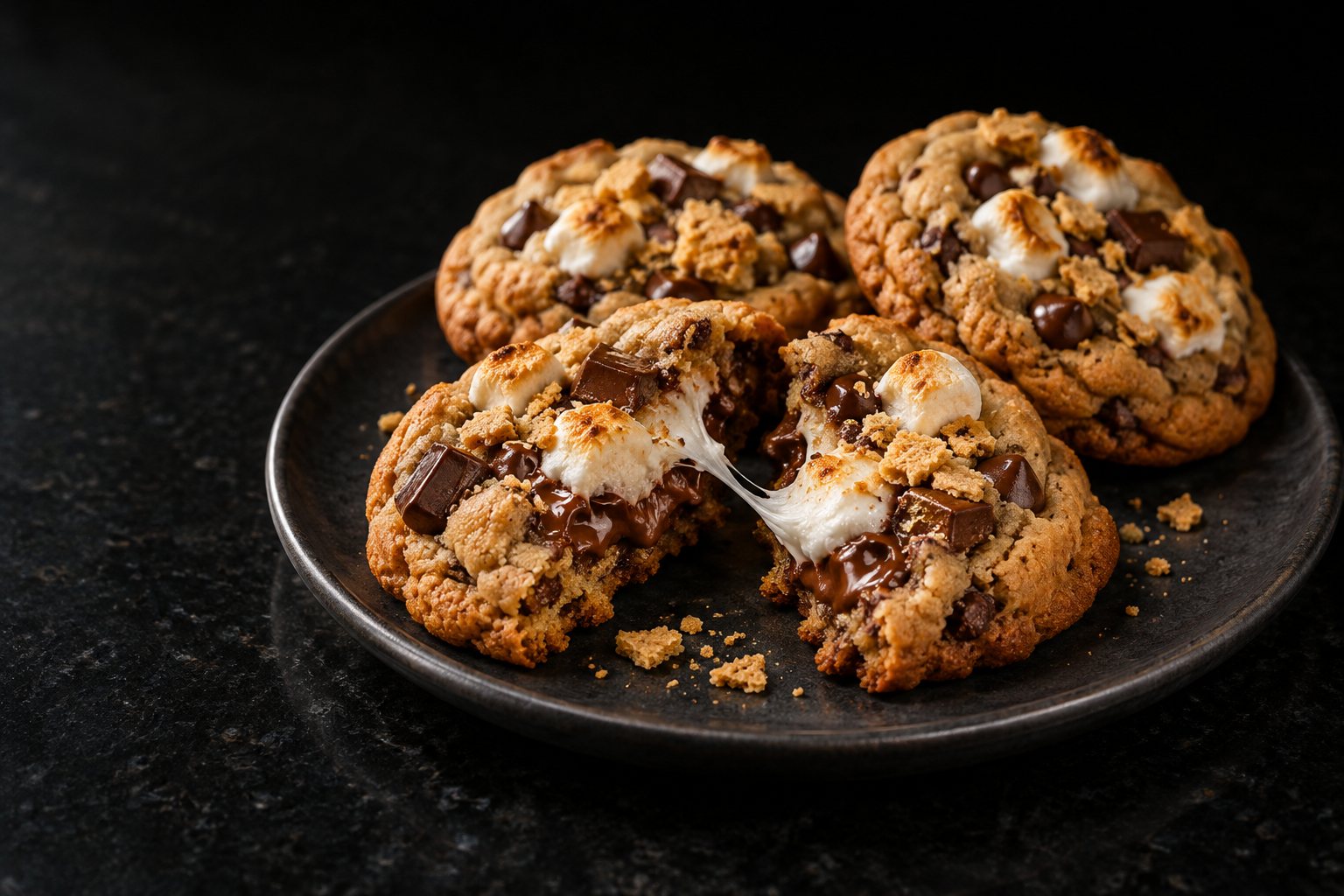
Say the party is tomorrow. Kids are coming, and you also want a plate that can sit with the adults as dessert. You want a chocolate chip cookie with marshmallow in it, gooey when someone breaks one, and not a puddle on the tray.
We read four named recipes, a second page from one of those cooks, and a fifth page that stops short of these questions. We haven't cooked any of them. Everything practical below comes from the named page and is linked, so you can check it. Cook from the page you choose.
At a glance
How each recipe fits this plan
- No image yet
Tessa Arias
Mini marshmallows go on during the bake, not the day before. She says a campfire s'more is messy and sticky, and this cookie has less of that. No chill is required. The card yields 40. Baked cookies keep up to 3 days.
Fits your plan No chill requiredYields 40 Recipe by Tessa Arias, Handle the Heat - No image yet
Sally McKenney
Marshmallow halves go on after the cookie bakes, then a broiler for 1–2 minutes. She says that toasts fast. She brought them to a pool party and called them sticky. Finished cookies can be made 1 day ahead. Do not freeze them with the marshmallow and chocolate on top.
Plan around this 1 day aheadBroil toasts fast Recipe by Sally McKenney, Sally's Baking Addiction - No image yet
John Kanell
Torn mini marshmallows go into the dough, and he says whole minis puff and get out of control. A blowout gets pushed back in with a cutter. Toppings stay prettier if they go on near the end. The card total is 20 minutes and does not include the chill. Baked cookies last 4 days.
Plan around this Halve the minis4 days Recipe by John Kanell, Preppy Kitchen - No image yet
Kayla Hoang
A halved marshmallow is stuffed inside the dough so the cookie pulls apart. She says a whole marshmallow's sweetness overwhelms the cookie, and skipping the chill lets the marshmallow melt into the dough and disappear. Stuffed dough can wait up to 1 day. Leftover cookies keep up to 4 days.
Fits your plan Pull-apart centerChill or it disappears Recipe by Kayla Hoang, The Kitchn
Tessa Arias
Fits your planNo chill requiredYields 40From S'mores Cookies by Tessa Arias, Handle the Heat. Modified June 8, 2026.
- Card
- 40 medium cookies
- Prep / cook
- 15 min / 10 min
- Total on the card
- 25 min
- Then
- 3 to 4 min more
Tessa Arias's page prints Modified: June 8, 2026. The card lists 15 minutes prep, 10 minutes cook, and 25 minutes total, for 40 medium cookies. Fifteen plus ten is twenty-five. The steps are a different clock: bake 6 to 7 minutes, then 3 to 4 minutes more after the marshmallows go on. Six plus three is nine, and seven plus four is eleven. The card's cook field is 10 minutes. We are not replacing that 10 with the sum of the steps.
The kid line is hers: “It’ll make you feel like a kid again!” The curly apostrophe is on the page. She also calls the cookies a huge crowd-pleaser, and says they suit a summer barbecue or cookout and a Christmas cookie plate. The campfire comparison is the mess line. “They’re messy, sticky, and such a crowd pleaser.” That sentence is about a s’more, not about the cookie. The next sentence is the cookie: “The cookie version retains all the best parts of a s’more but without as much mess and stickiness – or the need to build a campfire.” The dash is an en dash. “Without as much” is a comparison to the campfire, not to the other recipes on this page. Her texture line says the cookies are soft, thick, and chewy, with extra gooeyness from the marshmallows. That gooeyness is her description. We have not broken one open.
The marshmallow is not in the dough. Graham cracker crumbs and miniature chocolate chips go into the dough. After the first bake, she says to push 2 to 3 mini marshmallows and pieces of chocolate bar into each cookie, then return them for 3 to 4 minutes, until golden brown at the edges. The oven for that bake is 375°F. A separate note says not to overbake: the cookies should be just lightly golden at the edges. Both “golden brown” and “just lightly golden” are on the page. We are not picking one.
Chill is optional, and she says so twice. The rundown: “Easy, quick recipe – and you don’t even need to chill the dough!” The FAQ: this recipe works perfectly without chilling, but you may refrigerate the dough for up to 2 days. The freezer line is dough balls, not finished cookies. Bake them from frozen at 325°F, add a few minutes, and “Be sure to have your milk chocolate and marshmallows handy!” The toppings are still a bake-day step. Baked cookies: an airtight container at room temperature for up to 3 days, in the storage note and again at the end of the instructions. She also says to store them with a tortilla or a piece of bread to keep them soft for longer. That is a texture tip. It is not a safety ruling.
For this plan
Our reading: this is the kid-party page. The yield is 40, the chill can be skipped, and she is the cook who talks about mess by comparing the cookie to a campfire s’more. The marshmallows go on during the bake, so a tray finished yesterday is the 3-day tin, not a plain dough you top in the morning. She does not print a stuffed center.
Sally McKenney
Plan around this1 day aheadBroil toasts fastFrom S'mores Chocolate Chip Cookies by Sally McKenney, Sally's Baking Addiction. Updated April 9, 2022.
- Card
- 24 cookies
- Prep / cook
- 1 hr 25 min / 12 min
- Total on the card
- 1 hr 40 min
- Broil
- 1–2 min
Sally McKenney's page prints Updated: 04/09/2022. The card lists 1 hour 25 minutes prep, 12 minutes cook, and 1 hour 40 minutes total, for 24 cookies. One hour and twenty-five minutes plus twelve minutes is one hour and thirty-seven minutes, not one hour and forty. The dough chill is at least 1 hour and up to 2 days, and the instructions say chilling is mandatory. The make-ahead note says the dough can chill for up to 2–3 days. Two days and 2–3 days are both hers. We are not deciding which one the card's prep time is counting.
The marshmallow is a topping, after the bake. Halved regular marshmallows go on, sticky side down, and the pan goes back under the broiler for only 1–2 minutes. “Keep a very close eye on it—it toasts FAST!” The dash is an em dash. She usually broils on high, and she says to use a low broil if you know the oven gets overly hot on high. If the marshmallow holds a taller shape, press it down with the back of a spoon. Melted chocolate is spooned over that, then crushed graham cracker crumbs. The chocolate she wants for that spooning is a baking bar. “Do not use chocolate chips, as they contain stabilizers preventing them from melting into the proper consistency.” The dough itself is where her chocolate chips go. The ban is the topping. Allow the chocolate to set at room temperature, about 60 minutes, or in the refrigerator, about 30 minutes.
The party line is hers, including the napkin. She brought a double batch to a pool party, and she writes that each cookie disappeared faster than she could say “grab a napkin, they’re sticky!” The quotation marks and the apostrophe in “they’re” are curly. A wink emoji follows on her page. We are not treating that sentence as our tasting. It is her account of her own batch, and it is the mess warning on this page.
Ahead of time, the FAQ and the storage note do not use the same window. The FAQ says yes, you can make these cookies 1 day ahead. Cover and store them at room temperature or in the refrigerator overnight, then bring them to room temperature before serving. “The chocolate sets and the marshmallow stays gooey.” The same FAQ says you can bake and cool the plain cookies, freeze those, and add the marshmallow, chocolate, and crumbs on the day of serving or 1 day before. The note under the recipe says covered cookies stay fresh at room temperature for up to 3 days or in the refrigerator for up to 1 week. One day, 3 days, and 1 week are all printed. We are not collapsing them. The freeze warning is separate, and it is about the finished topping: “I don’t recommend freezing the cookies with the marshmallow and chocolate on top. The marshmallow never thaws very nicely!”
For this plan
Our reading: this is the page that tells you to finish the cookies a day before the party, and the page that calls that tray sticky. The broiler is the step she says to watch. A frozen topped cookie is the thing she tells you not to do. The 24 on the card is not 40.
The same cook has a second page, Toasted S’more Chocolate Chip Cookies, updated 01/14/2022. It is not a second source. Mini marshmallows go on after a partial bake, the room-temperature line there is up to 1 week, and the dough-chill lines on that page do not match each other. Those clocks are below, in the section on bake day. Do not mix the two pages and expect either card to survive.
John Kanell
Plan around thisHalve the minis4 daysFrom S'mores Cookies by John Kanell, Preppy Kitchen. Updated July 8, 2020.
- Card
- 20 cookies
- Prep / cook
- 10 min / 10 min
- Total on the card
- 20 min
- Chill on the card
- 1 hour
John Kanell's page prints By John Kanell, Updated Jul 8, 2020. The card lists prep 10 minutes, cook 10 minutes, chill 1 hour, and total 20 minutes, for 20 cookies. The card prints each of those units twice in a row: “10 minutes minutes,” “1 hour hour,” and “20 minutes minutes.” Ten plus ten is twenty. The hour is not inside that twenty. The steps say to cover and chill for “at lease an hour.” That spelling is the page's. We are reading it as his chill, not as a third length of time.
Most of the marshmallow is mixed into the dough. He uses mini marshmallows, torn in half, or marshmallow bits. “These marshmallows are one of the best parts of the cookie but they will puff up and get a bit out of control if you don't halve them.” The apostrophe in that “don't” is straight. A handful of the torn marshmallows is held back for the top, with pieces of Hershey’s bar. He prints two bakes and says he has done both. Top them and bake at 350 for 10 minutes, or bake for 8 minutes, then add the toppings and bake 2 to 3 minutes more. “I’ve baked these cookies both ways and the only difference is the toppings are more intact and pretty if you pop them on towards the end of baking.” The prose writes the oven as 350F and as 350 for 10 minutes. The instruction line writes 350°. We are not correcting the mark.
The mess has a name on this page, and a fix. The pro tip: “If your cookies have a marshmallow blowout use a circle-shaped cookie cutter to corral them together as soon as they come out of the oven.” There is no comma after “blowout.” A spatula or a knife can push the edges back in. The sentence above that tip says to see the note “for what to do it your cookie has some marshmallow seepage.” “It” is the page's spelling, not “if.” The instruction line is a third wording: “IF a some cookies had a blowout because of a few too many marshmallows to you can corral them back together with a round cookie cutter or a knife.” We are not cleaning that sentence up. Blowout and seepage are his words for the same problem. He does not print a kid line or an adult line.
Baked cookies last for 4 days in an airtight container at room temperature. The freezer FAQ is the dough, up to 3 months, not a finished cookie with marshmallow on it. He says the cookies are soft when they come out and need time on the sheet to firm up. He does not print how long that is, and he does not print an internal temperature.
For this plan
Our reading: this is the mixed-in marshmallow, and it is the page that expects a blowout often enough to print a tool for pushing it back. Pretty toppings are the late-add bake, which is his comparison, not a score against the other cooks. Four days means a tray baked today can be the party tomorrow, on his line. The card's 20 minutes is not the hour in the fridge.
Kayla Hoang
Fits your planPull-apart centerChill or it disappearsFrom S'mores Cookies by Kayla Hoang, The Kitchn. Published May 21, 2023.
- Card
- 28 cookies
- Prep
- 30 min
- Cook on the card
- 25–30 min
- Chill
- 15 min freeze, or up to 1 day
Kayla Hoang's page prints published May 21, 2023. The visible card says prep 30 minutes, cook 25 minutes to 30 minutes, and makes 28 (3-inch) cookies. It does not print a total. The recipe JSON on the same page says prep 30 minutes, cook 30 minutes, and total 60 minutes. We are using the visible cook range and not the JSON's single 30, and we are not inventing a total the card left off.
This is the stuffed center. Dough is wrapped around a halved regular marshmallow, cut side down, with a little marshmallow left exposed. “Using halves, rather whole marshmallows, ensure that the marshmallow’s sweetness doesn’t overwhelm the cookie.” “Rather whole” and “ensure” are the page's grammar. She says the center, broken in half, pulls apart the same way as the marshmallow in a s’more. That is her comparison. It is not a bake we did.
The chill is the warning, and she calls it the most important part. It lets the marshmallow and the dough bake at the same rate, limits spread, and “it helps prevent the marshmallow from melting into the dough and ultimately disappearing.” The method freezes the shaped dough about 15 minutes, or refrigerates it at least 30 minutes or up to 1 day. The make-ahead note says stuffed dough, tightly wrapped, up to 1 day in the refrigerator, baked for the same amount of time. Frozen stuffed dough keeps up to 1 month and bakes from frozen, with a few more minutes after the trays are rotated. She also says to scoop and stuff one cookie at a time. Dough that sits gets drier and can fall apart if it was pre-scooped.
The bake in the method is 6 minutes, then a rotate, then 5 to 6 minutes more, until the dough around the marshmallow is set and the marshmallow is melted and puffed. The oven line is 350ºF. The mark between 350 and F on that line is a masculine ordinal indicator, not a degree sign. An optional broil, while the cookies are still warm, runs from 15 seconds to 1 1/2 minutes, until the marshmallows just turn golden-brown. She says to rotate the sheet as needed. Leftover cookies go in an airtight container at room temperature for up to 4 days. She does not print a kid-party line, and she does not print an internal temperature.
For this plan
Our reading: this is the cookie you break open. The center is the point of the page, and the chill is what she says keeps that center from melting away. A whole marshmallow is the sweetness she tells you not to use. Four days, or stuffed dough held one day, is the bake-ahead she prints. The optional broil is measured in seconds as well as minutes.
The short version
For a kid party tomorrow, Tessa Arias’s card is the one that says the cookie will make you feel like a kid, yields 40, and does not require a chill. She says a campfire s’more is messy and sticky, and that this cookie has less of that mess. The mini marshmallows go on during the bake. Baked cookies keep up to 3 days at room temperature, which is her number.
Sally McKenney’s card is the one that tells you to make the finished cookies 1 day ahead, and the one that calls them sticky. Marshmallow halves go on after the bake, the broiler toasts fast, and she says not to freeze the cookie once the marshmallow and chocolate are on top. Her storage lines are 1 day, 3 days, and 1 week, depending on which paragraph you read. John Kanell’s card mixes torn minis into the dough, says they get out of control if you don’t halve them, and prints a cutter for a marshmallow blowout. Baked cookies last 4 days. His 20-minute total does not include the chill. Kayla Hoang’s card stuffs a halved marshmallow inside so the cookie pulls apart, and says skipping the chill lets that marshmallow melt into the dough and disappear. Leftovers keep 4 days. Stuffed dough can wait 1 day.
Nancy Fuller’s Food Network card dollops marshmallow creme on the raw dough, yields 36, and bakes 7 to 8 minutes. It does not print a chill, a storage line, or a melt warning. We are not using it to answer this plan. We have not cooked any of these, and we have not timed a batch.
Where the marshmallow goes
These are four different cookies that share a name.
Arias pushes 2 to 3 mini marshmallows onto a cookie that has already baked for 6 to 7 minutes. The crumbs and the miniature chocolate chips are already in the dough. The marshmallow’s time in the oven is the extra 3 to 4 minutes. McKenney bakes the chocolate chip cookie first, for about 10 minutes in the headnote and 10-11 minutes in the method, until barely golden brown around the edges. She says the cookies will look extremely soft when you take them out. Then the halved marshmallow goes on, and the broiler does the toasting. The chocolate for the top is spooned on after that, and it is not a chip. Kanell tears minis in half and mixes most of them into the dough, then holds some back for the top. He says the only difference between topping before the bake and topping near the end is that the late toppings stay more intact and pretty. Hoang wraps dough around one marshmallow half and leaves a little of it showing. The marshmallow bakes inside the cookie until it is melted and puffed.
McKenney’s other page, updated January 14, 2022, is closer to Arias’s timing than to her own broiler page. Mini marshmallows, graham pieces, and chocolate are pressed into a cookie that has already baked, then the pan goes back for 2 to 3 minutes. The broiler, if she uses it, is the last 30 seconds, or a kitchen torch once the cookies are out. That page yields 16 large cookies. Its card lists 2 hours 30 minutes prep, 13 minutes cook, and 2 hours 45 minutes total. It is still her page. It is not a fifth cook, and it is not permission to move the 1-week storage line on that page onto the 24-cookie page.
Fuller’s marshmallow is creme, dolloped on the raw dough, with a piece of chocolate and a graham cracker square pressed into it, before a bake of 7 to 8 minutes. The card yields 36 cookies. Total on the card is 1 hour. Active is 40 minutes. She does not say what the creme does in the oven. Silence is not a warning, and it is not a method for avoiding a puddle. That is why she is not one of the four rows.
Bake today or tomorrow
Arias can go either way, on her own lines. The dough does not have to chill, and it may be refrigerated for up to 2 days. Dough balls can be frozen and baked from frozen at 325°F, as long as the milk chocolate and marshmallows are still waiting for the second stage. Baked cookies keep up to 3 days at room temperature. A party tomorrow can be a tin baked today, or dough baked tomorrow with the marshmallows going on in that bake. She does not print a way to put the marshmallows on tonight and bake them in the morning.
McKenney prints the day-before tray in the FAQ: 1 day ahead, room temperature or the refrigerator overnight, then back to room temperature. The chocolate sets and the marshmallow stays gooey. That is one paragraph. The note says up to 3 days covered at room temperature, or up to 1 week in the refrigerator. The freeze she allows is the plain baked cookie, or the raw dough balls, for up to 3 months. Frozen dough balls bake for an extra minute, no thaw, and then you continue with the marshmallow. The freeze she refuses is the cookie that already has marshmallow and chocolate on it, because the marshmallow never thaws very nicely. Her dough chill is mandatory, at least 1 hour and up to 2 days in the instructions, and up to 2–3 days in the make-ahead note.
On the toasted page, the same cook prints different dough clocks. The instructions say at least 2–3 hours or up to 3 days, and she recommends chilling overnight for less spreading. The make-ahead note says up to 4 days. Baked cookies on that page stay fresh covered at room temperature for up to 1 week. The make-ahead there bakes frozen dough and then presses the toppings in. It does not repeat the sentence about a topped cookie that never thaws nicely. We are not moving the 1-week line, or the 4-day dough line, onto the page with the pool-party sentence.
Kanell’s baked cookies last 4 days at room temperature in an airtight container. His freezer line is dough, up to 3 months. The chill is at least an hour in the steps, spelled “at lease,” and 1 hour on the card. The card’s total of 20 minutes is prep plus cook. It is not the chill. A party tomorrow fits his 4-day line if you bake today. It does not fit the 20 minutes if you still owe the dough an hour.
Hoang’s stuffed dough is the thing that waits. Freeze about 15 minutes, or refrigerate at least 30 minutes or up to 1 day, and the make-ahead note repeats the 1 day. Frozen stuffed dough keeps up to 1 month and is baked from frozen. Leftover baked cookies keep up to 4 days at room temperature. The 15-minute freeze is also the chill she says keeps the marshmallow from disappearing. Skipping it to save the morning is the choice she tells you not to make.
Kid party or the break-open plate
Arias is the cook who assigns the cookie to being a kid. The sentence is “feel like a kid again,” and the occasions she names are a barbecue, a cookout, and a Christmas cookie plate. The mess she is willing to claim is “without as much mess and stickiness” as a campfire s’more. She still calls the marshmallow extra gooey. A yield of 40 is the headcount on her card. Doubling, she writes, yields about 80 medium-sized cookies. Half is 20, in a note. We are not turning any of those into a guest list.
McKenney’s occasion is a pool party, in her own voice, and the word she pairs with it is sticky. She does not call the cookie an adult dessert. What she does print, if the plate has to sit, is the 30 minutes in the refrigerator or the 60 minutes at room temperature for the spooned chocolate to set, and the day-ahead FAQ. Set chocolate is a clock. It is not a claim that the cookie stopped being sticky. Her yield is 24, and a double batch is the pool-party story, not a second card.
Kanell does not sort the cookie into kid or adult. The decision he does print is looks: toppings added near the end stay more intact and pretty, and a blowout gets corralled as soon as the pan comes out. Pretty, on his page, is the topping that did not spread. It is not a tasting, and it is not an audience.
Hoang does not say “adult.” She does say why the marshmallow is a half: a whole one, in her grammar, is the sweetness that overwhelms the cookie. She also describes the center you break in half, and the pull. If the dessert plate is the one somebody pulls apart, her page is the one written for that shape. Arias’s page is the one written for the kid feeling. Those are readings of what the cooks wrote. They are not a score, and they are not a reason to stuff Hoang’s marshmallow into Arias’s dough.
The related film is a YouTube Short. Its title is “breaking open this gooey s’mores cookie.” The tile on this site drops the emoji. Sensory Cooking is the channel. The film is visual inspiration. It is not evidence that any recipe here stays gooey, pulls apart, or holds until tomorrow. The word fluffy is the film’s subject name. None of these four recipes uses it for the cookie. We are not adding it.
What they tell you to watch
Four warnings are specific enough to plan around, and they come from the cook who printed them.
Arias: you don’t have to chill, and you do have to watch the color. Just lightly golden at the edges, and also golden brown at the edges after the second bake. Dark nonstick pans, she writes, may burn the bottoms before the cookies spread and bake evenly. She wants a light-colored aluminum half-sheet. Butter for creaming should be a cool room temperature, 67°F, or a couple of degrees colder if the kitchen is very warm. That 67°F is the butter, measured as a stick she describes, not a temperature in the baked cookie. Don’t let the dough sit out long in a warm place if flat cookies are the problem you have.
McKenney: the broiler toasts fast, in 1–2 minutes, and high heat is her usual setting only if the oven is not already too hot. Chocolate chips will not melt into the topping she wants, because of stabilizers. The dough chill is mandatory. Freezing a cookie that already has marshmallow and chocolate on it gives a marshmallow that, in her words, never thaws very nicely. Sticky is the serving warning, from the pool party.
Kanell: halve the minis or they puff and get out of control. If the marshmallow blows out or seeps, push it back as soon as the cookies come out, with a round cutter, a spatula, or a knife. Flour measured wrong is his other warning, and he calls too much flour the most common mistake. That is a baking warning, not a marshmallow warning. We are not repeating his measuring lesson as if we had tested the batch.
Hoang: chill the stuffed dough or the marshmallow melts into the dough and disappears. Stuff one cookie at a time or the dough can fall apart. Use halves so the sweetness doesn’t overwhelm the cookie. The optional broil is 15 seconds to 1 1/2 minutes, and she tells you to rotate the sheet. A broil that short is the same kind of watch as McKenney’s 1–2 minutes. The ovens are not the same setting, and the marshmallows are not in the same place. Do not trade the clocks.
Follow one page. Do not put Hoang’s stuffed half into Kanell’s mixed-in dough, or McKenney’s broiler onto Arias’s 375°F bake, and expect any of the cards to still describe the pan.
Eggs and a cookie tin, from USDA
Every card here uses eggs. Arias uses 2 large eggs. McKenney’s 24-cookie page uses 1 large egg. Kanell uses 1 large egg. Hoang uses 2 large eggs. Fuller’s card uses 2 large eggs. McKenney’s toasted page uses 1 large egg plus 1 egg yolk. None of them prints an internal temperature for the cookie.
The USDA Food Safety and Inspection Service’s Safe Minimum Internal Temperature Chart says: “Cook all food to these minimum internal temperatures, as measured with a food thermometer, before removing food from the heat source.” For reasons of personal preference, consumers may choose to cook food to higher temperatures. The row labeled Eggs is 160 degrees F (71.1 degrees C). The chart has rows for leftovers and casseroles, both 165 degrees F (73.9 degrees C). It does not have a row labeled cookies. The page’s last-updated line reads April 14, 2025. Checked October 27, 2026. This page will not apply the Eggs row to a baked cookie, and it will not treat a gooey marshmallow, a soft center, or a lightly golden edge as that thermometer.
The USDA’s Leftovers and Food Safety page says to throw away perishable food left at room temperature for more than 2 hours, and for more than 1 hour if the temperature is over 90°F, such as at an outdoor picnic during summer. It also says leftovers must be refrigerated within 2 hours of cooking, or after food is removed from an appliance that was keeping it warm, and that leftovers can be kept in the refrigerator for 3 to 4 days. The page’s last-updated line reads July 31, 2020. Checked October 27, 2026. The cooks’ room-temperature lines are 3 days (Arias), up to 3 days or a day ahead (McKenney), 4 days (Kanell and Hoang), and up to 1 week on McKenney’s other page. Those are their numbers. The USDA sentences are about perishable food. This page will not clear a cookie tin, or a pool-party tray, against either one.
“It’ll make you feel like a kid again!”
Tessa Arias, Handle the Heat
“Keep a very close eye on it—it toasts FAST!”
Sally McKenney, Sally's Baking Addiction
“Additionally, it helps prevent the marshmallow from melting into the dough and ultimately disappearing.”
Kayla Hoang, The Kitchn
Watch the texture
Related films
Our films are visual inspiration, not demonstrations that a recipe works.
Gooey s’mores cookie
Short · Watch on YouTube