

Before you make it · No. 16
Smash burger setup before you shop
One burger at a time, two in a 12-inch skillet, or six on one named griddle? We read four cooks so you can see what the pan, the press, and the cheese ask of you before you shop.
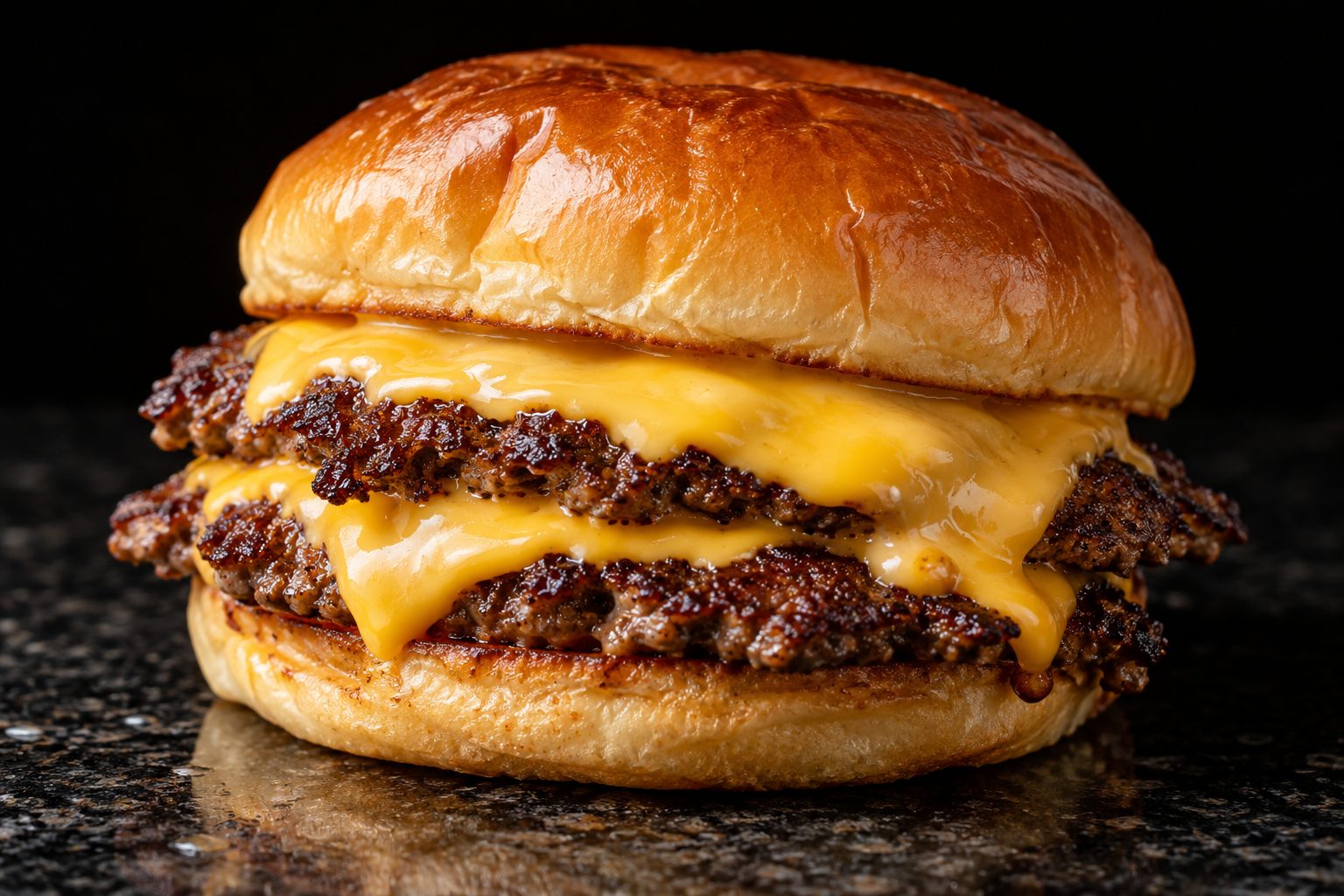
Say you want a cheese smash burger at home. You have a heavy skillet, or you are deciding whether a griddle is worth buying. You can serve in rounds. A four-patty stack, a quad, is optional. You want the surface, the press, and the cheese settled before you shop.
We read four named cooks. J. Kenji López-Alt has two different Serious Eats methods, and this page keeps them apart. We haven't cooked these versions. Everything practical below comes from the named page and is linked, so you can check it. Cook from the page you choose.
At a glance
How each recipe fits this plan
- No image yet
Kenji, ultra-smash
Two 2-ounce patties, one burger at a time, in stainless or cast iron. American, cheddar, or a homemade melting cheese between the patties. A quad is not this burger.
Fits your plan One burger at a time Recipe by J. Kenji López-Alt, Serious Eats - No image yet
Kenji, classic
A 12-inch stainless, carbon-steel, or cast-iron skillet, two 4-ounce patties at a time. Cheese is optional and unnamed. The first side is about 1 1/2 minutes. Do not borrow the ultra-smash clock.
Plan around this Single patty, not a stack Recipe by J. Kenji López-Alt, Serious Eats - No image yet
Meathead
Two diner burgers in the 12-inch Lodge skillet he names, or six on his 20 by 10 7/16 inch Lodge griddle. American cheese, covered after the flip. Those counts are his equipment.
Plan around this His pans only Recipe by Meathead Goldwyn, AmazingRibs - No image yet
Brian Lagerstrom
He presses portions between parchment with a pot before they hit a hot cast-iron skillet, then presses again with a spatula. The header says two double burgers. The method says six 85-gram portions from 450 grams of meat.
Plan around this Yield doesn't match Recipe by Brian Lagerstrom - No image yet
Joshua Weissman
A grill or skillet at medium-high, a heavy spatula, and American cheese in the last minute. No pan size and no batch count. The ingredients say 5 ounces. The directions shape a 3-ounce ball.
Risky for this plan Ounces don't match Recipe by Joshua Weissman
Kenji, ultra-smash
Fits your planOne burger at a timeFrom The Ultimate Smash Cheeseburger by J. Kenji López-Alt, Serious Eats. Updated September 21, 2025.
- Patties
- 2 × 2 oz
- At once
- One burger
- Pan
- Stainless or cast iron
- First side
- About 45 seconds
The card lists 5 minutes prep, 5 minutes cook, 5 minutes active, and 10 minutes total, for 1 serving. The beef line is 4 ounces of freshly ground beef chuck, divided into two 2-ounce balls. The note says “These burgers cook very fast, so it's best to make them one at a time.” If you are making more than one, he says to keep them warm under a tent of foil while you cook the next. He does not say how long that tent holds.
In the home section he writes, “For cooking, I use either a stainless steel or a cast iron pan, with my preference leaning toward the former.” He says to stay away from nonstick. The same paragraph aims the pan at 600 to 700°F over high heat for several minutes. The numbered method says to preheat a large stainless sauté pan or skillet over high heat for 2 minutes. Both clocks are on the page. Both are pan heat, not a meat temperature. He also writes that the beef needs enough fat to sizzle without greasing the pan, and that fresh-ground chuck will do. The restaurant blend he describes earlier, around 25 percent fat, is not the home ingredient line.
The smash uses a wide spatula plus a second spatula for pressure. The special-equipment line names a stiff metal spatula and a metal bench scraper. He wants the bun buttered, toasted, and topped before the meat goes in. The ingredient list is one slice of good melting cheese, “such as American, cheddar, or homemade melting cheese.” In the essay he recommends store-bought American or homemade melty slices, added to one patty as soon as it is flipped, with the second patty stacked on top. That is one slice between two patties, not four cheeses.
The method cooks until the patties are well browned and the tops are beginning to turn pale pink or gray in spots, about 45 seconds, then scrapes and flips. That is his first-side cue. It is not a doneness temperature.
For this plan
Our reading: a heavy stainless or cast-iron skillet, and doubles served one burger at a time, fit what this page describes. A quad is a different stack. If the only pan is nonstick, he says stay away. Count any later burgers as another round. The foil tent is his holding line, and it has no minutes.
Kenji, classic
Plan around thisSingle patty, not a stackFrom Classic Smashed Burgers by J. Kenji López-Alt, Serious Eats. Updated December 27, 2025.
- Portions
- Four × 4 oz
- At once
- 2 in a 12-inch
- Preheat
- Medium, then high
- First side
- About 1 1/2 min
The card lists 5 minutes prep, 10 minutes cook, and 15 minutes total, for 4 burgers. The beef line is 16 to 20 ounces, divided into four 4-ounce portions. That is one patty per burger, not the ultra-smash double. The note says “We recommend cooking only two patties at a time in a 12-inch skillet.” It also says patties can be cooked one at a time in a smaller skillet.
The pan is a 12-inch stainless steel, carbon steel, or cast iron skillet. He adds a little oil, heats it over medium for about 5 minutes, then turns it to high until it smokes. Two beef pucks go in. A firm, stiff metal spatula smashes each one to roughly 4 to 4 1/2 inches across and 1/2 inch thick, with a second spatula if you need more pressure. A why-it-works line says smashing within the first 30 seconds. The numbered step smashes as the pucks go in. We are not merging that line with the ultra-smash method.
He cooks without moving until a golden brown crust develops, about 1 1/2 minutes, then scrapes and flips with the edge of the spatula. Cheese, if you are using it, goes on now. The ingredient line says “Cheese slices (if desired).” It does not name American, cheddar, or a melting slice. The buns are listed as four toasted burger buns. The method says to transfer the patties to toasted buns. It does not, in the text we read, say to toast those buns in the same skillet.
The next line is a preference, not a thermometer reading: about 30 seconds longer for medium-rare. We are not using that phrase as a ground-beef target. The official section below is the temperature. His 1 1/2 minutes is a first-side observation. It is not the ultra-smash's 45 seconds, and neither number is a safety check.
For this plan
Our reading: this is a skillet batch of two single patties, then another round. It fits a heavy 12-inch pan and serving in rounds. It does not fit a stacked double, and it does not name the cheese. Keep its clock on this page only.
Meathead
Plan around thisHis pans onlyFrom The Ultimate Diner Burger Recipe (a.k.a. The Smash Burger) by Meathead Goldwyn, AmazingRibs. Last modified August 18, 2026.
- His skillet
- 2 burgers
- His griddle
- 6 burgers
- Cheese
- American
- First side
- About 3 min, maybe 5
The card lists 30 minutes prep, 6 minutes cook, and 36 minutes total, for 4 quarter-pounder burgers. He calls diner burgers small disks, 4 ounces or less. The page was last modified August 18, 2026.
The equipment passage is specific. “I have the Lodge Logic Pro 20″ x 10 7/16″ Cast Iron Griddle. I can get 6 burgers on there.” He then names the Lodge Logic 12″ pre-seasoned skillet and says it will hold only 2 diner burgers. He also calls a 12″ All-Clad a good choice, and any heavy-bottomed pan whose handle will not melt. “If you can afford a griddle, get one. It can hold up to 6 burgers.” That “up to 6” is the same paragraph as his Lodge griddle. It is not a measurement of a griddle we have not seen.
He wants a heavy surface and a solid spatula, not a slotted one, because a slotted spatula deforms the top. If you do not have a solid spatula, he says you can smash with the bottom of a small frying pan or a saucepan. He also wants two spatulas: one for the raw meat, and a clean one to flip and serve. Smash soon after the patty goes on, and not again until the flip. The surface preheat is “about at least 350°F (167°C), as hot as you can get it,” and he wants it above 300 to 310°F, which he calls the Maillard range. That is the pan, not the meat.
Buns go first. Butter them, set them cut-side down, press, and set a dinner plate on top until the bread is golden. Then wipe the surface and cook the burgers. “Don’t touch the burgers for about 3 minutes. Maybe 5 minutes, depending on how hot your pan gets.” Cheese is 4 slices of American, added after the flip. On a grill he closes the lid. Indoors, “place a mixing bowl, pie pan, pot, or disposable aluminum pan over the burgers to speed the melting of the cheese.” The cover has to fit the setup. He does not give a minute count for the melt.
On doneness he writes that you cannot have a rare diner burger, because by the time the surface is the right color the meat is well done. That is his color argument. He also links to his own ground-meat safety page. We did not use that page for a temperature. The thermometer reading is in the official section, and it does not come from the color of the crust.
For this plan
Our reading: use this page when the question is his skillet versus his griddle. Two of his diner burgers in that 12-inch Lodge, or six on that Lodge griddle, is the claim he makes. It is not a stacked double, and it is not your pan until you have counted the patties that actually fit.
Brian Lagerstrom
Plan around thisYield doesn't matchFrom Smash Burgers by Brian Lagerstrom. Metadata modified September 18, 2026.
- Header
- 2 double burgers
- Portions written
- Six × 85 g
- Meat listed
- 450 g
- Skillet width
- Not given
The card lists 30 minutes prep, 10 minutes cook, and 40 minutes total. The servings line says 2 double burgers. The beef line says 450 grams of boneless beef short rib. The patty instructions say to measure six 3-ounce, 85-gram portions, press each between parchment with a flat-bottomed pot, and refrigerate them. Six times 85 grams is 510 grams. We are not fixing that gap, and we are not turning either number into a shopping list.
The cook step is a cast-iron skillet on high. He does not give a diameter or say how many patties share the pan. Buns are toasted first in the skillet with butter, then set aside somewhere warm. The patties are seasoned, set in the oiled skillet, and pressed with a spatula. He writes about 90 seconds on the first side, then the flip. Cheese goes on after the flip, for another 30 seconds. The cheese line is “Kraft singles or your favorite melting cheese.” He then says to assemble once the cheese is fully melted and the burgers are fully cooked, two patties per burger. He does not give a temperature. The 90 seconds and the 30 seconds are not a safety schedule.
Pressing under a pot, on parchment, before the pan, is a different workflow from smashing a loose ball only on the hot surface. Do not treat it as the same step Kenji or Meathead describes.
For this plan
Our reading: this is the other double, and it is the one that presses before the pan. It does not say what skillet width you need, and the two-burger header does not match six portions. Plan the batch without using these weights as the grocery order.
The article text we read has no visible published or updated date. The page's machine-readable dates say published December 3, 2020, and modified September 18, 2026. Those are metadata, not a byline.
Joshua Weissman
Risky for this planOunces don't matchFrom Smash Burger by Joshua Weissman. Metadata dated August 6, 2025.
- Listed
- 5 oz
- Shaped
- 3 oz ball
- Card
- Serves 1
- At once
- Not stated
The card lists 10 minutes prep, 8 minutes cook, and 1 serving. The ingredient list is 5 ounces (142 grams) of 75/25 ground beef, 1 slice of American cheese, and 1 hamburger bun. The directions say to weigh the portion and shape it into a 3-ounce ball. The page does not explain the difference. We are not picking 3 or 5 for you.
Heat is “Preheat your grill or skillet to medium-high heat.” He does not say what the grill is, so this is not evidence for pressing on open grates. The smash is a heavy spatula, into the pan. He does not give pan dimensions, a second tool for scraping, or a count of patties cooked together. He does not say to toast the bun.
The directions say to cook 3 to 4 minutes per side. The same sentence ends on a preference rather than a thermometer. We are not using that preference as a target, and we are not quoting it as a method. Cheese is the American slice, added during the last minute. That is one slice on one patty.
For this plan
Our reading: this page does not answer how many burgers fit, or which ounce figure to buy. It is a poor place to settle the setup. The 3-to-4-minute clock is also a different order of time from the other four methods, which is useful only as a warning against one shared smash-burger timer.
The recipe text we read has no visible date. Machine-readable dates on the page both say August 6, 2025. The footer copyright says 2024. We did not resolve which one to trust.
The short version
For a heavy skillet and doubles served in rounds, Kenji López-Alt’s ultra-smash is the page that matches the plan. It is two 2-ounce patties, one burger at a time, in stainless steel or cast iron, with one slice of melting cheese between them. His classic smashed burger is a different recipe. It is four 4-ounce patties, two at a time in a 12-inch skillet, one patty per burger. The first side there is about 1 1/2 minutes. On the ultra-smash it is about 45 seconds. Use one clock with the method that printed it.
Meathead Goldwyn is the page that puts a number on two pieces of equipment he names: two diner burgers in a 12-inch Lodge skillet, six on his Lodge griddle. Brian Lagerstrom does build a double, and he presses the portions before they hit the pan, but his header and his portion count do not agree. Joshua Weissman lists 5 ounces and then shapes a 3-ounce ball, and he never says how many patties share the surface.
A quad, on this page, means four patties in the planning sense. None of these methods is that stack. None of them names four cheeses. The film is the picture that raised the question. It is not the method.
None of the minute counts is a ground-beef safety check. Cooks’ color cues are not one either. The official section is the temperature.
Where the setups disagree
The batch is the first split. Kenji’s ultra-smash wants one burger at a time, and that burger is two thin patties. His classic page wants only two patties at a time in a 12-inch skillet, and those patties are the burgers. A smaller skillet, on that note, is one patty at a time. Meathead reports two diner burgers in one named 12-inch skillet and six on one named griddle. Brian does not say how many share the skillet. Joshua does not say it either.
The smash is the second split. Kenji and Meathead smash on the hot surface, early, and Kenji’s classic why-it-works line says within the first 30 seconds. Meathead says soon after the patty goes on, and not again until the flip. Brian smashes first, between parchment, with a flat-bottomed pot, and presses again with a spatula in the pan. Those are not the same step.
The surface is the third split. Both of Kenji’s pages include stainless steel. The ultra-smash prefers it and rules out nonstick. The classic page lists stainless, carbon steel, or cast iron, and it oils the pan. The ultra-smash home section wants enough fat in the beef that he does not grease the pan. Meathead wants a heavy griddle or a heavy pan, gives preheat temperatures for the surface, and toasts the buns on that surface before the meat. Brian wants cast iron and also toasts the buns in the skillet first. Joshua says grill or skillet. Follow the surface from the page you cook. Do not average them into one pan rule.
Cheese is the fourth split. The ultra-smash names American, cheddar, or a homemade melting cheese, one slice, between two patties, as soon as they are flipped. Meathead names American, after the flip, and covers the burgers to speed the melt. Brian names Kraft Singles or another melting cheese, after the flip. Joshua names one slice of American, in the last minute. The classic page says cheese slices if desired, and does not name a kind. Nobody on these pages specifies four cheeses.
What they leave unstated, across all five methods: a capacity formula for a pan they have not measured, a minute count for how long a finished patty can wait, and a four-patty stack. Kenji’s foil tent is the only holding line, and it has no duration.
A quad is four patties
The Short linked below is visual inspiration. Its YouTube title is about four patties and melted cheddar. That title is not a cheese list, and the film is not evidence that a home stack works. We did not treat a frame as a recipe.
If you already know how many patties fit your surface, call that number C. Patties needed are burgers times patties per burger. The minimum rounds are the patties divided by C, rounded up. One quad and two doubles are both four patties, so they are the same round count only if C is the same. They are not the same burger. A four-layer stack cannot be assembled until all four patties are cooked. Two doubles can be served as two rounds of Kenji’s ultra-smash, which is the thing his page already describes.
C is blank until you have established it. Meathead’s 2 and his 6 belong to the pans he named. They are not the default for a 12-inch skillet, and they are not the default for a griddle. This page does not estimate C from a diameter. The round count is not a clock. Kenji’s foil tent, Meathead’s cover, and Brian’s “somewhere warm” for the buns are not a tested holding time for a quad.
Four layers also do not tell you the meat weight. Kenji’s ultra-smash double is 4 ounces total. His classic portion is 4 ounces for one patty. Meathead’s diner burger is 4 ounces or less. Brian’s header, his 450 grams, and his six 85-gram portions do not agree. Joshua’s 5 ounces and his 3-ounce ball do not agree. Do not build a grocery order by mixing those figures, and do not build one from the film.
Ground beef, from the official pages
The cooks above give crust color, a pink or gray top, a “fully cooked” line, or a minute count. Meathead also writes that a diner burger is not rare, because the surface color he wants means the meat is well done. This page does not decide who is right about color. It does not add a probe diagram.
The FDA’s Safe Food Handling page says: “Color and texture are unreliable indicators of safety. Using a food thermometer is the only way to ensure the safety of meat, poultry, seafood, and egg products for all cooking methods.” The same page’s table of safe minimum internal temperatures, measured with a food thermometer, lists Ground Meat at 160°F. The text we retrieved did not show a separate “content current as of” line. Checked October 28, 2026.
The USDA Food Safety and Inspection Service’s hamburger page says: “Color is not a reliable indicator of doneness, so the only way to be sure that hamburgers are cooked safely is to use a food thermometer. Ground beef is safe when cooked to an internal temperature of 160 °F as measured with a food thermometer.” For thin burgers, that page says you can insert the probe at an angle, or sideways into the burger. The page’s last-updated line reads October 2, 2024. Checked October 28, 2026.
A browned crust, melted cheese, and a cook’s minute count do not replace that thermometer. We have not cooked these burgers, and we have not taken a temperature.
“These burgers cook very fast, so it's best to make them one at a time.”
J. Kenji López-Alt, Serious Eats
“We recommend cooking only two patties at a time in a 12-inch skillet.”
J. Kenji López-Alt, Serious Eats
“If you can afford a griddle, get one. It can hold up to 6 burgers.”
Meathead Goldwyn, AmazingRibs
Watch the texture
Related films
Our films are visual inspiration, not demonstrations that a recipe works.
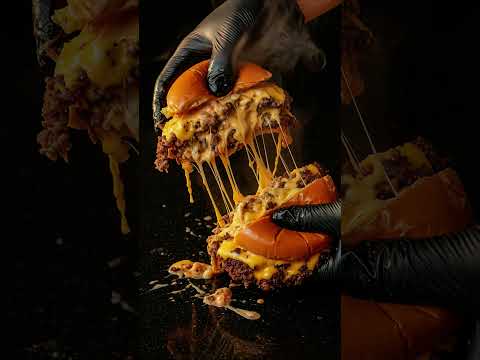
Four patties and all that melted cheddar
Short · Watch on YouTube