

Before you make it · No. 18
Rice by the texture you want
Soft jasmine, separate basmati, clinging short-grain, or brown that stays apart? Five named methods, each with its own rinse, water, and rest. Nothing here is a ratio for every rice.
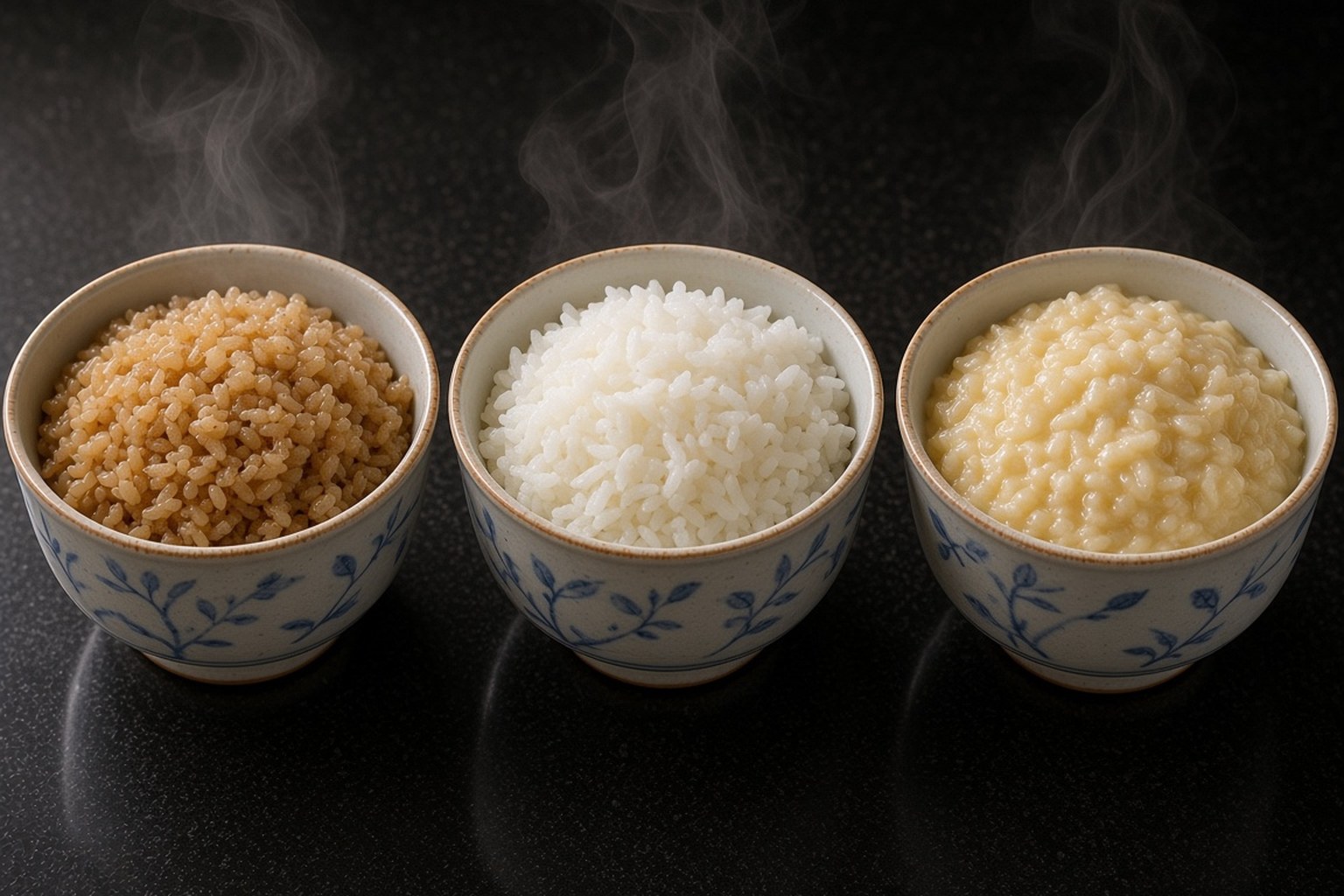
Say you want rice with a texture you can name before you start: soft and fluffy, grains that stay distinct, tender rice that holds together, or brown long-grain that stays separate. You have a pot. A rice cooker is a maybe. You want the rinse, the water, and the rest to belong to the same method.
We read five named method profiles and kept each cook's variety, batch, and equipment on the water amount they printed. We haven't cooked these versions. Texture words below are our reading of what each page says, not a tasting. Everything practical comes from the named page and is linked, so you can check it. Cook from the page you choose.
At a glance
How each recipe fits this plan
- No image yet
Nagi Maehashi
Soft, fluffy white jasmine from a no-rinse baseline of 1 cup rice to 1 1/4 cups water. Rinsing, or rinsing and a 1-hour soak, changes that water. Stovetop only on this page.
Fits your plan Rinse changes her water Recipe by Nagi Maehashi, RecipeTin Eats - No image yet
Pailin Chongchitnant
Jasmine with distinct grains. Rinse and drain, then start at 1 cup rice to 1¼ cup water, up to 1 ½ cups. About 20 minutes on low, then 5 minutes off the heat if the bottom is dry. A cooker uses that same preparation.
Fits your plan Water is a range Recipe by Pailin Chongchitnant, Hot Thai Kitchen - No image yet
Tilda
Light, separate basmati, with the US and Canadian pages kept apart. The US page rinses and does not state a soak. Canada soaks 20 minutes, then rinses. Their rests differ too.
Plan around this Two regional pages Recipe by Tilda USA - No image yet
Namiko Hirasawa Chen
Tender Japanese short-grain that clings. Wash, drain, and soak 20–30 minutes in the measured cooking water. One printed batch is 540 ml of dry rice to 600 ml of water. A 1:1 alternative is a separate soak and drain, not the same path.
Plan around this Two water paths Recipe by Namiko Hirasawa Chen, Just One Cookbook - No image yet
Lundberg Family Farms
Separate brown long-grain, for this product. The chart's liquid changes with the batch, and each row includes fat. The pot simmers 45 minutes and rests 10. A cooker is told to use the same liquid amounts.
Plan around this Match one chart row Recipe by Lundberg Family Farms
Nagi Maehashi
Fits your planRinse changes her waterFrom How to Cook Jasmine Rice by Nagi Maehashi, RecipeTin Eats. Updated May 8, 2025.
- No rinse
- 1 cup : 1 1/4 cups water
- If rinsed
- Minus 2 tbsp per cup
- Rinse and soak 1 hr
- Minus 3 tbsp
- Pot
- 12 min, then 10 covered
Nagi Maehashi's white jasmine baseline is 1 cup of dry rice to 1 1/4 cups of water, with no soak. She prints that as cups, not as a weight. She describes jasmine as softer than most white rice, and she wants it soft and fluffy rather than gummy. That description is hers. We have not compared grains.
On rinsing, the card says “Rinsing is optional – it barely makes a difference to fluffiness.” The same page says a rinse means less water: subtract 2 tablespoons per cup of rice from the 1 1/4 cups. The essay above the card adds a second adjustment that the rinsed ingredient line does not list: rinse and soak for 1 hour, and subtract 3 tablespoons from that same 1 1/4 cups. Those subtractions belong to her jasmine method. They are not a rinse rule for another cook's rice.
The pot is a saucepan with a tight-fitting lid. She brings the rice and water to a rapid simmer with the lid off, then turns the heat down to a gentle simmer, puts the lid on, and cooks 12 minutes, or until the water is absorbed. The lid stays on for 10 minutes off the heat. This page does not give a rice-cooker adaptation.
For this plan
Our reading: follow her no-rinse baseline, or follow one of her two rinse adjustments with the water that adjustment names. The 12 minutes and the 10-minute rest are the covered pot on this page, not a cooker cycle.
Pailin Chongchitnant
Fits your planWater is a rangeFrom How to Cook Perfect Rice (With or Without a Rice Cooker) by Pailin Chongchitnant, Hot Thai Kitchen. Modified January 6, 2026.
- Jasmine
- 1:1¼, up to 1:1½
- Same page, short-grain
- 1:1, or 1:1¼
- Pot
- About 20 min, then 5
- Cooker
- Same prep; cycle not given
Pailin Chongchitnant's white jasmine line is a range by volume, not a single cup: start with 1 cup of rice to 1¼ cup of water, and she says you may need up to 1 ½ cups of water. She says to use the same cup for rice and water, and that the ratio is by volume, not weight. The extracted steps we read do not include a presoak. She tells you to start at the low end of the range.
Washing is part of this method, not an optional fluffiness tweak. She writes, “Washing or rinsing rice is an important step which will prevent gummy rice.” She also writes that the same type of rice can still vary with age, variety, and how firm you want it. That is her judgment. It is the disagreement with Nagi's optional rinse, and this page does not pick a winner.
On the stove she wants a low simmer for about 20 minutes, or until the rice looks done, then 5 minutes covered with the heat off once the bottom of the pot is dry. In a cooker she uses the same wash and the same measured water, then cooks. She does not name a program or a cycle length. She does say that a Japanese rice cooker's water lines are not the measure for jasmine. The same page gives short-grain white rice as 1 cup of rice to 1 cup of water, or 1¼ parts water for softer rice. That short-grain line is not her jasmine line, and it is not the same instruction as Namiko Chen's 1:1 path below. She also says this process does not apply to glutinous rice, and the page prints separate water for basmati. This guide does not repeat the basmati figures.
For this plan
Our reading: for distinct jasmine grains, keep her rinse with her jasmine range and her 20-plus-5 pot timing. If you use a cooker, keep her measured water and do not borrow another machine's lines. Her short-grain line stays on her page until you are cooking that grain.
We read the live page on October 28, 2026. Her basmati amounts and the firm-rice top-up stay on that page.
Tilda
Plan around thisTwo regional pagesFrom Tilda's US basmati page and Canadian basmati page (with MOB Kitchen). Neither page states a date.
- US covered pan
- Same cup, 1:2
- Also printed
- 120g and 240g/ml
- US open pan
- 120g, at least 500 ml
- Canada
- Soak 20 min; rest 5, lid off
Tilda's US page and Tilda's Canadian page are two sets of instructions for basmati, not two wordings of one method. The US page tells you to wash or rinse until the water runs clear, and it calls that step the one that gives more separate, fluffy grains. It does not state a soak. The Canadian page, made with MOB Kitchen, starts with a 20-minute soak, then a drain and a cold rinse.
The US covered pan uses a 2-to-1 water-to-rice ratio with the same cup you used for the rice, on low heat for 10–12 minutes, then 3 minutes covered off the heat. The same section also says that for 2 servings you use 120g of Tilda Pure Basmati, or 1 cup, and that for 120g of rice you use 240g/ml of water. Those lines are both printed. This page does not treat 120g, “1 cup,” and 240g/ml as the same measurement. There is no US quantity card here until that equivalence is settled.
The US open pan is a different method on the same page: for 120g of rice, at least 500 ml of water, uncovered for 10–12 minutes over medium heat, then drain and cover for 3 minutes. That is extra water you pour off, not an absorption ratio. The page does not specify a rice cooker. Canada says to add 2 measures of water for each measure of the original dry rice, simmer 10–12 minutes, then take the lid off and stand 5 minutes. The written simmer step does not say when the lid goes on. It only says to remove the lid before the 5 minutes.
For this plan
Our reading: choose the US covered pan, the US open pan, or the Canadian soak, and keep that page's rinse, water, and rest together. The two regions are alternatives. Neither one corrects the other.
Namiko Hirasawa Chen
Plan around thisTwo water pathsFrom How to Cook Rice in a Pot on the Stove and How to Cook Rice in a Rice Cooker by Namiko Hirasawa Chen, Just One Cookbook. Both updated February 25, 2025.
- Example
- 540 ml rice : 600 ml water
- Printed range
- 1:1.1–1.2 by volume
- Other path
- 1:1 after a separate soak
- Rice cup
- 180 ml, not a US cup
Namiko Hirasawa Chen is writing about Japanese short-grain white rice. She describes grains that cling without becoming mushy, and she separates that rice from sweet rice, also called glutinous rice, which she uses for mochi. This card is plain cooked rice. It is not a seasoned sushi method, and it is not a glutinous-rice method.
The pot page says to wash and drain, then soak the rice in the measured cooking water for 20–30 minutes. She prints a volume range of 1:1.1 or 1.2. The worked example is 3 rice-cooker cups of dry rice with 600 ml of water. She prints that rice as 540 ml and as 2¼ cups, and the water as 2½ cups. A rice-cooker cup is 180 ml, which she also calls an American ¾ cup. A US cup is a different count. In a heavy pot with a tight lid, the method is low heat for 12–13 minutes after the water boils, then 10 minutes covered off the heat. The card on that page prints prep 10 minutes, cook 20 minutes, soak and steam 30 minutes, and a total of 30 minutes. Those fields do not add up to one clock that includes every stage she lists. This page does not invent a combined time.
The cooker page uses the same 540 ml / 600 ml example: wash, drain, soak 20–30 minutes, then a white-rice program. She writes that her own cooker takes about 55 minutes for three rice-cooker cups, and that this run includes soaking and steaming. That 55 minutes is her machine, not a duration for every cooker. Steam the rice 10 minutes only when the program does not already do it. The same page allows a 1:1 ratio only after a separate 20–30 minute soak in other water and a thorough drain. That path is not the same as soaking in the measured cooking water. Do not add the two.
For this plan
Our reading: pick the pot or the cooker, then pick one water path and keep its soak with it. The 1:1.1–1.2 example soaks in the cooking water. The 1:1 line soaks, drains, and then measures. Pailin's 1:1 short-grain line does not say to do either of those soaks.
The pot page's editor's note says the post was republished on March 15, 2024. The date on both cards is updated February 25, 2025. We followed the cards and the method text, not the comments.
Lundberg Family Farms
Plan around thisMatch one chart rowFrom Organic Long Grain Brown Rice, 2 lb by Lundberg Family Farms.
- ½ cup dry
- 1 cup liquid
- 1 cup dry
- 2 cups liquid
- 2 cups dry
- 3 1/2 cups liquid
- Pot
- 45 min, then 10 covered
Lundberg's instructions are for its organic long-grain brown rice, the 2 lb product page. The description says the grains remain separate when cooked. That is the company's product line, not a tasting of our own. The stovetop steps do not say to rinse or to soak. Absence is not a recommendation to skip a step you already trust. It means those steps are not in the instructions we read.
The chart is three batches, not a rule for scaling. Dry rice, liquid, and butter or oil move together: ½ cup of rice with 1 cup of liquid and 1½ tsp of fat; 1 cup of rice with 2 cups of liquid and 1 Tbsp of fat; 2 cups of rice with 3 1/2 cups of liquid and 2 Tbsp of fat. Two cups is not double the 1-cup row. The pot method says to combine the rice, the liquid, and the butter or oil, simmer 45 minutes with a tight lid, then 10 minutes covered off the heat.
For a rice cooker, the page says to use the same liquid amounts. It does not name a program, a cycle length, or a separate rest. A cooker's white-rice setting from another profile is not this instruction.
For this plan
Our reading: use the row for the batch you are cooking, including the fat on that row, and allow the 45 minutes plus the 10-minute rest if you are on the stove. Do not turn the 1-cup row into a ratio for the 2-cup row.
The short version
Pick the texture, then the rice you actually have, then one named method. Soft, fluffy jasmine is Nagi Maehashi’s package or Pailin Chongchitnant’s, and those two do not agree about rinsing. Light, separate basmati is a Tilda page, US or Canadian, chosen on purpose. Tender short-grain that holds together is Namiko Hirasawa Chen’s plain Japanese rice, pot or cooker, with the soak that matches the water. Separate brown long-grain, on a longer cook, is the Lundberg product chart.
Every water amount on this page belongs to the variety, the batch, and the equipment named with it. The 1-cup brown-rice row is not a ratio for jasmine. Nagi’s 1 1/4 cups are not a ratio for basmati. Chen’s 540 ml example is not a ratio for a US cup of another grain. We have not cooked any of these, and the sources do not establish a single best method.
Where the methods disagree
Rinsing is the jasmine split. Nagi calls a rinse optional for fluffiness and, if you rinse, subtracts water from her 1 1/4 cups. Pailin treats washing as what keeps jasmine from turning gummy, and her water is a range from 1¼ to 1 ½ cups by volume, with about 20 minutes on the stove and 5 minutes off the heat. Use one of those packages whole. The pages do not say which result you will prefer.
Basmati splits by region, on Tilda’s own sites. The US page rinses and does not state a soak. It offers a covered pan and an open pan you drain. The Canadian page soaks for 20 minutes, then drains and rinses, and it rests 5 minutes with the lid off instead of 3 minutes covered. The US covered-pan section prints a same-cup 2-to-1 instruction and also prints 120g of rice with 240g/ml of water, while calling 120g “1 cup.” Keep both printings visible. Do not average them into one measure, and do not average the US rest with the Canadian rest.
Short-grain water is three printed instructions, not one consensus. Pailin’s page says 1:1 by volume, or 1:1¼ for softer short-grain white rice. Chen prints 1:1.1–1.2, with a 540 ml to 600 ml example, soaked in that cooking water. Her cooker page also allows 1:1 after a separate soak and a thorough drain. The matching digits are not the same process. Glutinous rice, which both of them set aside from these methods, is outside this guide.
Brown rice on the Lundberg chart changes proportion as the batch grows: ½ cup to 1 cup of liquid, 1 cup to 2 cups, 2 cups to 3 1/2 cups, each with its own fat. That is a batch difference. It is not evidence of a universal brown-rice ratio, and it is not a mistake to “correct” by doubling.
A pot time is not a cooker time. Nagi does not give a cooker method. Pailin keeps the preparation and does not name a cycle. Chen’s 55 minutes includes soaking and steaming on the cooker she names, for three rice-cooker cups. Lundberg tells you to use the same liquid amounts and does not name a program. If a page leaves the setting unspecified, it stays unspecified.
Leftover rice, from the official page
Storage and reheating below are the UK Food Standards Agency’s printed lines, not a texture method and not a rule taken from a recipe author. The Home food fact checker applies to England, Northern Ireland and Wales. Updated August 21, 2026. Checked October 28, 2026.
The rice section says: “Rice may be eaten cold if it is cooled down quickly. Put the rice in the fridge and consume within 24 hours.” It also says: “Keep rice in the fridge for no more than one day until reheating.” And: “When you reheat any rice always check the dish is steaming hot all the way through.” Leftover rice should be chilled “as quickly as possible, ideally within one hour.” “You should never reheat rice more than once.” On why timing matters, the page says uncooked rice can contain spores of Bacillus cereus, and “The spores of Bacillus cereus can survive being cooked.”
The same page has further lines on takeaway rice and on freezing. This guide does not restate them. It also does not turn a cook’s note about holding rice into a safety rule. We have not stored or reheated a batch for this page.
“Rinsing is optional – it barely makes a difference to fluffiness”
Nagi Maehashi, RecipeTin Eats
“Washing or rinsing rice is an important step which will prevent gummy rice.”
Pailin Chongchitnant, Hot Thai Kitchen
“When you reheat any rice always check the dish is steaming hot all the way through.”
UK Food Standards Agency, GOV.UK