

Before you make it · No. 6
Pulled ribbon candy for a home kitchen
A sugar lamp at 320 degrees, or a home oven and sugar gloves? We read one ribbon recipe and two pulled candy-cane pages so you can see the heat, the weather, and the kit before you start.
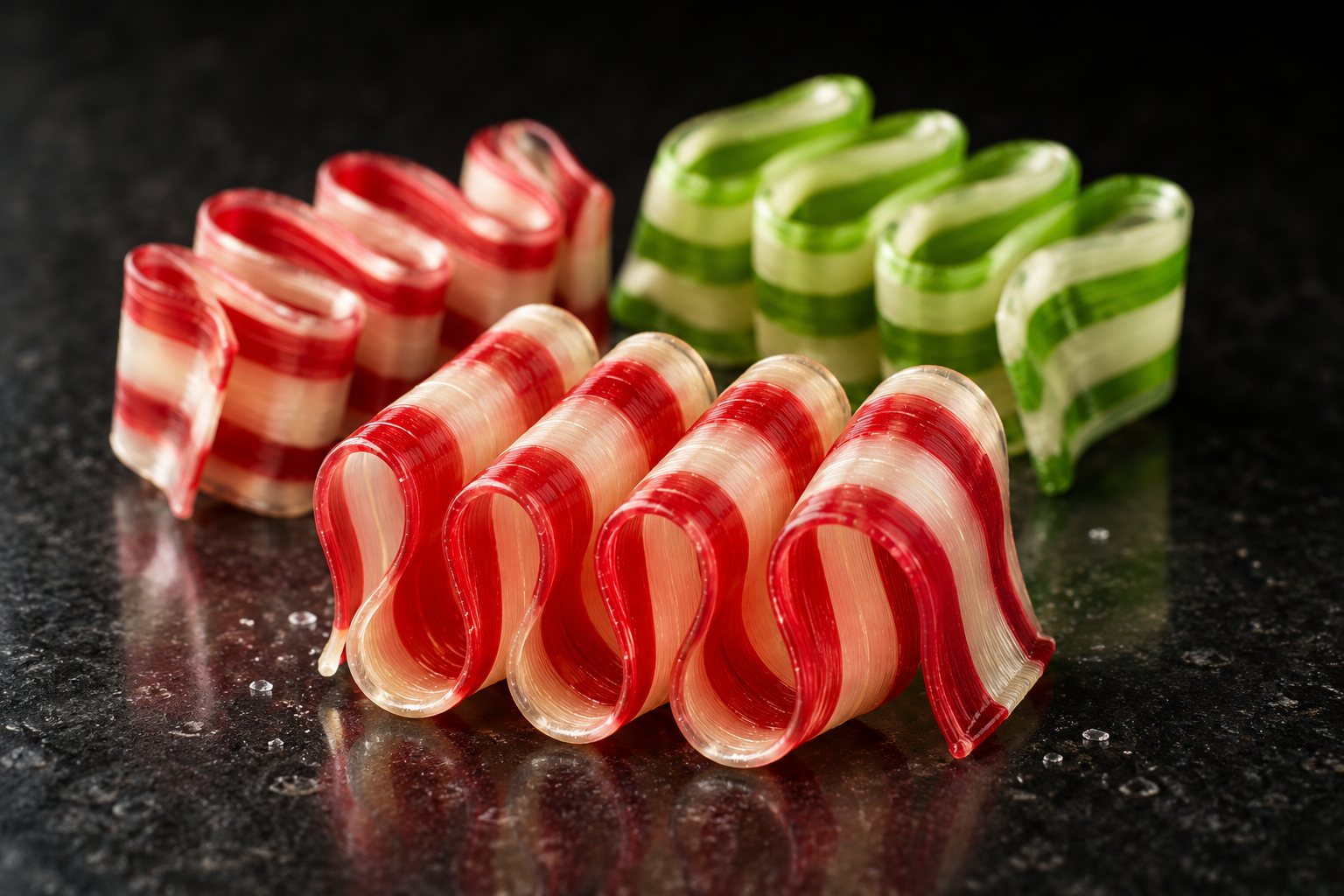
Say you watched a ribbon of pulled sugar turn shiny and you want to know whether a home kitchen can do that. You cook occasionally. You do not have a sugar lamp. You have not pulled sugar before, and you have not checked the humidity.
The ribbon recipe we could open is Jacques Torres’s, and it tells you to take a class. The home pulls we could open are candy canes, from Noelle Carter and from Martin Earl, not ribbons. We also read a LorAnn hard-candy page that pours and does not pull, plus the Exploratorium’s stage chart and weather note. We haven’t made any of these. Everything practical below comes from the named page and is linked, so you can check it. Cook from the page you choose. The film is visual inspiration, not a kitchen test.
At a glance
How each recipe fits this plan
- No image yet
Jacques Torres
Advanced card, 30 minutes, cooked to 320 degrees F, pulled under a sugar lamp. He says to take a professional class first, and that your fingers will develop burn blisters.
Risky for this plan Sugar lampYield line cut off Recipe by Jacques Torres, Food Network - No image yet
Noelle Carter
A home candy-cane pull, not a ribbon. Her card is 1 hour. The canes cook to 290 degrees, she calls that soft crack, and they are pulled while still extremely hot. The oven is set to 200 degrees.
Plan around this Sugar gloves Recipe by Noelle Carter, Los Angeles Times - No image yet
Martin Earl
He would not recommend candy canes as your first candy. The essay aims at 285–300°F. The recipe step says 285°F, and a caption on the same card says their altitude-adjusted temp is 277°F. The oven is about 170°F.
Risky for this plan Not a first candyTwo temperatures Recipe by Martin Earl, ThermoWorks
Jacques Torres
Risky for this planSugar lampYield line cut offFrom Candy Ribbon by Jacques Torres, Food Network. No date on the recipe card.
- Level
- Advanced
- Card total
- 30 min
- Cook
- 10 min
- Heat
- 320 degrees F
Jacques Torres’s Food Network card lists the recipe as advanced, with 20 minutes of prep, 10 minutes of cooking, and 30 minutes total. The show line is Passion for Dessert with Jacques Torres, episode Holiday (CANDY). No date is printed on the card we opened. The yield line stops at “18 pieces, depending on the si.” We are not filling in the rest.
The directions open with a class, not a shopping list: “Before you begin this recipe, please take a class from a professional on working with sugar.” The next sentence calls it a skill professional pastry chefs develop after years of experience. Then his own warning: “Working with sugar will burn your fingers so know before you start that your fingers will develop burn blisters.” That is his sentence. It is not a first-aid sheet, and this page does not add one.
The syrup is cooked to 320 degrees F. He says to brush the inside of the pan or the sugar may recrystallize. The cooked sugar goes onto 3 or 4 silicone baking mats, then under a sugar lamp for the pull. The page prints: “The lamp can melt the sugar so it is important keep rotating it and folding it onto itself.” The missing “to” is on the page. The directions we read do not mention gloves, a home oven, a marble slab, or humidity.
For this plan
Our reading: the 30 minutes are the card, not the class, and not the years of experience in the sentence above the card. A home kitchen without a sugar lamp is outside what this page describes. The burn line is his warning. Follow the linked first-aid pages below rather than this recipe if you need care instructions.
Noelle Carter
Plan around thisSugar glovesFrom Candy canes by Noelle Carter, Los Angeles Times. Published December 5, 2014.
- Card time
- 1 hour
- Heat
- 290 degrees
- Oven
- 200 degrees
- One portion
- 10–15 min pulling
Noelle Carter’s Los Angeles Times recipe, published December 5, 2014, is candy canes. The card says 1 hour and a generous pound. She writes that pulled sugar had seemed beyond her, then: “Candy canes take practice because the sugar needs to be handled while it is still extremely hot.” The essay also says to allow plenty of time and patience, and that sugar work will take time to master. The 1 hour is the card. The mastery line is the essay. We are not adding them together.
The cane syrup is cooked to 290 degrees, which she calls soft crack. On the same page, her taffy is a different pull: 255 degrees, which she calls hard ball, cooled until it can be handled without burning your hands. She says some recipes call for a higher taffy temperature, and that 255 works better for her. The canes are the opposite timing. “Hot sugar is dangerous; it burns easily and can become a sticky mess.” She says you need heat-resistant sugar gloves, and that you have to work fast, because as the sugar cools it hardens and becomes brittle. A warm oven brings it back to malleable. Her numbered steps heat that oven to 200 degrees.
The 10 to 15 minutes are printed on the colored portion, the time until that portion is lightened, opaque, and almost too tough to keep pulling. The larger portion says to work it the same way and does not print a second clock. The end note says the recipe requires sugar gloves, available at cooking and baking supply stores and online, and: “Be careful when handling hot sugar, as it is sticky and can easily burn you.” Finished canes go into an airtight container in a cool, dry place. She does not mention a sugar lamp.
For this plan
Our reading: this is a home oven and a 1-hour card, with a glove she says you buy and a pull she says takes practice because the sugar is still extremely hot. It is a candy cane, not a ribbon. The taffy on her page is a lower temperature and a cooler pull. Do not borrow 255 degrees for the canes.
Martin Earl
Risky for this planNot a first candyTwo temperaturesFrom How to Make Homemade Candy Canes by Martin Earl, ThermoWorks. Published December 7, 2022; modified November 25, 2025.
- Essay
- 285–300°F
- Recipe step
- 285°F
- Caption
- 277°F adjusted
- Oven
- About 170°F
Martin Earl’s ThermoWorks page is also candy canes, not ribbon candy. The recipe data says published December 7, 2022, and modified November 25, 2025, which matches the visible byline. He writes: “We wouldn’t recommend this as your first foray into candy making, but if you have a little experience with the art, this can be a fun holiday treat that will really impress, if you decide to share it with others.” The page does not print a total time or a yield. We are not turning the blog’s reading time into a cook time.
The essay aims at a non-altitude-adjusted syrup of 285–300°F (141–149°C), which he calls high soft crack or even low hard crack. He says the lower temperature is easier to work and can give a passable texture, and the higher end is harder to handle and closer to a store cane. If you are new to pulling and intend to make canes a habit, he says maybe practice at 285°F, then work up to 300°F. For elevation he says to subtract 1°F (0.6°C) for every 500 ft above sea level. The recipe step then says to flavor the syrup when it reaches 285°F (141°C), adjusted for elevation. A caption on that same card says their altitude-adjusted temp is 277°F. The page does not say which number is the one to follow, and it does not say what elevation produced 277°F. We did not pick one.
The warmer is a home oven set to about 170°F (77°C), or as low as it will go. He pours onto a very lightly oiled countertop. The hands he describes are heat-proof cotton gloves under vinyl, latex, or nitrile kitchen gloves. He says to repeat the fold about 15 to 20 times, or until the candy becomes very difficult to pull. If the oven is on the warm side, he says the log may slacken: “Don’t worry unless it completely melts.” If the candy in the oven gets too soft, the step says to take the pan out for a few minutes or prop the door open. Storage is one line: an airtight container away from humidity. He does not say to skip a humid day. The page names a ThermoWorks instant-read thermometer. We are not reviewing the tool.
For this plan
Our reading: against a first pull, his own opening is the risk. The next clause is for someone who already has a little experience. If that clause should lead, the flag can move. Either way, the page prints 285–300°F, 285°F, and 277°F, and it does not say they are the same target. It is a candy cane, not a ribbon.
A reader comment dated December 25, 2023, and Earl’s reply dated March 4, 2024, sit under the recipe. The reply says it took him four tries. Those lines are older than the modified date. They are not the recipe card, and they are not used above.
The short version
For a first pull in a home kitchen, none of the three pulled pages is an easy fit, and only one of them is ribbon candy.
Jacques Torres is the ribbon. The card is 30 minutes and 320 degrees F, the pull is under a sugar lamp, and he tells you to take a professional class before you begin. He also writes that your fingers will develop burn blisters. That is his warning, not a care sheet.
Noelle Carter and Martin Earl are candy canes. Carter’s card is 1 hour at 290 degrees, in a 200-degree oven, with sugar gloves, pulled while the sugar is still extremely hot. Earl says he would not recommend the canes as your first candy. His essay aims at 285–300°F, his recipe step says 285°F, and a caption on the same card says 277°F. We have not pulled any of this, and we have not timed a batch.
Where the temperatures split
The Exploratorium’s current candy-stage chart is the scale these targets can be read against. It is written for sea level. Soft-crack is 270° F–290° F. Hard-crack is 300° F–310° F. A clear-liquid stage sits at 320° F, which the chart describes as the point where the water has boiled away and the remaining sugar is liquid and light amber. Above about 350° F, the same chart says the sugar begins to burn. The chart also says to test a thermometer in plain boiling water, which should read 212° F at sea level, and to subtract 1° F from every listed temperature for each 500 feet above sea level.
Carter’s 290 degrees is the top of that soft-crack band, and she calls it soft crack. Earl’s essay range, 285–300°F, starts inside soft-crack and ends where the chart’s hard-crack begins. He calls that whole range high soft crack or low hard crack. His recipe step is 285°F, adjusted for elevation, and the caption beside it is 277°F. Torres’s 320 degrees F is the chart’s clear-liquid stage, not its hard-crack band. He does not describe a color. We are not deciding which target makes a ribbon.
Earl and the Exploratorium both print the same altitude rule, 1°F per 500 feet, in slightly different notation. Carter and Torres do not print an altitude line. Do not move the adjustment onto a page that does not have it.
On the cold-water check, the Exploratorium’s hard-crack stage says: “CAUTION: To avoid burns, allow the syrup to cool in the cold water for a few moments before touching it!” That sentence is about the test on their chart. It is not a first-aid page.
What the day does to the candy
The Exploratorium’s weather note, still on its older annex page and undated, says: “On a humid day, once the candy has cooled to the point where it is no longer evaporating moisture into the air, it can actually start reabsorbing moisture from the air. This can make the resulting candy softer than it is supposed to be.” The next paragraph says dry days are recommended, although humidity’s effects “can be somewhat counterbalanced by cooking the candy to the upper end of the appropriate temperature stage.” It also says cool weather is recommended, because, generally, the faster candy cools, the less chance it has to form unwanted crystals. The page does not give a humidity percentage. We did not measure a kitchen, and we are not moving the “upper end” sentence onto Torres, Carter, or Earl. Their pages do not print it.
What the cooks print is storage, and one general sugar sentence. Earl says to store the canes in an airtight container away from humidity. He does not say to cancel a humid cooking day. Carter’s cane line is an airtight container in a cool, dry place. Earlier on her page, in the honeycomb paragraph rather than the cane steps, she writes that sugar is hygroscopic and draws moisture from the air, and that sugar candy can become sticky if left out too long. That sentence is hers, about sugar candy, in that paragraph. LorAnn’s hard-candy page, which is a pour and not a pull, says hard candy can become sticky on humid days, to make it when humidity is low, and to box it airtight as soon as it has cooled. LorAnn also says not to refrigerate. No byline and no recipe date are on that page.
A hard candy that skips the pull
LorAnn’s page cooks a syrup to 300°F (149°C), which it calls hard-crack, and pours it into molds or onto a sheet. It says the temperature will continue to rise slightly after the pan leaves the burner. It says adding flavoring can make the syrup steam vigorously, and to stand back. It is not ribbon candy, it has no pull, and it has no sugar lamp. If the pull is the part a home kitchen is not set up for, this is the hard-candy page we could open that does not ask for one. It is a different candy. The thermometer check on that page agrees with the Exploratorium at sea level: boiling water should read 212°F. It adds that the boiling point decreases at higher elevations, and it does not print Earl’s 1°F-per-500-feet line.
Where the kitchens split
Torres pulls under a sugar lamp that he says can melt the sugar, on silicone mats, after a class. The directions do not mention gloves. Carter parks portions in a 200-degree oven and requires sugar gloves. Earl parks the log in an oven at about 170°F, or as low as the oven will go, and he specifies cotton gloves under kitchen gloves, on a lightly oiled counter. Follow one page’s heat, warmer, and hands. The three pulls are not interchangeable, and two of them are canes.
The clocks split the same way. Torres’s card is 30 minutes and does not include the class. Carter’s card is 1 hour, and the 10 to 15 minutes belong to the colored portion. Earl prints no total. A first evening is Carter’s card only if you already have the gloves and you accept her “extremely hot” line. It is not Torres’s card, and it is not the project Earl says not to start with.
Heat, from the official pages
A sugar syrup on the stove is boiling. Torres and Carter both say the sugar can burn you. Earl’s page puts gloves on the pull and does not add care steps. This article does not add any.
The National Fire Protection Association’s Cooking safety page says: “Stay in the kitchen while you are frying, grilling, boiling, or broiling food.” For an oven fire, the same page says to turn off the heat and keep the door closed. Carter and Earl both hold candy in a heated oven. That NFPA sentence is about an oven fire. It is not a manual for a 170°F or 200-degree candy warmer, and it is not a manual for a sugar lamp. No updated date is printed. The statistics on the page cite 2020–2024. Checked October 26, 2026.
First aid for a burn is not on those recipes. It is on the Mayo Clinic’s Burns: First aid, by Mayo Clinic Staff, dated April 7, 2026, and on the American Red Cross page Burns: How To Help, which shows no date. The two pages do not give the same care instructions. This article does not restate them and does not combine them. Open the page you are going to follow.
The film shows a ribbon being pulled until it shines. It is not a record of these recipes, and it is not evidence that a home kitchen is set up for the pull.
“Before you begin this recipe, please take a class from a professional on working with sugar.”
Jacques Torres, Food Network
“Hot sugar is dangerous; it burns easily and can become a sticky mess.”
Noelle Carter, Los Angeles Times
“We wouldn’t recommend this as your first foray into candy making, but if you have a little experience with the art, this can be a fun holiday treat that will really impress, if you decide to share it with others.”
Martin Earl, ThermoWorks
Watch the texture
Related films
Our films are visual inspiration, not demonstrations that a recipe works.

Pulling ribbon candy until it shines
Short · Watch on YouTube