

Before you make it · No. 28
Peking duck at home, dried the day before
A whole duck, scalded, glazed with maltose, dried uncovered in the fridge for a day, then roasted in a home oven and wrapped in thin pancakes. Our recipe, assembled from named cooks. We have not cooked it.
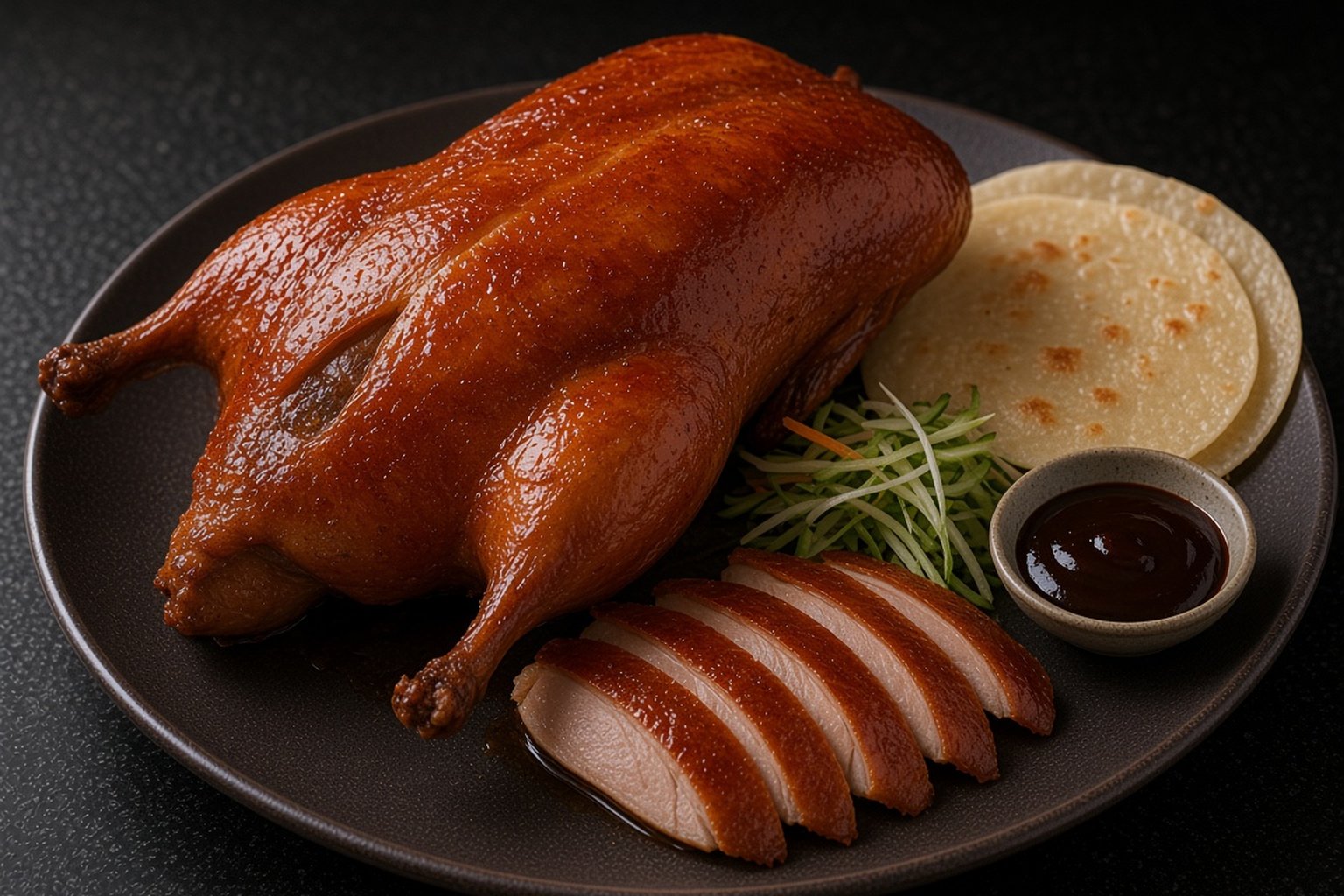
This is our Peking duck for a home oven. We assembled it from the cooks linked at the bottom. We checked Wei Guo’s, Bill Leung’s and Elaine’s pages on November 19, 2026, and the others on November 10. We have not cooked it. Nothing below is a tasting or a test.
It takes two days. On the first, you scald, glaze and dry the duck in the fridge. On the second, it roasts for about an hour and a quarter, rests, and is carved at the table. The pancakes can be bought frozen or made while the duck roasts.
The recipe
Serves 6 as a main with pancakes.
Duck
- 1 whole duck, about 2.5 kg (5 1/2 pounds), thawed in the fridge if frozen
- 2 tablespoons (about 35 g) fine salt
- about 1.5 liters (6 cups) boiling water, for scalding
Glaze
- 2 tablespoons (about 40 g) maltose
- 1/2 cup (120 ml) hot water
- 1 teaspoon rice vinegar or white vinegar
Sauce
- 3 tablespoons sweet bean sauce (tianmianjiang), or hoisin
- 1 teaspoon sugar
- 1/2 tablespoon duck fat from the roasting tray
To wrap
- 18 to 24 Peking duck (Mandarin) pancakes, frozen from an Asian grocery, or the homemade ones below
- 1 cucumber, peeled, seeded and cut into thin sticks
- 4 scallions, cut into thin strips
Homemade pancakes (optional, makes 12)
- 180 g (1 1/2 cups) all-purpose flour
- a pinch (1/8 teaspoon) salt
- 160 ml (2/3 cup) boiling water
- 1 teaspoon neutral oil, plus a little more for brushing
Method
- Day one: salt. Pat the duck dry with paper towels, inside and out. Rub the salt over the skin and inside the cavity. Set it breast up on a wire rack over a tray.
- Scald. Put the rack in the sink. Pour the boiling water slowly over the whole skin, then turn the duck and do the back. Drain any water that runs into the cavity, and pat the duck dry. Pick off any feather ends with tweezers.
- Glaze. Stir the maltose, hot water and vinegar until the maltose dissolves. Brush a thin, even coat over all the skin. Refrigerate the duck uncovered on its rack for 1 hour, then brush a second coat. Two coats are enough; discard what is left.
- Dry. Leave the duck uncovered on the rack in the fridge for 24 hours, and up to 48. The skin is ready when it looks and feels dry and leathery.
- Day two: heat the oven. Heat a fan oven to 200°C (390°F), or a conventional oven to 220°C (425°F). Put a roasting tray on the lowest shelf to catch the fat. Close the cavity openings with toothpicks or small skewers.
- Roast. Set the duck straight on the middle rack, breast up, over the tray. Roast 15 minutes. Turn the oven down to 180°C (350°F) fan or 200°C (390°F) conventional. Wrap the wing tips and the ends of the legs in foil so they do not burn. Roast about 60 minutes more, until the skin is a deep, even mahogany and the dripping slows.
- Check it. Use an instant-read thermometer in the thickest part of the breast and the inner thigh, away from the bone. Both should read at least 74°C (165°F). If not, keep roasting and check every 10 minutes. The clock is a guide; the thermometer decides.
- Rest. Lift the duck onto a board and leave it uncovered for 15 minutes.
- Make the sauce while it rests. Warm 1/2 tablespoon of fat from the tray in a small pan. Add the sweet bean sauce and sugar and stir over low heat until small bubbles appear. Spoon it into a dish.
- Warm the pancakes. Steam frozen or refrigerated pancakes for about 3 minutes, or homemade ones for about 1 minute, until soft and pliable. Keep them under a cloth.
- Carve and wrap. Slice the skin and meat thinly, so every piece has some skin. Spread a little sauce on a pancake, add a few slices with cucumber and scallion, roll it up and eat it straight away.
Homemade pancakes
- Stir the flour and salt in a heatproof bowl. Pour in the boiling water and mix with chopsticks until it clumps into a rough dough. When it is cool enough to touch, knead about 8 minutes, until smooth and soft, dusting with flour only if it sticks. Cover and rest at room temperature at least 1 hour. You can do this while the duck roasts.
- Roll the dough into a log and cut it into 12 pieces. Flatten each into a 5 cm (2 inch) disc. Brush the top and edge of six discs with oil and press a plain disc onto each, making six pairs.
- Roll each pair into a thin round about 18 cm (7 inches) across, turning it often so both layers spread evenly.
- Heat a dry frying pan over medium-low heat. Cook one pair 30 to 45 seconds, until bubbles lift between the layers, then turn it. The underside should be mostly pale, with only a few faint brown spots. Cook about 30 seconds more, then let it cool for half a minute and peel the two layers apart along the seam. Stack them under a warm cloth.
- Steam them for about a minute before serving. Extra pancakes can be frozen for up to 3 weeks.
Where cooks agree and differ
Every whole-duck page we read dries the skin before it goes near the oven. Wei Guo dries hers uncovered in the fridge for 24 to 48 hours. J. Kenji López-Alt dries his uncovered in the fridge for 12 to 36 hours, until the skin looks leathery. Elaine hangs hers in a cool room for at least a day, and longer in winter. We used the fridge, as Guo and López-Alt do, and Guo’s 24 hours as the minimum.
All three brush on maltose, or honey in its place. The order of the boiling water is where they part. Guo scalds the skin first and glazes after. López-Alt glazes first and pours the boiling water over after the dry. Elaine soaks the duck in vinegared water instead of scalding it. We followed Guo, because her glaze then dries on with the skin.
All three use a home oven and say plainly that it does not copy a restaurant’s hanging oven. Their heat differs. Guo starts hot and finishes at 180°C fan. López-Alt stands the duck on a can of water at 350°F, then 250°F. Elaine roasts at 180°C, then 120°C, and crisps the skin with hot oil or a final blast. We used Guo’s oven plan, because it is written for a duck of this size and gives both fan and conventional settings, and her thermometer check. She is the only one of the cooks who prints an internal temperature.
Bill Leung does not roast a whole duck at all. He sears four breasts and finishes them under the broiler, for a weeknight version. We kept the whole bird because that is the dish the page is about. His pancake method is the one we wrote, since it is measured and makes a small batch. Guo buys her pancakes frozen and steams them; that is the easier path.
The sauce splits too. Guo and Elaine use sweet bean sauce, warmed with duck fat and sugar or stirred with sesame oil. Leung serves hoisin. López-Alt’s essay calls hoisin the traditional condiment and prints a plum sauce. We wrote Guo’s sweet bean sauce and named hoisin as the swap she also allows.
Guo fills the cavity with apple, scallion, garlic and whole spices, and Elaine seasons it with oyster sauce, wine and five-spice. We left the cavity plain. The USDA’s roasting chart for a whole duckling says not to stuff it.
What to watch for
Dry means dry. If the skin is not dry and leathery on day two, give it more time in the fridge. Guo allows up to 48 hours, and López-Alt up to 36.
Watch the fat. A 2.5 kg duck gives up a lot of it. Keep the tray under the bird, and empty it carefully if it gets close to the rim.
Serve the skin quickly. Guo roasts on the day she serves, and says reheated duck may be drier and the skin may not crisp again.
Raw duck sits in the fridge for a day here. For time and temperature guidance on duck, see the USDA’s Duck and Goose from Farm to Table, last updated January 8, 2025, and its Safe Minimum Internal Temperature Chart, last updated April 14, 2025. Those pages are their guidance. We are not reading them as a clearance for this recipe.
The related Peking duck film is AI-generated. It is not a test of this recipe.
Watch the texture
Related films
Our films are visual inspiration, not demonstrations that a recipe works.

Peking Duck & Pancakes: The Secret Is in the Skin
Long film · Watch on YouTube