

Before you make it · No. 23
Omurice for tonight
Ketchup chicken rice wrapped in a soft two-egg omelette. Our recipe, assembled from named cooks. We have not cooked it.
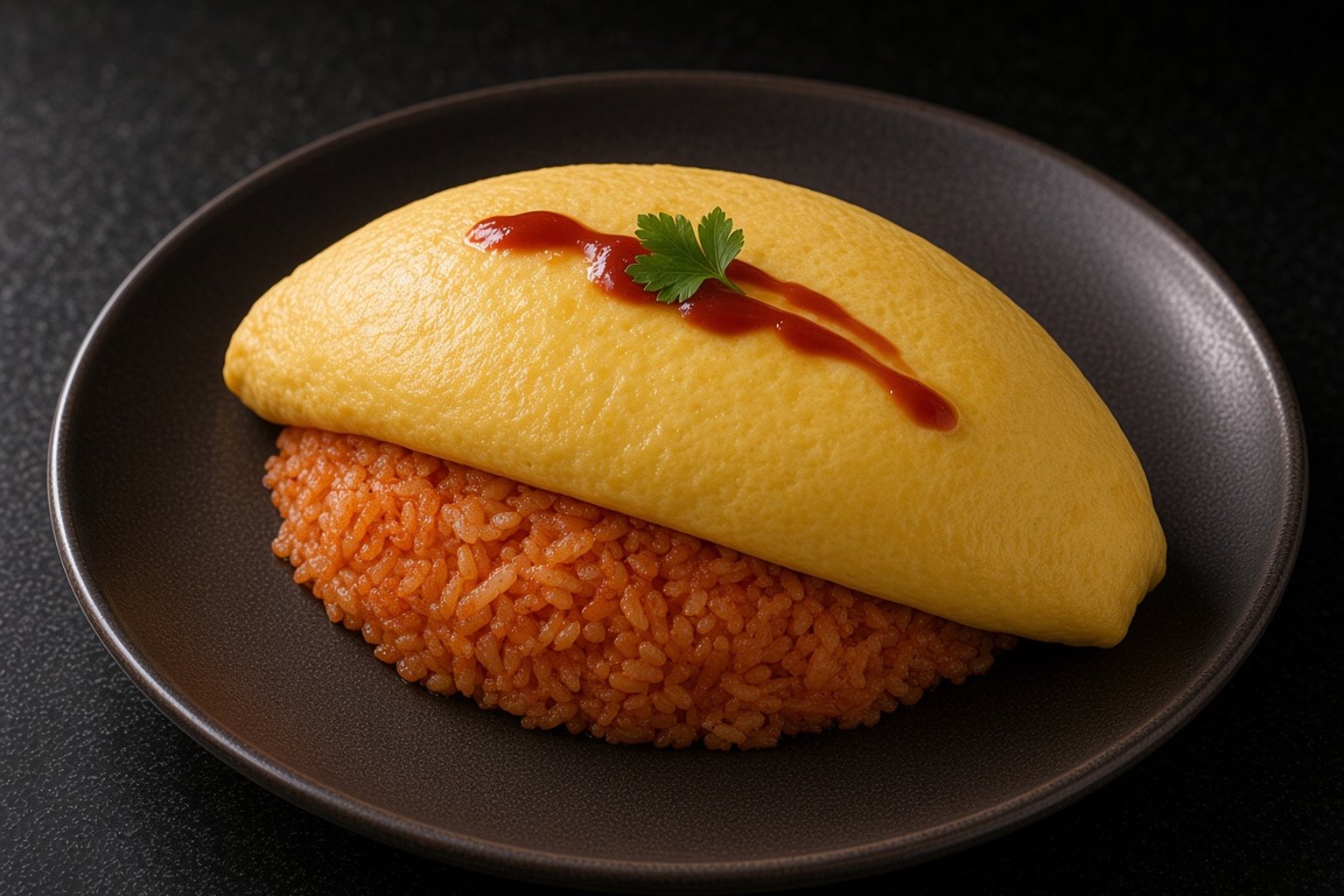
This is our omurice. We assembled it from the cooks linked at the bottom, and we checked their recipe pages on November 16, 2026. We have not cooked it. Nothing below is a tasting or a test.
The picture is generated. It shows the omelette laid over the rice with the rice showing at the front. This recipe folds the egg all the way around the rice and turns it out seam side down, so the rice is hidden.
The recipe
Two servings, one omelette at a time. Make the rice first and keep it warm. The egg goes fast once the pan is hot.
Ketchup chicken rice
- 300 g (about 2 cups) cooked Japanese short-grain rice, made the day before if you can
- 150 g (about 5 oz) boneless, skinless chicken breast, cut in 1/2 inch (1.5 cm) pieces
- 100 g (about 1/2 small) onion, finely diced
- 1 tablespoon (14 g) unsalted butter
- 3 tablespoons (about 50 g) ketchup
- 1 teaspoon Worcestershire sauce
- 2 tablespoons green peas, thawed if frozen
- 1/4 teaspoon table salt, or 1/2 teaspoon Diamond Crystal kosher salt
- black pepper
Omelettes
- 4 large eggs, 2 for each omelette
- 2 pinches table salt, one for each omelette
- 2 tablespoons (28 g) unsalted butter, 1 tablespoon for each omelette
- ketchup for the top
You need an 8 inch (20 cm) nonstick frying pan for the eggs. A larger frying pan works for the rice.
Method
- If the rice is from the fridge, warm it until it is just warm and the grains separate. If it is freshly cooked, spread it on a tray so the steam can leave while you cut the chicken and onion.
- Melt the tablespoon of butter in the larger pan over medium heat. Cook the onion, stirring now and then, until it is soft and see-through.
- Add the chicken, season it with half the salt and some pepper, and cook it, stirring, until it is cooked through. See the USDA chart under what to watch for.
- Turn the heat down a little. Add the ketchup and Worcestershire and stir until the sauce darkens and thickens and the wet shine is gone from the bottom of the pan.
- Add the rice. Break up the clumps with the edge of a spatula, cutting and folding rather than mashing, until every grain is evenly red. Add the peas and the rest of the salt and pepper, and toss until the peas are hot. Take the pan off the heat and divide the rice in two. Shape each half into a short oval, like a small football, with a spoon or the side of a bowl. Cover it to keep it warm.
- For the first omelette, crack 2 eggs into a bowl with a pinch of salt. Beat them by cutting through the whites with chopsticks or a fork until the color is even. If you want a very smooth surface, pour them through a fine sieve.
- Heat the 8 inch pan over medium heat. Add 1 tablespoon of butter and swirl it until the pan is coated and the foam settles. A drop of egg should sizzle as soon as it lands. Pour in the eggs.
- Stir quickly in small circles with chopsticks while you shake the pan, so the egg sets into small, soft curds. Tilt the pan to run the loose egg out to the edges. Stop stirring while the top is still glossy and wet, about half set. Smooth the curds flat so there are no holes.
- Set one oval of rice across the middle of the egg and turn off the heat. Tip the pan away from you. With a spatula, fold the near edge of the egg over the rice. Slide the parcel to the far side of the pan and fold the far edge over. It does not have to close. That side ends up underneath.
- Hold a plate against the far rim of the pan and turn the pan over, so the omurice lands on the plate seam side down. Lay a paper towel or a sheet of plastic wrap over it and press it gently into an even oval.
- Repeat with the other 2 eggs, butter, and rice. Finish each one with a line of ketchup.
Where cooks agree and differ
The dish is the same on all four pages: onion and chicken, cooked rice tossed with ketchup, then a thin egg set over it. Every cook makes the egg to order. The differences are the shape of the egg, the rice, and what goes in with the ketchup.
Three of the four wrap the rice. Namiko Hirasawa Chen, Yuto Omura, and Shihoko Ura each beat 2 eggs per omelette, cook them only partway, put the rice in the middle, fold, and turn the parcel onto the plate. Marc Matsumoto makes one soft 3-egg omelette, molds the rice on the plate first, and slides the egg on top. We wrote the wrap because three cards print it. Matsumoto’s version is the one to cook if you would rather not fold.
The pan is the clearest agreement. Chen names an 8 inch (20 cm) nonstick pan and writes that a smaller pan makes the flip hard and a larger one makes shaping hard. Omura names 20 cm and a small nonstick pan in his steps. Matsumoto’s omelette goes in an 8 inch nonstick pan. Ura uses a large frying pan without a size. We took the 8 inch pan.
The rice amount is close across the pages. Matsumoto uses 300 g for 2 servings and Ura 2 cups for 2. Omura uses 200 g for 3. Chen cooks 2 servings of rice, then sets a third of the chicken rice aside for later. We used 300 g. Chen wants the rice warm, and says to spread fresh rice out so it dries a little. Matsumoto starts with cold leftover rice and heats it in the pan. We followed Chen.
For the sauce, Chen and Omura both pair ketchup with a teaspoon of Worcestershire. Matsumoto uses ketchup with oyster sauce. Ura uses ketchup alone. The amount of ketchup runs from 2 tablespoons (Ura, Matsumoto) to 5 (Chen, for a batch that makes three portions). We used 3 tablespoons with Worcestershire, which is Omura’s line. Chen cooks the ketchup down before the rice goes in, so the rice does not turn wet. Matsumoto adds it after the rice and stir-fries until it starts to caramelize. We used Chen’s order.
The chicken is breast on three cards, 150 g on each of Omura’s, Ura’s, and Matsumoto’s. Chen uses 3 oz of thigh. We used breast. Thigh is Chen’s choice and fits the same method.
The egg mixture splits. Chen and Ura beat the eggs with salt only. Omura adds milk and a little oil, and Matsumoto adds a tablespoon of cream. Chen and Omura both strain the eggs. We kept salt only and made the sieve optional.
The fat splits too. Chen uses butter in the rice and a tablespoon of butter for each omelette. Omura uses olive oil and butter for the rice and a thin film of oil for the egg. Ura uses olive oil for both. Matsumoto uses oil for the rice and butter for the egg. We used Chen’s butter throughout.
Chen adds peas. So do Omura and Ura. Omura adds mushrooms and white wine, and Ura adds carrot. We kept peas only.
What to watch for
Get everything ready before the egg goes in. Chen shapes the rice into an oval before it meets the egg. She writes that shaping it on the egg tends to tear the omelette.
Stop the egg early. Chen, Omura, and Ura all put the rice on while the egg is half cooked, and the egg keeps cooking from the pan. If the top looks dry before the rice is on, the fold is more likely to crack.
Do not force the fold. Omura writes that the far side need not close, because it ends up underneath, and that pushing it can break the omelette. Chen sets the hot pan on a damp cloth while she folds so the egg does not brown.
Chen, Omura, and Ura all stop the egg while it is still soft, and Matsumoto leaves his loose enough to finish off the heat. For egg handling, see the USDA’s Shell Eggs from Farm to Table, last updated November 20, 2024. For chicken and egg temperatures, see the USDA’s Safe Minimum Internal Temperature Chart, last updated April 14, 2025. Those pages are their guidance. We are not reading them as a clearance for this dish.
How long the chicken rice keeps is not one number. Chen says up to 3 days in the fridge or 1 month in the freezer, and makes the omelette fresh. Omura says up to 2 days in the fridge or 3 weeks frozen, for the ketchup rice only, with a new omelette. Ura and Matsumoto print no hold. For leftovers in general, see the USDA’s Leftovers and Food Safety, last updated July 31, 2020. We are not choosing a number.