

Before you make it · No. 8
Japanese blueberry cheesecake for tomorrow
Four hours of chilling, a foil-wrapped water bath, or a plain cake you can serve warm? We read three named pages so you can see what a jiggly cheesecake asks of you before you shop.
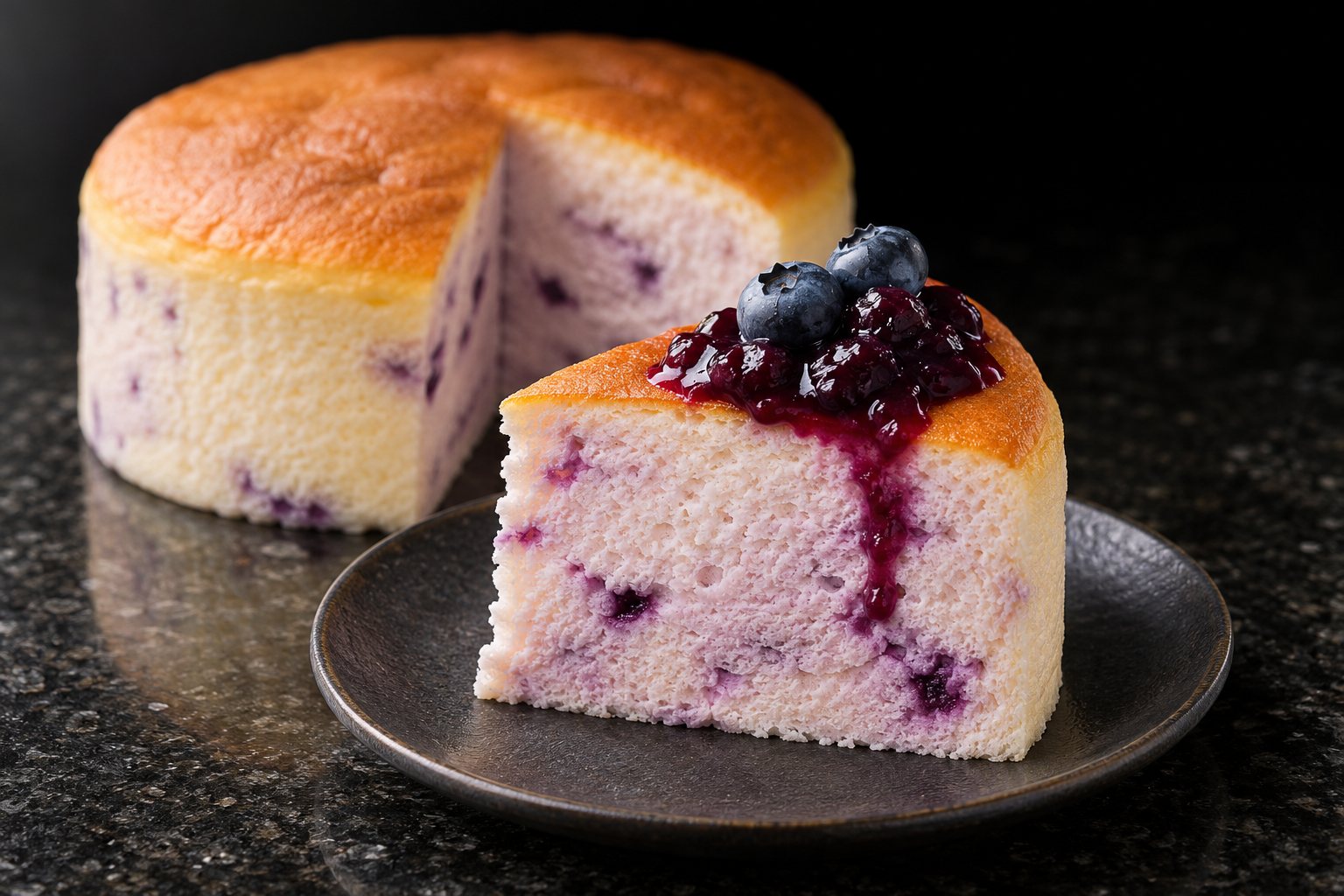
Say you want a jiggly, soufflé-style blueberry cheesecake for guests tomorrow. You bake occasionally, and you have a home oven. You want to know whether the long part is the bake or the chill, what the water bath actually involves, and what the cooks say goes wrong.
We read three named pages: Namiko Hirasawa Chen's blueberry soufflé cheesecake, the plain Japanese soufflé cheesecake she links for tips, and Charlotte Rutledge's Japanese-style soufflé cheesecake at King Arthur Baking. We haven't baked these versions. Everything practical below comes from the named page and is linked, so you can check it. Cook from the page you choose.
At a glance
How each recipe fits this plan
- No image yet
Blueberry soufflé
Chill at least 4 hours after the cake cools. The card total is 2 hours. The pan is a foil-wrapped springform in 1 inch of boiling water. Fridge up to 3 days.
Fits your plan Card total skips the chillFoil on the pan Recipe by Namiko Hirasawa Chen, Just One Cookbook - No image yet
Plain soufflé
The tip page the blueberry recipe links. Chill at least 4–6 hours; overnight is best. Card total is 1 hour 50 minutes, beside an 8-hour cool-and-chill line. No berries.
Plan around this Same cook, different cakeNo blueberries Recipe by Namiko Hirasawa Chen, Just One Cookbook - No image yet
King Arthur
Serve warm, at room temperature, or chilled. Warm is fluffy; chilled is creamier. Bake 50–60 minutes, then 20 minutes with the door ajar. No berries, and no convection.
Plan around this No blueberriesWarm is allowed Recipe by Charlotte Rutledge, King Arthur Baking
Blueberry soufflé
Fits your planCard total skips the chillFoil on the panFrom Blueberry Cheesecake by Namiko Hirasawa Chen, Just One Cookbook. Updated September 18, 2024.
- Card total
- 2 hours
- Bake
- 60 min, then 30
- Door ajar
- 15 min
- Chill
- At least 4 hours
Namiko Hirasawa Chen's card lists 30 minutes prep, 1 hour 30 minutes cook, 4 hours chilling, and a total of 2 hours, for one 9-inch cake. The page header says 2 hours as well. Thirty minutes plus 90 minutes is 2 hours. Our reading: that total matches prep plus the bake, and the chill printed on the same card sits outside it. The recipe opens with “Please note that this recipe requires 4 hours of chilling time.”
The method bakes at 320ºF (160ºC) for 60 minutes, then at 300ºF (150ºC) for 30 minutes, until a wooden skewer in the center comes out clean, without wet batter. Those two stages add to the card's 90-minute cook. Then the cake stays in the oven with the door slightly ajar for 15 minutes, “to avoid sudden temperature change, which could result in the collapse of the cake.” She cools it to room temperature on a rack and refrigerates it for at least 4 hours or overnight. The page does not say how long the counter cooling takes. For a convection oven, she says to lower the temperature by 25ºF (15ºC).
She uses a bain-marie for this blueberry soufflé cheesecake. “A water bath is ideal for cooking delicate foods like soufflés and custards, as the hot water creates gentle, uniform heat around the food and adds moisture inside the oven.” The equipment note is a 9-inch springform with a 4-inch height. The method says to wrap the base in aluminum foil, preferably extra-large heavy duty foil, to prevent seepage, and to pour 1 inch (2.5 cm) of boiling water into the roasting pan. A smaller or bigger pan, she writes, means you should adjust the ingredients. The recipe does not print that adjustment.
The blueberries are in two places. The batter uses blueberry cream cheese, and she names Philadelphia Blueberry Cream Cheese Spread. The topping is a cooked blueberry sauce, and the heading also says you can use blueberry jam. The sauce instructions end by serving it over the cheesecake before serving. On the version in the headnote she used jam to save time. The page does not give the sauce a storage time of its own.
The same page uses the words stiff peaks for two different shapes. The note says the whites form stiff peaks, “but the tip of the peak will fold back on itself.” The method says “the peaks should stand straight up when you lift up the beaters” and that the whites should not slide around. “Once the egg whites are over beaten, they can’t be used for the recipe.” She then points to her Japanese soufflé cheesecake post for detailed tips. That post is the next recipe. It does not share this pan, this flour, or this peak test.
On keeping the cake, the storage lines are: “It can be kept in the refrigerator for up to 3 days or in the freezer for up to 2 months.” “Defrost at room temperature while covered.” The headnote calls it make-ahead friendly and says it stores well in the fridge and freezer, which is why she calls it a potluck or party dessert.
For this plan
Our reading: guests tomorrow fit the 3-day fridge line if you bake today and chill at least 4 hours. Count that chill on top of the 2-hour total. The sauce is a before-serving step. The foil and the inch of boiling water belong to this recipe.
Plain soufflé
Plan around thisSame cook, different cakeNo blueberriesFrom Japanese Cheesecake by Namiko Hirasawa Chen, Just One Cookbook. Republished May 20, 2026.
- Card total
- 1 hr 50 min
- Cool + chill line
- 8 hours
- Chill
- At least 4–6 hours
- Fridge
- Up to 3–4 days
This is Chen's plain Japanese cheesecake, republished May 20, 2026. The editor's note says the post was originally published December 11, 2016, updated December 11, 2024, and republished with expanded tips on May 20, 2026. There are no blueberries. She writes that she has made it for parties and potlucks for years. The blueberry page is the one that sends you here for tips.
The card lists 25 minutes prep, 1 hour 25 minutes cook, 8 hours cooling and chilling, and a total of 1 hour 50 minutes. Twenty-five minutes plus 1 hour 25 minutes is 1 hour 50 minutes. Our reading: the total matches prep plus cook, and the 8-hour line is outside it. Before you start, she requires a cooling time of 1–2 hours and a chilling time of at least 4–6 hours, or overnight. The long ends of those ranges, 2 hours and 6 hours, add to the card's 8 hours. The short ends add to 5. That is arithmetic from the printed lines, not a cake we timed.
The detailed method reduces the oven to 320ºF (160ºC) for 70–75 minutes, then to 300ºF (150ºC) for 10 more minutes, until the top is golden. The card's 1 hour 25 minutes matches 75 minutes plus those 10. A 70-minute first stage plus 10 would be 1 hour 20, shorter than the card. Convection temperatures are printed beside those two stages, and the preheat note says to reduce a convection oven by 25ºF (15ºC). She preheats to 350ºF (180ºC) because the door will be opened to put the pan in. After the bake, the heat goes off and the cake stays in, door slightly ajar, for 15–20 minutes. During that cool she says the height slowly shrinks from about 4 inches to 2 inches. Then it cools to room temperature and chills for at least 4–6 hours or overnight.
The chill is printed in more than one place. The FAQ says “At least 4–6 hours, but overnight is best.” A tip headed “Chill overnight” says to refrigerate 4–6 hours for the best texture and flavor. She also says to take it out of the fridge 10–15 minutes before slicing for a softer bite. Storage is up to 3–4 days in the refrigerator, or up to 3–4 weeks in the freezer, thawed overnight in the refrigerator.
What fails, in her tips: “Too high, and the cake will rise too fast, crack, and collapse.” “Don’t open the oven door during baking” because temperature fluctuations cause cracking and collapsing. “A sudden drop in temperature will collapse the soufflé.” The FAQ answer is the same pair of causes: “Cracks usually mean the oven was too hot or the cake cooled too fast.” On the meringue, “Soft peaks won’t support the cake.” Firm peaks, where the tip curls back on itself, are the target. Overfolding, she writes, deflates the air. Cake flour is required. Asked about all-purpose flour, she answers “No—it makes the cake dense.”
The bath is a large baking sheet set in the preheating oven, with hot water “½ inch deep (halfway up the sides).” The pan is a 9 by 4 inch round cake pan, lined and lifted with parchment straps. The method we read does not mention foil or a springform. She gives the origin in one sentence: pastry chef Yasui Juichi at Osaka's Plaza Hotel. King Arthur's page, below, prints a different origin and calls the history disputed. We did not check either story past these two pages.
For this plan
Our reading: tomorrow fits this plain cake if you can give it the chill, including the overnight she calls best. It is the wrong page when the blueberries are the point. Her failure lines belong to this recipe. The blueberry page links here, and the two pages do not share a pan, a flour, or a peak test.
Reader comments on the page describe cracked and collapsed cakes. Those comments are not this recipe. The failure lines above are Chen's tips and FAQ.
King Arthur
Plan around thisNo blueberriesWarm is allowedFrom Japanese-Style Soufflé Cheesecake by Charlotte Rutledge, King Arthur Baking. Updated August 13, 2024.
- Card total
- 1 hr 50 min
- Bake
- 50–60 min
- Door ajar
- 20 min
- Chill
- Optional
Charlotte Rutledge's King Arthur recipe, updated August 13, 2024, is a plain Japanese-style soufflé cheesecake. The byline says she was an employee-owner from 2011 to 2022. The page thanks Namiko Hirasawa Chen, whose Japanese Cheesecake post on Just One Cookbook inspired some of the techniques used here. There are no blueberries. Rutledge writes that the cake is best enjoyed unadorned, and the serving line is to have it warm, at room temperature, or chilled, “without any accompaniments (at least initially to experience the pure flavor and unique texture).”
The texture depends on that choice. “When served warm, the Japanese cheesecake is fluffy and sponge cake-esque, with a lemon-forward flavor; when served chilled, the cake is creamier, with a more pronounced cream cheese tang.” The card lists 30 minutes hands-on, a bake of 1 hour 10 minutes to 1 hour 20 minutes, and a total of 1 hour 50 minutes, for one 8-inch cheesecake. Thirty minutes plus 1 hour 20 minutes is 1 hour 50 minutes. Our reading: the total matches hands-on time plus the long end of the bake. The 20 minutes with the door ajar comes later in the method.
She heats a 9 by 13 inch pan with hot water 3/4 inch deep, then preheats to 325°F. The cake pan is an 8-inch round at least 2 inches deep. Bake 50 to 60 minutes, until the top is golden and set and a skewer comes out clean. Turn the oven off, open the door, and leave the cake in for 20 minutes. “the cake will shrink and that’s OK.” The meringue is whipped to soft-to-firm peaks, and she adds “but not stiff.” “The baking temperature is critical to the success of this cake.” If the oven runs hot, she says it is safer to bake at 320°F. “For best results, do not use a convection oven or setting to bake this cake.” The method we read does not mention foil.
Storage is covered in the refrigerator for up to 1 week, or frozen for up to 1 month. Partially frozen is another texture. Otherwise defrost overnight, 8 to 12 hours, in the refrigerator. On history, the baker's tip says the origins are somewhat disputed, and that the most accepted account on this page is chef Tomotaro Kuzuno, who encountered German käsekuchen in Berlin in 1969 and developed his own version. That is King Arthur's sentence. Chen's page names Yasui Juichi. We stopped at the two pages.
For this plan
Our reading: a same-morning bake can be ready for guests tomorrow if warm or room temperature is the cake you want, and if the hands-on time, the bake, and the 20 minutes in the oven finish before they eat. Blueberries are not on this page. Bake it the day before and her fridge line is up to 1 week, with the creamier chilled texture she describes.
The techniques note credits Chen's blog. The times, the pan, the convection line, and the warm-or-chilled choice are Rutledge's, as printed on the King Arthur page.
The short version
For a blueberry cake and guests tomorrow, Chen’s blueberry soufflé is the page that has the berries. Plan the 60 minutes and the 30 minutes in the oven, the 15 minutes with the door ajar, time on the counter until it is at room temperature, and at least 4 hours in the refrigerator. The 2-hour total on the card matches prep plus the bake. The chill is extra. The cake then keeps, on her page, for up to 3 days in the fridge.
Her plain soufflé is the tip page that recipe links. It is a different cake: no blueberries, cake flour, a 9 by 4 inch pan on a baking sheet, and a chill of at least 4–6 hours that she also calls best overnight. The collapse and crack lines live there. King Arthur’s cake, by Charlotte Rutledge, is the one you can serve warm. Chilling on that page changes the texture. It does not add blueberries, and the page says the cake is best unadorned, at least at first.
All three bake in a water bath. The baths are not the same depth, the same pan, or the same water. We have not baked any of them.
Where the clocks disagree
The blueberry card is the only one of the three whose total is 2 hours, and the only one that lists a 4-hour chill as its own card field. The plain soufflé card is 1 hour 50 minutes, with a separate 8-hour cooling-and-chilling field and a written cooling time of 1–2 hours before a chill of at least 4–6 hours. King Arthur is also 1 hour 50 minutes, with no chill field, because warm, room temperature, and chilled are all serving options she prints.
The second oven temperature is a Chen pattern. Both of her pages drop from 320ºF to 300ºF. King Arthur holds 325°F for 50 to 60 minutes and tells you to use 320°F if the oven runs hot. Convection splits the same way. Both Chen pages say to reduce the temperature by 25ºF (15ºC). Rutledge says not to use a convection oven or setting.
Follow one page’s pan and clock. The blueberry springform is 9 inches and 4 inches tall, wrapped in foil. The plain cake uses a 9 by 4 inch cake pan and parchment straps, and the method does not mention foil. King Arthur uses an 8-inch pan at least 2 inches deep, inside a 9 by 13 inch pan of water.
The blueberries do not transfer. Chen’s blueberry batter uses blueberry cream cheese spread, and the sauce or jam goes on before serving. Her plain cake is glazed with apricot jam. Rutledge glazes with apricot jam and lemon juice and asks you to taste the cake on its own first. None of the three pages tells you to stir fresh blueberries into one of the other batters.
The water bath is a different job on each page
Chen’s blueberry method starts the water boiling, wraps a springform so the water does not seep, and sets that pan in a roasting pan with 1 inch of boiling water. She calls the bath the way to get gentle, uniform heat and moisture. She does not offer a dry-oven version.
Her plain method puts a baking sheet in the oven while it preheats and adds hot water until it is 1/2 inch deep, which that sentence also calls halfway up the sides. The cake pan goes onto that sheet. Her tip says a hot water bath creates uniform heat and keeps moisture in the oven. The same tips say not to open the door during baking.
Rutledge pours hot water 3/4 inch deep into a 9 by 13 inch pan, then preheats to 325°F, and bakes the cake in that pan. Her page does not say the bath is optional, and it does not mention foil.
The hassle is real on all three, and it is not one shared setup. Foil is a blueberry-page instruction. A sheet already in the oven is a plain-page instruction. A 3/4-inch bath in a 9 by 13 is King Arthur’s.
Peaks, cracks, and collapse
The blueberry page asks for stiff peaks and then describes two shapes. The note’s stiff peak has a tip that folds back. The method’s stiff peak stands straight up, and the whites do not slide. Whites that are overbeaten, she writes, can’t be used. The plain page says soft peaks will not support the cake, and firm peaks, with a tip that curls back, are the target. King Arthur stops at soft-to-firm peaks and says not stiff. Those are three pages. We are not picking a winner.
Cracks and collapse are spelled out on the plain page: too hot a rise, an open door during baking, or a sudden cool. The blueberry page’s own collapse line is the 15 minutes with the door ajar, so a sudden temperature change does not collapse the cake. King Arthur also cools with the door ajar, for 20 minutes, and she calls the shrink fine. She names temperature as critical and does not print Chen’s “don’t open the door” sentence. None of the three pages gives an internal temperature. A clean skewer, or a skewer with no wet batter, is the doneness line they print.
Leftovers, from the USDA
Each recipe prints its own hold. Chen’s blueberry cake: refrigerator up to 3 days, freezer up to 2 months, defrost at room temperature while covered. Her plain cake: refrigerator up to 3–4 days, freezer up to 3–4 weeks, thaw overnight in the refrigerator. Rutledge: covered in the refrigerator up to 1 week, freezer up to 1 month, then either eat it partially frozen or defrost 8 to 12 hours in the refrigerator. Both of Chen’s pages cool the cake to room temperature before the chill. The plain page also names 1–2 hours of cooling. None of them says how long a sliced cake can sit on the table.
The USDA Food Safety and Inspection Service’s Leftovers and Food Safety page, last updated July 31, 2020, and checked October 26, 2026, says: “Within 2 hours of cooking food or after it is removed from an appliance keeping it warm, leftovers must be refrigerated.” It says to throw away perishable food left in room temperature for more than 2 hours, or 1 hour if the temperature is over 90° F. It says leftovers can be kept in the refrigerator for 3 to 4 days or frozen for 3 to 4 months, and that frozen leftovers are safe indefinitely while they can lose moisture and flavor over longer storage. Safe thawing, on that page, is the refrigerator, cold water, or the microwave. The refrigerator-storage temperature it names is 40° F or below.
That page does not mention cheesecake, and its cooking temperatures are for meat and poultry. It does not list a temperature for this cake. This page does not decide whether a 3-day fridge line, a 1-week fridge line, a room-temperature defrost, or a 1–2 hour cool meets the USDA sheet. The official page is the link. The recipe you cook is the clock you followed to get there.
“Please note that this recipe requires 4 hours of chilling time.”
Namiko Hirasawa Chen, Just One Cookbook
“A sudden drop in temperature will collapse the soufflé.”
Namiko Hirasawa Chen, Just One Cookbook
“When served warm, the Japanese cheesecake is fluffy and sponge cake-esque, with a lemon-forward flavor; when served chilled, the cake is creamier, with a more pronounced cream cheese tang.”
Charlotte Rutledge, King Arthur Baking
Watch the texture
Related films
Our films are visual inspiration, not demonstrations that a recipe works.
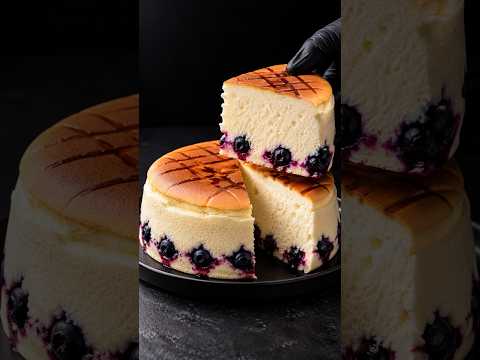
How soft is this Japanese blueberry cheesecake?
Short · Watch on YouTube