

Before you make it · No. 3
Crème brûlée for tomorrow
Chill overnight, use a torch, or fall back on the broiler? We read three named recipes so you can see what the custard and the sugar shell ask of you before you shop.
Say you might bring crème brûlée for guests tomorrow. You bake occasionally, you have a home oven, and a kitchen torch is a maybe. You want a sugar shell that still cracks when people eat it.
We read three named recipes and pulled out the clock, the torch-or-broiler choice, and what each cook says can go wrong. We haven't cooked these versions. Everything practical below comes from the named page and is linked, so you can check it. Cook from the recipe you choose.
At a glance
How each recipe fits this plan
- No image yet
King Arthur
Chill 1 to 2 hours, or overnight, after the custards cool. The card total is 1 hour 48 minutes. A torch is easiest; the broiler can burn the sugar quickly.
Plan around this Read past the card total Recipe by King Arthur Test Kitchen - No image yet
Serious Eats
Chill uncovered at least 4 hours, up to 2 days. She wants the sugar torched at serving. Her broiler test left a softer crust and a warmer custard.
Plan around this Brûlée at the table Recipe by Genevieve Yam, Serious Eats - No image yet
Sally's Baking
Chill loosely covered at least 4 hours, up to 2 days. Torch and serve, or refrigerate up to 1 hour. The broiler is the no-torch fallback, watched closely.
Fits your plan Broiler time not given Recipe by Sally McKenney, Sally's Baking Addiction
King Arthur
Plan around thisRead past the card totalFrom Classic Crème Brûlée by King Arthur Test Kitchen. Updated September 4, 2024.
- Hands-on
- 20 min
- Bake
- 28–35 min
- Card total
- 1 hr 48 min
- Chill
- 1–2 hours, or overnight
The King Arthur Test Kitchen card lists 20 minutes hands-on, a bake of 28 to 35 minutes, and a total of 1 hour 48 minutes, for 4 servings. The instructions then say to cool the custards completely and refrigerate them “1 to 2 hours, or up to overnight; no need to cover.” Overnight does not fit inside 1 hour 48 minutes. From the card alone, it is not clear whether that total already includes the 1 to 2 hour chill.
The headnote says the dessert is ideal for preparing ahead and caramelizing the sugar just before serving. For the easiest caramelizing, the recipe uses a torch until the sugar is a deep golden brown. The broiler is the other option: “a broiler element can turn sugar from browned to burned quickly.” The page gives no broiler time and no distance from the element.
The custards bake in a water bath, in 1/2-cup ramekins about 2 inches tall, until set but still a bit jiggly in the center, about 30 minutes. The topping sugar is granulated or coarse sparkling sugar.
For this plan
Our reading: tomorrow fits “up to overnight.” A same-evening plan still has to cover the bake, a complete cool, and 1 to 2 hours of chilling. Count the chill on top of the card total until the card shows otherwise. With no torch, stay at the broiler.
Serious Eats
Plan around thisBrûlée at the tableFrom Crème Brûlée by Genevieve Yam, Serious Eats. Published February 8, 2023.
- Card total
- 6 hr 30 min
- Chill
- At least 4 hours
- Ahead
- Up to 2 days
- Crack
- About 20 minutes
Genevieve Yam's card lists 1 hour 15 minutes prep, 45 minutes cook, 4 hours 30 minutes cooling, and 6 hours 30 minutes total, for 6 servings. The method says to cool the custards about 1 hour, then refrigerate them uncovered for at least 4 hours. The make-ahead note says the custards can be made up to 2 days ahead, still uncovered. Starting from scratch, the card's own total is 6 hours 30 minutes.
She treats the chill as what lets the custard stand up to the flame: “It is crucial to chill your custards.” Before caramelizing, she lets them stand 20 minutes at room temperature so they are cool rather than refrigerator-cold. That is her serving preference. The sugar goes on right before serving. In the essay she writes, “Avoid torching your crème brûlées in advance,” because over 20 to 30 minutes the topping melts into a puddle. The make-ahead note is stricter and slightly different: after 20 minutes, the crisp topping will soften and liquify. The page prints both clocks. We have not timed a crust.
A torch is her recommended tool. Her method passes the flame 1 to 2 inches from the surface, and she says how close and how long depends on the strength of the torch. On the broiler, the essay and the note do not match. The essay says the sugar melted unevenly over a lengthy 7 minutes, the crust was less crisp than the torched ones, and the custards warmed enough that another minute or two would have worried her about curdling. The note says to set a rack 3 to 4 inches from the flame and broil about 5 minutes, because broiler strength varies and the sugar may burn if left unattended. Her summary: “A broiler is an acceptable alternative if you don’t have a blowtorch, but it's a higher risk one, with less even results.”
On the custard itself, the custards she baked with no water bath “bubbled away aggressively and resulted in a curdled mess.” The ones in a water bath set. For doneness, the essay says the center should read between 170ºF and 180ºF; the method says about 35 minutes and 175ºF to 178ºF. The card's cook time is 45 minutes. Too much topping sugar, she writes, makes a thick crust that takes longer to caramelize, which risks curdling or burning the custard. Too little leaves a thin crust. She prefers raw sugar and calls granulated sugar the lower-risk substitute, because raw sugar takes longer to melt and can overbrown.
For this plan
Our reading: tomorrow fits the 2-day window if the custards are already chilled. Caramelize when you are ready to eat. Her own page calls the broiler the higher-risk path, and it gives two different broiler times.
The same page cites Harold McGee and Cindy Mushet. We did not read those books. The doneness temperatures and the water-bath result above are Yam's, as printed on her recipe.
Sally's Baking
Fits your planBroiler time not givenFrom Easy Crème Brûlée by Sally McKenney, Sally's Baking Addiction. Updated August 18, 2025.
- Prep
- 15 min
- Bake
- About 35 min
- Card total
- 4 hr 50 min
- Chill
- At least 4 hours, up to 2 days
Sally McKenney's card lists 15 minutes prep, 35 minutes cook, and a total of 4 hours 50 minutes, for 8 servings. The method also says to cool the custards at least 1 hour, then chill them, loosely covered, for at least 4 hours and up to 2 days before the sugar goes on. Her overview says the same chill can be overnight, and she calls that a make-ahead dessert. Her notes add two earlier holds: the unbaked custard mixture can be covered and refrigerated for up to 1 day before baking, and the baked custards can be made up to 2 days ahead.
The sugar is a thin layer of granulated sugar over the whole surface. She tested superfine and coarse sugar and stayed with granulated. Leave a bare spot, she writes, and “When applied to heat, the cooled custard will curdle.” Caramelize with a kitchen torch and serve immediately, or store in the refrigerator for up to 1 hour. She adds: “Caramelized topping is best enjoyed right away.”
With no torch, her note says to broil on high, ramekins on a baking sheet on a rack directly under the broiler, until the sugar is caramelized. “Keep a close eye on it.” She gives no minute count and no rack position beyond “directly under the broiler.”
She calls a water bath imperative for the texture. “A regular hot oven typically produces rubber-y tasting crème brûlée with cracked surfaces.” Bake time follows the ramekins: hers are 1 inch deep and take 35 minutes, and she says to begin checking at 30. The centers should still jiggle. For a thermometer, she says they are done at 170°F (77°C). She also writes that a first try is often over-baked, which is what happened on hers.
For this plan
Our reading: tomorrow sits inside the 2-day window. Of the three recipes, this is the only one that states a refrigerated hold after caramelizing, and that hold is up to 1 hour, with “best right away” still on the page. Borrow her 35 minutes only if your ramekins match her 1-inch depth.
The page says the recipe is adapted from Allrecipes and Mark Bittman. We read this version, not those earlier ones.
The short version
For guests tomorrow, all three recipes can work: bake the custards ahead, chill them for the time that recipe names, and caramelize the sugar at serving. Each recipe’s instructions caramelize with a torch and give the broiler as the alternative. Each one tells you to watch the broiler.
None of the three cards describes a finished crème brûlée inside a single hour. King Arthur’s total is already 1 hour 48 minutes, before you sort out the chill line. Serious Eats and Sally McKenney both want at least 4 hours in the refrigerator after the custards cool.
The crack is the part they do not time the same way. Serious Eats says the topping melts over 20 to 30 minutes, and the make-ahead note says it softens after 20 minutes. Sally McKenney says it is best right away and also allows up to 1 hour in the refrigerator. King Arthur says to caramelize just before serving and does not say how long the shell stays crisp. We have not checked a crust in a kitchen.
Where the three recipes disagree
The minimum chill is the first split. King Arthur says 1 to 2 hours, or overnight, with no need to cover. Serious Eats says at least 4 hours, uncovered, up to 2 days. Sally McKenney says at least 4 hours and up to 2 days, loosely covered. Use the cover, the clock, and the ramekin from one recipe. The bake each one prints belongs to the dish it names: about 30 minutes in King Arthur’s 2-inch-tall 1/2-cup ramekins, about 35 minutes in Serious Eats’ method (45 minutes on that card), and 35 minutes in Sally McKenney’s 1-inch ramekins, checked from 30.
The broiler is the second split. King Arthur gives a warning and no time. Serious Eats calls it higher risk, and the same page says both a lengthy 7 minutes and about 5 minutes. Sally McKenney says broil on high directly under the broiler and gives no minutes. A torch is available on all three pages; none of them tells you to buy a particular model.
Topping sugar splits too. King Arthur uses granulated or coarse sparkling sugar. Serious Eats prefers raw sugar and calls granulated the lower-risk stand-in. Sally McKenney tested superfine and coarse and uses granulated, in a layer that covers the custard so a bare spot does not curdle when it hits the heat.
What fails, in their words: no water bath left Yam with custards that curdled, and McKenney says a hot oven without one typically turns the custard rubbery, with cracked surfaces. Both of them, and King Arthur, use a water bath. The pages describe that bath differently, so the depth of the water stays in the recipe you cook.
Heat, from the official pages
A kitchen torch and a broiler are open heat. The recipes above tell you to watch the sugar. They do not include a fire sheet, and this page does not add burn treatment.
The National Fire Protection Association’s cooking-safety page says: “Stay in the kitchen while you are frying, grilling, boiling, or broiling food.” The same page says that for an oven fire, turn off the heat and keep the door closed, and that the leading cause of fires in the kitchen is unattended cooking. Checked October 26, 2026.
The U.S. Consumer Product Safety Commission’s Recipe for Safer Cooking says to keep an eye on your cooking and stay in the kitchen, and that unattended cooking is the #1 cause of cooking fires. For an oven or broiler fire, that page says to keep the oven door shut and turn off the heat. A script request for this URL was rejected from our workspace. The sentences here are from a rendered copy of the page, also checked October 26, 2026. Open the link before you rely on it.
Neither official page is a manual for a kitchen torch. The torch you use should carry its own warnings. We did not review a model.
“A broiler is an acceptable alternative if you don’t have a blowtorch, but it's a higher risk one, with less even results.”
Genevieve Yam, Serious Eats
“a broiler element can turn sugar from browned to burned quickly.”
King Arthur Test Kitchen
“Caramelized topping is best enjoyed right away.”
Sally McKenney, Sally's Baking Addiction
Watch the texture
Related films
Our films are visual inspiration, not demonstrations that a recipe works.
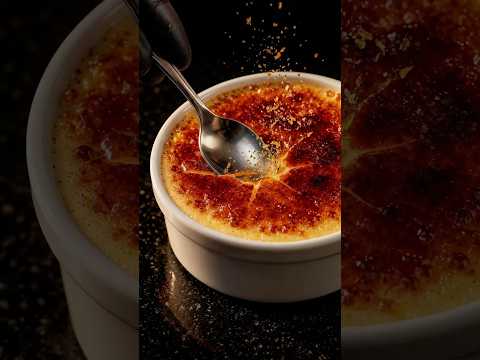
That first crème brûlée crack
Short · Watch on YouTube