

Before you make it · No. 7
Chocolate cream donuts for a gathering
Fry, bake, or fill when you serve? We read named doughnut and cream pages so you can see the clock, the oil, and the mess before you shop.
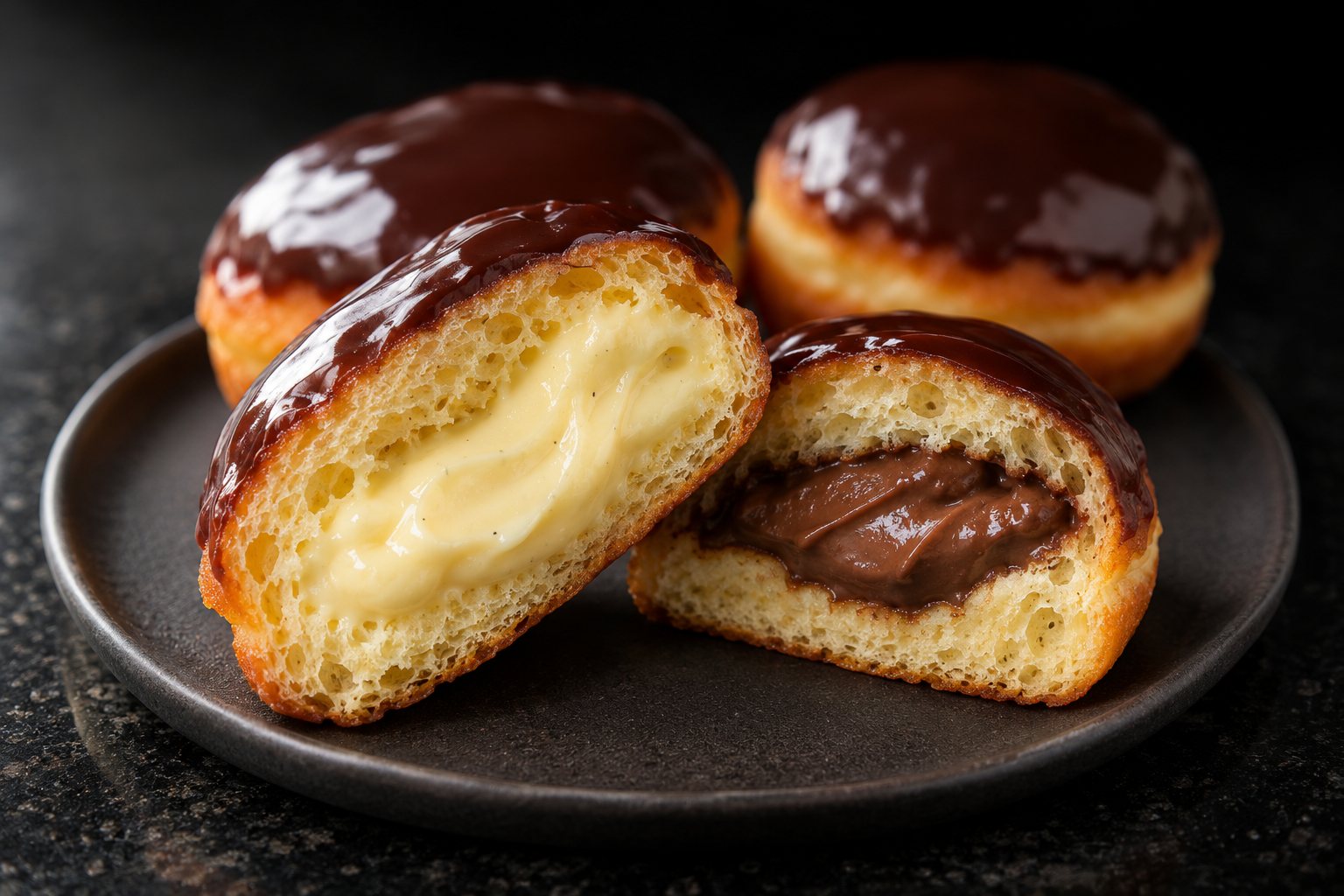
Say you want cream-filled chocolate donuts for people eating today. You have a home kitchen. You are deciding whether to fry or bake, how long the cream can wait, and whether to fill the donuts before you leave or when you serve them.
We read named doughnut pages and named cream pages and pulled out the fry-or-bake line, the hold each page prints, and what each one says about filling. We haven't cooked these versions. Everything practical below comes from the named page and is linked, so you can check it. Cook from the page you choose.
At a glance
How each recipe fits this plan
- No image yet
Susan Reid
The same yeast dough can be fried or baked. Baking drops the crispy crust and the fried flavor. The Boston cream finish she names is pastry cream plus a chocolate glaze, and this card does not time the cream.
Plan around this Pastry cream plus glaze Recipe by Susan Reid, King Arthur Baking - No image yet
Sally McKenney
She says not to bake this dough. Filled rounds are fried at 350°F and filled after 5 to 10 minutes, with jam or pastry cream. The same-day line is on the glazed doughnuts. Her pastry cream page allows 24 hours, and it is vanilla.
Plan around this Fry this dough Recipe by Sally McKenney, Sally's Baking Addiction - No image yet
Rebecca Neidhart
Chocolate cream for fried yeast donuts. Her page prints a 3-day essay, a 3-to-4-day card, and a 5-day FAQ. She would rather fill cold cream into unfilled donuts just before serving. A zip bag is the messier tool.
Fits your plan Three hold times Recipe by Rebecca Neidhart, Good Things Baking Co
Susan Reid
Plan around thisPastry cream plus glazeFrom Yeast-Raised Doughnuts by Susan Reid, King Arthur Baking. Updated October 27, 2023.
- Fry
- 350°F, ≤1 min a side
- Or bake
- 350°F, about 14 min
- Card total
- 2 hr 16 min
- Cream on this card
- Not timed
Susan Reid's King Arthur card, updated October 27, 2023, lists 40 minutes hands-on, a total of 2 hours 16 minutes, and 16 doughnuts, depending on size. The headnote names three finishes. One of them is the Boston cream doughnut: “Fill with pastry cream and top with a quick chocolate glaze for a Boston Cream Doughnut.” That is pastry cream plus glaze. It is not a chocolate-cream center, and the card does not say how long the cream keeps or when to fill.
The fry is the numbered method. Heat peanut oil or vegetable shortening in a heavy frying pan or skillet to 350°F. Fry two or three at a time until golden brown, then turn them. “Each side should take no more than a minute.” Drain, then fill or frost as desired.
The bake is a tip, not the numbered method. Follow the recipe through the shaping, and let the rounds rise 45 to 60 minutes instead of the fry path's 30 minutes to an hour. Bake in a preheated 350°F oven for about 14 minutes, until light golden brown, and check one with a small cut for raw dough at the center. Then: “Cool, fill, and top as desired.” The tip says what that choice costs: “While you'll lose the signature crispy crust and deep-fried flavor of a fried doughnut, baking is a lot simpler and very tasty.”
For this plan
Our reading: today can fit the 2 hour 16 minute card only if the cream is already made, because this page never adds a chill. Bake is the path on her page that skips the fry, and she says you lose the crust and the fried flavor. The finish she names for Boston cream is still pastry cream plus chocolate glaze. A chocolate-cream center is a different page.
Sally McKenney
Plan around thisFry this doughFrom How to Make Homemade Glazed Doughnuts by Sally McKenney, published August 25, 2023, and her separate pastry cream, published August 23, 2024.
- Filled fry
- 350°F, 1.5–2 min a side
- Then fill
- After 5–10 min
- Card total
- 2 hr 30 min
- Her pastry cream
- Up to 24 hours
Sally McKenney's glazed-doughnut card lists 2 hours 10 minutes prep, 10 minutes cook, and 2 hours 30 minutes total, for 12 donuts and 12 holes. The essay says she first shared the recipe in 2016. The header we read does not show a later updated date. The fry in the numbered method is 375°F (191°C), about 1 minute a side, two or three at a time. She tells you to wear kitchen gloves if oil is splashing, and to keep the oil at about one-third of the pot.
On baking, the page is direct: “I don’t recommend baking this dough—this dough is best for frying in oil.” For a baked doughnut she points at other recipes, including crumb cake, pumpkin, cinnamon sugar, and lemon poppy seed. On an air fryer she writes that you can try it, “but the donuts will taste more bread-like, and more like baked donuts,” and she strongly recommends following the fried recipe.
Filled doughnuts are a separate answer on the same page. Use a 3-inch cutter with no hole, drop the oil to 350°F (177°C), and fry 1.5 to 2 minutes on each side. “Let doughnuts cool for 5–10 minutes before filling.” She names jam or pastry cream, a piping bag with a long tip such as Ateco 230, and filling until the doughnut feels heavy. That answer does not repeat a storage line.
The same-day line is step 9 of the glazed method, after the glaze: “Doughnuts are best enjoyed the same day.” Leftovers, she writes, can be kept in an airtight container at room temperature or in the refrigerator for another day or two. Her pastry cream is a second recipe. The card says to refrigerate it at least 3 hours and up to 24 hours, and the make-ahead note says up to 24 hours in advance. That cream is vanilla. The page does not give a chocolate version. A staff reply on July 22, 2026 says they have not tested one. We are not treating that reply as a storage direction.
For this plan
Our reading: a gathering today can use cream she made up to 24 hours ahead, then this dough, fried. She fills 5 to 10 minutes after frying, which is sooner than “when you serve” if serving is hours later. The same-day sentence and the room-temperature leftover sentence belong to the glazed doughnuts. They are not reprinted on the filled answer or on the pastry cream card.
The doughnut page says it is adapted from Mark Bittman and Top Pot Doughnuts. We read this version, not those earlier ones.
Rebecca Neidhart
Fits your planThree hold timesFrom Chocolate Cream Donut Filling by Rebecca Neidhart, Good Things Baking Co. Posted September 1, 2024.
- Essay
- Up to 3 days
- Card
- Up to 3–4 days
- FAQ
- Up to 5 days
- Serve
- Fill just before
Rebecca Neidhart's page, posted September 1, 2024, is a chocolate cream donut filling, which she also calls a slightly thicker chocolate pastry cream. She recommends yeast donuts as the base and says to fry them. This page does not print an oil temperature or a fry time. She points to a separate yeast-donut recipe for the dough. We did not open that page, so those clocks are not claims here.
The hold is printed three ways. The essay says: “You can make the filling up to three days before filling your donuts with it.” The recipe step says the cooled filling “will keep in the refrigerator for up to 3-4 days.” The FAQ says that in an airtight container in the refrigerator, “your filling should keep for up to five days.” The page does not say which of those three governs. She does say to keep the cream filling in the refrigerator, and she writes that eggs and dairy will spoil if it sits out. That sentence is hers. It is not a USDA line.
Fill only once the donuts have cooled completely. The method then says to refrigerate the filled donuts until you serve them, and if they are completely chilled to set them out for about 30 minutes. The FAQ is stricter on the rest and different on the plan: at least 30 minutes out of the refrigerator, or the donut could feel dry and tough. The sentence she marks as the better plan is missing a letter on the page (“he best”). The rest of it reads: “leave the donuts unfilled at room temperature, then fill them with cold chocolate cream just before serving.” She adds that the refrigerator dries out baked goods and that the donuts stay fresher longer at room temperature. A piping bag is the tool in the method. Without one, a zip bag “will be messier and harder to control, but can definitely work.”
For this plan
Our reading: for chocolate cream filled when you serve, this is the page that says so. Every hold she prints is long enough to make the cream before today. The page still does not pick one of the three holds. Filling at the gathering is the plan she prefers, and she is the one who says a zip bag is the messier way to do it. The donuts on this page are fried. Bake is not an option she prints.
The short version
For chocolate cream filled when people eat, Rebecca Neidhart is the page written for that filling. She would rather leave the donuts unfilled, keep the cream cold, and fill just before serving. Susan Reid is the page that will fry or bake the same yeast dough, and the Boston cream finish she names is pastry cream plus a chocolate glaze. Sally McKenney says this dough is for frying. Her filled version waits 5 to 10 minutes, then takes jam or pastry cream.
None of the cream pages agrees on one hold. Neidhart prints three. Sam Merritt’s chocolate note sits on a pastry-cream page that prints three more. McKenney’s own pastry cream is up to 24 hours, and it is vanilla. David Turner’s King Arthur pastry cream is up to 5 days, and it is vanilla. We have not made, filled, or tasted any of them.
The related short is visual inspiration. It is not a clock, a filling formula, or a kitchen test.
Where fry and bake part ways
Reid’s numbered method is the fry, at 350°F, no more than a minute a side, two or three at a time, in peanut oil or vegetable shortening. The bake is the tip under that method. It uses a longer rise, 45 to 60 minutes, then about 14 minutes at 350°F, and she tells you to make a small cut in one doughnut and look for raw dough at the center. She says baking loses the crispy crust and the deep-fried flavor, and that it is simpler.
McKenney refuses that trade for her dough. She says she does not recommend baking it. The baked doughnuts she links are other recipes. Her air-fryer answer is the same family of warning. In her words, the donuts will taste more bread-like, and more like baked donuts, and she wants the recipe followed as fried. Her ring doughnuts fry at 375°F for 1 minute a side. Her filled rounds fry at 350°F for 1.5 to 2 minutes a side. Those are two temperatures on one page.
Neidhart’s filling page says to fry the donuts and then dip them in sugar while they are fresh from the fryer, or to cool them before a glaze. It does not print the oil temperature. The doughnut recipe she points to is not a source on this page.
The fry lines we could read are not interchangeable. Reid’s minute at 350°F, McKenney’s minute at 375°F, and McKenney’s 1.5 to 2 minutes at 350°F belong to the dough and the shape on that card. Neidhart does not add a fourth time here.
The cream is not one clock
Reid says “pastry cream” and does not link a formula or a hold. Turner’s King Arthur pastry cream, updated October 8, 2026, is a different recipe by a different author. The page says the formula was revised in December 2024. It is vanilla. Cover it and refrigerate until completely cool, at least 4 hours. Then: “Store pastry cream in the refrigerator, covered, for up to 5 days. Do not freeze.” Reid’s doughnut card does not say to use this tub.
McKenney’s pastry cream, published August 23, 2024, is also vanilla. Refrigerate at least 3 hours and up to 24 hours. The make-ahead note repeats 24 hours. She lists doughnuts among the uses. She does not publish a chocolate variation on that page.
Merritt’s pastry cream, updated October 7, 2021, includes a chocolate note: finely chop 4 ounces of 60% chocolate, reduce the butter to 2 tablespoons, and proceed with the recipe as written. The storage lines are not reprinted under that note. They are three sentences elsewhere on the same page. The method says to chill for several hours or up to 3 days before using. The FAQ says to keep it chilled, in an airtight container, for at most three days. The storing note says it will keep in the refrigerator for up to 3–5 days. She does not recommend freezing it, because the texture degrades and it begins to separate. She mentions donuts as a place for extra cream. She does not give a fry, a bake, or a same-day rule for a filled doughnut.
Neidhart is the chocolate cream written for donuts, and her three holds are the essay’s three days, the card’s 3–4 days, and the FAQ’s five days. She does not mention the freezer.
A vanilla pastry cream and a chocolate pastry cream are different recipes. A 24-hour vanilla cream and a 5-day vanilla cream are different recipes. Two chocolate pages that each print more than one hold do not become one number by averaging them.
Filling, same-day, and the mess
When the cream goes in is its own split. Reid says to fill as desired after frying, or to cool, fill, and top after baking, and she does not say how cool or how soon. McKenney’s filled answer says 5 to 10 minutes after frying, then fill until the doughnut feels heavy. Neidhart says the donuts have to cool completely. Her method refrigerates the filled donuts until serving and then gives them about 30 minutes out if they are fully chilled. Her FAQ prefers the other arrangement: unfilled donuts at room temperature, cold chocolate cream, filled just before serving. She writes that the refrigerator dries the donuts out.
McKenney’s “best enjoyed the same day,” and the further day or two at room temperature or in the refrigerator, are step 9 of the glazed doughnuts. The filled FAQ does not repeat them. Neidhart does not print a same-day sentence. She prints a just-before-serving sentence, and she also prints a refrigerate-the-filled-donuts sentence. Reid prints neither.
The mess she names is the tool. A piping tip is the method. A zippered bag with a corner cut off will be messier and harder to control. McKenney names a long piping tip and the moment the doughnut feels heavy. She also names oil splashing, and she says to wear kitchen gloves if it does. She says not to pour used oil down the sink. Those are her lines for her pot.
Hot oil and dairy, from the official pages
A fry is hot oil. The recipes above tell you how they heat it. They do not include a fire sheet, and this page does not add burn treatment.
The National Fire Protection Association’s cooking-safety page says: “Stay in the kitchen while you are frying, grilling, boiling, or broiling food.” Under cooking with oil it says: “Always stay in the kitchen when frying on the stovetop.” The same oil section says: “Never throw water on the fire.” The lid instructions are on that page. Checked October 26, 2026. No updated date was visible.
The USDA’s Deep Fat Frying and Food Safety page names donuts among foods that can be cooked in a deep fryer, and it says: “Hot oil can burn people and start fires.” It says never to leave the fryer unattended. On a grease fire it says: “In the event of a grease fire, never use water to put out the fire.” It also says to refrigerate leftovers within 2 hours of frying, or within 1 hour if the temperature is above 90°F, and not to pour oil down the sink. No updated date was visible. Checked October 26, 2026.
Those two official pages both say not to use water on the fire. They do not describe the rest of the response in the same words. This page does not merge them into a procedure. Burn care is not copied here. Mayo Clinic’s Burns: First aid, dated April 7, 2026, and the American Red Cross page Burns: How To Help, which showed no date, do not give the same instructions. The steps stay on those pages.
The dairy clocks above are the cooks’ clocks. The USDA pages are a different set, and they do not match one another either. Leftovers and Food Safety, last updated July 31, 2020, says to throw away perishable food left at room temperature more than 2 hours, or 1 hour if the temperature is over 90°F, and that leftovers can be kept in the refrigerator for 3 to 4 days. That page does not name cream-filled pastries. The deep-fat page’s 2-hour line is about leftovers of frying. A Consumer’s Guide to Food Safety: Severe Storms and Hurricanes, last updated February 25, 2020, is an emergency chart. The row “Pastries, cream filled” says discard if held above 40°F for over 2 hours. The row “Custards and puddings” says discard on that same condition. Keep Your Food Safe During Emergencies says to discard cream-filled pastries if the refrigerator has been without power for more than 4 hours. No updated date was visible on that page. All four were checked October 26, 2026.
None of those USDA pages is a doughnut recipe, and none of the cooks’ day counts is printed on those USDA pages. The official lines stay on the official pages.
“While you'll lose the signature crispy crust and deep-fried flavor of a fried doughnut, baking is a lot simpler and very tasty.”
Susan Reid, King Arthur Baking
“I don’t recommend baking this dough—this dough is best for frying in oil.”
Sally McKenney, Sally's Baking Addiction
“You can make the filling up to three days before filling your donuts with it.”
Rebecca Neidhart, Good Things Baking Co
Watch the texture
Related films
Our films are visual inspiration, not demonstrations that a recipe works.
So much chocolate cream in one donut
Short · Watch on YouTube