

Before you make it · No. 20
Choux for tomorrow: bake, fill, serve
Empty shells, the filling, and the assembled puffs keep on different clocks. We read four named cooks so you can see what can move to today.
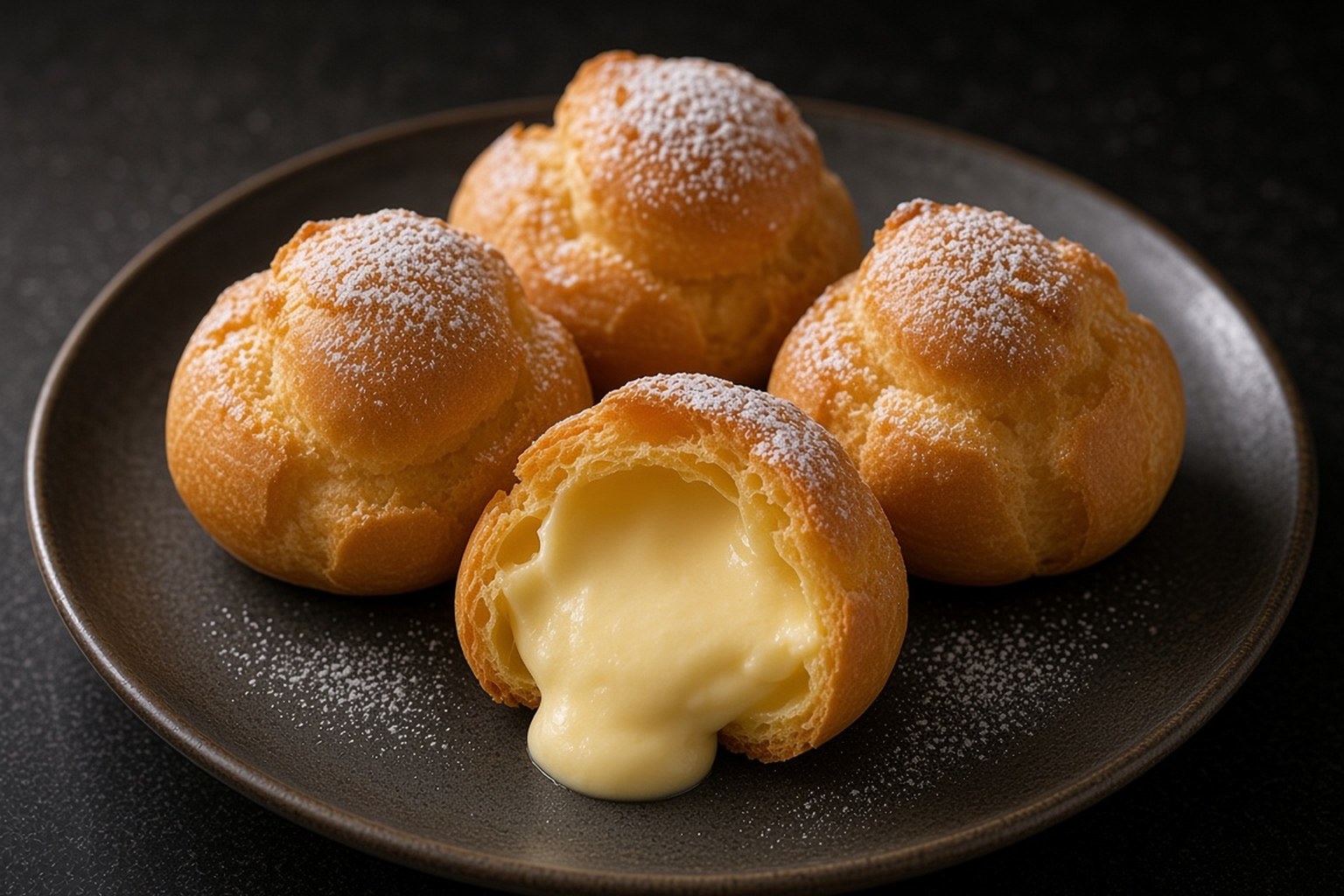
You already saw cream puffs in A crisp or chewy dessert for tomorrow. This page starts after that choice. The gathering on that page is still the plan here: dessert for eight, about 45 minutes of hands-on time, a home oven, a one-hour drive, and no oven at the other end. Hosting at home would change these flags. That switch is still open.
We read four named cooks and lined up the clocks they print for empty shells, filling, and assembled puffs. We have not baked these versions. Everything practical below comes from the named page and is linked, so you can check it. Cook from the recipe you choose. A clock on one page does not move to another cook, or from one filling to another.
At a glance
How each recipe fits this plan
- No image yet
Jessica Gavin
Empty shells keep 5 days airtight at room temperature, or 1 month frozen, then 300°F for 5 to 10 minutes. Cool again before filling. Her filled-puff lines stay on the cream-puffs page.
Plan around this Travel not covered Recipe by Jessica Gavin - No image yet
Sally McKenney
Unfilled shells keep 1 day at room temperature, 5 days in the refrigerator, or 3 months frozen. Covered filled leftovers keep up to 3 days. She prints no refresh minutes and no non-frozen fill-to-serve deadline.
Plan around this No fill-ahead texture clock Recipe by Sally McKenney, Sally's Baking Addiction - No image yet
Nagi Maehashi
Unfilled shells keep 3 days airtight, temperature unstated, or 3 months frozen. Refresh 3 to 5 minutes at 350°F. Custard chills 4 to 5 hours. Shells soften within a few hours. Her gathering story uses an oven on arrival.
Plan around this No oven there Recipe by Nagi Maehashi, RecipeTin Eats - No image yet
Dini Kodippili
Unfilled shells keep 1 to 2 days in the fridge, or 1 month frozen. Refresh at 350°F for 5 to 10 minutes. Pastry cream can be made the day before and kept up to 4 days. She wants them filled within 2 hours.
Plan around this Prep over 45 min Recipe by Dini Kodippili, The Flavor Bender
Jessica Gavin
Plan around thisTravel not coveredFrom Homemade Cream Puffs by Jessica Gavin. February 11, 2026.
- Unfilled
- 5 days, or frozen 1 month
- Refresh
- 300°F, 5–10 min
- Then
- Cool before filling
- Bake
- About 60–70 min
Her filled-puff lines are already in the cream puffs section. Read them there. This section is the empty-shell hold and the refresh. Her card total, and the complete cool that sits outside it, are on that page too.
Her notes say: “Store baked shells at room temperature in an airtight container for 5 days or frozen for 1 month.” To crisp stored shells, “Stored shells can be reheated at 300ºF (149ºC) on a sheet pan until slightly hardened on the outside, 5 to 10 minutes.” Then cool on a rack before filling. The FAQ also says you can make them up to 1 day ahead for the freshest, crisp-tasting pastry, and that a refresh is 300 degrees for about 5 to 10 minutes, then cool, fill, and serve the same day. Both refresh lines are for shells. Neither one times that second cool.
The method bakes about 60 to 70 minutes, 10 minutes at each step down in temperature, and then says to cool completely. Prep plus cook equals the total printed on her card. The cool, including the cool after a refresh, still has no minute count. She names other fillings on the same page, including pastry cream, pudding, jam, and ice cream. She does not give those fillings the whipped-cream storage lines. On filled cream puffs that are frozen, she writes that they will not be as crisp in texture or as fresh in taste. A thaw step from that answer is not copied here.
For this plan
Our reading: empty shells can move to today on her 5-day or 1-month lines, then refresh and cool before you leave, because the destination has no oven. The filled-puff conflict stays on the cream-puffs page. She does not describe packing a one-hour drive.
Sally McKenney
Plan around thisNo fill-ahead texture clockFrom Choux Pastry (Pâte à Choux) by Sally McKenney, Sally's Baking Addiction. Updated April 3, 2022.
- Card total
- 1 hr 30 min
- Unfilled
- 1 day, 5 days cold, or 3 months frozen
- Filled leftovers
- Up to 3 days, covered
- Ice cream
- Freeze 1 hour–1 day
Sally McKenney's card lists 15 minutes prep, 35 minutes cook, and a total of 1 hour 30 minutes. Fifteen plus 35 is 50 minutes. The card does not say what the other 40 minutes are. That is arithmetic from the printed lines, not a kitchen timing.
For cream-puff and profiterole shells she preheats to 400°F (204°C), bakes 20 minutes, then reduces to 350°F (177°C) for 10 to 15 minutes more. Cool completely before filling. She gives no minute count for that cool, and no refresh time anywhere on the page.
The unbaked dough can be covered and refrigerated for up to 3 days. The make-ahead note adds a freeze of up to 3 months, thawed in the refrigerator before shaping and baking. After a refrigerator hold, she says there is no need to bring the dough to room temperature, unless it is too stiff to pipe. Baked, unfilled pastries: covered, 1 day at room temperature, 5 days in the refrigerator, or frozen up to 3 months, thawed in the refrigerator before filling.
Filled leftovers: “Cover and store leftover filled pastries in the refrigerator for up to 3 days.” That is a leftover allowance. The page does not give a separate non-frozen fill-to-serve texture deadline, and this page does not invent one from the 3 days. She names whipped cream, lemon curd, jam, and pastry cream for the split shells. Those linked fillings were not opened, so they do not add clocks here. Ice-cream profiteroles are a different note: fill, then “Freeze for 1 hour or up to 1 day.” That freeze belongs to the ice-cream branch.
For this plan
Our reading: shells, and the unbaked dough if you use it, can move to today. Whipped cream has no fill-ahead texture clock on her page, so fill it near service. The ice-cream freeze is a home-freezer plan. It does not cover the drive, and it does not stand in for whipped cream.
The visible page says updated April 3, 2022. We read this choux page, not her separate whipped-cream, curd, jam, or pastry-cream recipes.
Nagi Maehashi
Plan around thisNo oven thereFrom Profiteroles by Nagi Maehashi, RecipeTin Eats. Published November 7, 2018; updated June 23, 2025.
- Card total
- 1 hr 10 min
- Unfilled
- 3 days, or frozen 3 months
- Refresh
- 350°F, 3–5 min
- Custard chill
- 4–5 hours
Nagi Maehashi's card lists 30 minutes prep, 40 minutes cook, and a total of 1 hour 10 minutes. The custard is refrigerated 4 to 5 hours until set. That chill is outside the 1 hour 10 minutes. She gives no maximum for how long the set custard can then wait.
On the card, the oven starts at 220°C/420°F (200°C fan). Two trays bake 15 minutes at a time. She then reduces the heat to 180°C/35°0F (160°C fan) — the degree sign is printed inside the Fahrenheit number — pierces the shells, and bakes 5 to 7 minutes more. The essay says the shell should take 15 minutes in a 180°C/350°F oven before you pierce. Both sentences are on the page. We are not picking one. Cool fully before filling. She gives no minutes for that cool. She pipes 40 to 50 shells and bakes two trays at a time. Do not scale her bake or her custard chill to eight guests.
Unfilled cooked shells keep in an airtight container for 3 days, or in the freezer for 3 months. She does not say whether those 3 days are at room temperature or in the refrigerator. The make-ahead note refreshes them “3 to 5 minutes at 180C/350F.” On texture she writes: “Profiteroles are at their prime when made as closely as possible to serving because the crispy shells soften within a few hours.” Chocolate-topped leftovers filled with custard or cream are, she writes, still good for 24 to 36 hours. Custard keeps better than cream, and cream soaks the pastry more. That is a leftover-quality line, not a fill-ahead deadline and not a safety rule.
Her gathering story takes the shells, the custard in a piping bag, and the chocolate separately, then crisps the shells in an oven where she is serving. Refreshing at home before a drive, with no oven at the other end, is our adaptation. She does not describe that drive. She also prints an emergency reheating step for custard-filled shells and says it is for emergencies only. This page leaves that step out.
For this plan
Our reading: the custard chill can start today, for the 4 to 5 hours she prints, with no longer maximum stated. Shells can move to today on the 3-day or 3-month lines, then refresh. Her own gathering uses an oven on arrival. The no-oven drive is the gap.
The page says the choux is slightly adapted from Gourmet Traveller and the custard from another recipe. We read this page, not those earlier ones. The 3-day shell temperature is unstated on her page.
Dini Kodippili
Plan around thisPrep over 45 minFrom The Best Profiteroles Recipe (with Pastry Cream) by Dini Kodippili, The Flavor Bender. Updated May 21, 2024.
- Card total
- 5 hr 35 min
- Unfilled
- Fridge 1–2 days, or frozen 1 month
- Refresh
- 350°F, 5–10 min
- Filled texture
- Best within 2 hours
Dini Kodippili's card lists 1 hour 5 minutes prep, 45 minutes cook, 4 hours chilling, and a total of 5 hours 35 minutes. Adding those three components gives 5 hours 50 minutes. The essay says the pastry cream has to be chilled overnight, and the card says to make the pastry cream the day before. The page does not explain how overnight, 4 hours, and 5 hours 35 minutes sit together. None of those figures is a start time on this page.
The card bakes at a preheated 375°F / 191°C for 30 to 40 minutes, with a pierce in the last 5 minutes, then cools the shells completely. She gives no minutes for that cool. She writes about 30 pastries from one batch, and also 25 to 30 shells depending on how big you pipe them. Do not scale that bake to eight guests. Her printed prep, 1 hour 5 minutes, is already past the 45-minute hands-on figure on this plan. Splitting the days does not show that the work fits. We have not timed her hands-on work, and the word prep on the card is not a measurement we made.
Unfilled shells: 1 to 2 days in the fridge, or up to a month in the freezer. She does not state a room-temperature hold. Refresh at 350°F for about 5 to 10 minutes, depending on size, then cool, then fill. Pastry cream is the filling this recipe times: make it the day before, and the make-ahead tips say the filling lasts 4 days in the fridge. Diplomat cream, whipped cream, and ice cream are named on the page. She does not give them this 4-day line. We did not open her separate pastry-cream or diplomat-cream posts.
Filled, she writes: “choux pastry is best served within 2 hours of being filled.” The card says crispness goes after a couple of hours. Keep them covered in the fridge until serving, and fill as close to serving as possible so they do not get too soggy. The 2 hours is her texture window. It is not permission to leave them out of the refrigerator. She also says filled profiteroles can be frozen, that they will be much softer, and that frozen ones will not be as good as when freshly made. A thaw step from that note is not copied here.
For this plan
Our reading: pastry cream can be made the day before, inside her 4-day fridge line, and shells can be baked today on the 1-to-2-day fridge hold or the 1-month freeze. Fill inside her 2-hour window. Refresh before you leave if there is no oven at the destination. Her printed prep already overshoots 45 minutes.
The visible page says updated May 21, 2024. The card's make-ahead line spells “pasties” where the essay says pastries. We are following the clocks, not the spelling.
The short version
For this gathering, the move the four pages support is components today and assembly near service. Empty shells have a printed hold on every page. Filled puffs do not share one promise that they will still be crisp tomorrow.
Jessica Gavin’s empty shells keep 5 days airtight at room temperature, or 1 month frozen, then 300°F for 5 to 10 minutes and a cool she does not time. Her filled-puff lines stay on the cream puffs comparison. Sally McKenney’s unfilled shells keep 1 day at room temperature, 5 days refrigerated, or 3 months frozen, thawed in the refrigerator. Her covered leftover line is up to 3 days, and she prints no separate texture deadline and no refresh minutes. Nagi Maehashi’s unfilled shells keep 3 days airtight, with the temperature unstated, or 3 months frozen, then 3 to 5 minutes at 350°F. Her custard chills 4 to 5 hours, her shells soften within a few hours, and the gathering she describes uses an oven on arrival. Dini Kodippili’s unfilled shells keep 1 to 2 days in the fridge or 1 month in the freezer, then 350°F for 5 to 10 minutes. Her pastry cream can be made the day before and kept up to 4 days, and she wants the puffs served within 2 hours of filling.
Filling tonight and counting on crisp shells tomorrow is a risky reading of these pages. A leftover line that says the puffs keep is not a line that says they stay crisp. None of the four earns a clear fit for the whole plan. The drive, the missing oven, or the 45-minute figure is still open on at least one clock for every cook. We have not baked any of them.
Where the four clocks split
The shell hold is the first split. Gavin: airtight, room temperature, 5 days, or frozen 1 month. McKenney: covered, 1 day at room temperature, 5 days refrigerated, or 3 months frozen, thawed in the refrigerator. Maehashi: airtight 3 days, temperature not stated, or 3 months frozen. Kodippili: fridge 1 to 2 days, or freezer 1 month, with no room-temperature allowance. Use one cook’s container, place, and length.
The refresh is the second split. Gavin: 300°F, 5 to 10 minutes, then cool. Maehashi: 180C/350F, 3 to 5 minutes. Kodippili: 350°F, 5 to 10 minutes, depending on size, then cool. McKenney prints no refresh minutes. All four say to cool completely, or fully, before filling, and none of them times that cool. A second cool after the refresh is just as untimed. With no oven at the destination, a printed refresh has to happen before the drive. Crispness after that drive is not in these sources.
The filling is the third split. Gavin’s timed filling on this reading is whipped cream, and the separate ahead-hold for that cream is not stated on her page beyond the filled-puff lines already on the cream-puffs comparison. McKenney names whipped cream, lemon curd, jam, and pastry cream, and gives the non-frozen shells no fill-to-serve texture deadline. Her ice-cream profiteroles freeze 1 hour or up to 1 day. That branch stays with the ice cream. Maehashi’s custard chills 4 to 5 hours until set, with no longer maximum. Kodippili’s pastry cream is made the day before and kept up to 4 days. Diplomat cream, whipped cream, and ice cream appear on her page without that clock. Do not hand one filling another cook’s number.
The card totals do not close the plan. Gavin’s prep plus cook equals the total on her card, and the complete cool still has no minutes. The cream-puffs page already flags that cool as outside her card total. McKenney’s total is 40 minutes longer than prep plus cook, and the card does not assign those minutes. Maehashi’s 1 hour 10 minutes does not include the 4-to-5-hour custard chill. Kodippili’s prep, cook, and 4-hour chill add to 5 hours 50 minutes, and the card says 5 hours 35 minutes, while the essay also says overnight. Those are checks on the printed lines, not corrected recipes.
The batches differ, so the bakes are not a speed ranking. McKenney’s card says 16 puffs. Maehashi writes 40 to 50. Kodippili writes about 30, and also 25 to 30 depending on size. Gavin’s yield is already on the cream-puffs page. Do not scale a bake or a chill to eight guests.
A two-day stage list
This is a scheduling list, not a method. Quantities, temperatures, and doneness stay on the recipe you cook. The durations below are only the ones that cook printed. Cooling after baking, and cooling after a refresh, are unknown on all four pages, so this list has no exact start time.
- Choose one cook and one filling, and stay on that page’s clocks.
- Bake today when that cook’s shell hold still covers tomorrow, or bake tomorrow if the day allows.
- Cool completely. No page here gives the minutes.
- Store the shells only on that cook’s line: Gavin’s 5 days or 1 month, McKenney’s 1 day, 5 days, or 3 months, Maehashi’s 3 days or 3 months, or Kodippili’s 1 to 2 days or 1 month.
- Start a custard or pastry-cream chill only on Maehashi’s 4 to 5 hours or Kodippili’s day-before and 4-day lines. Make whipped cream when its cook gives you no ahead duration. McKenney’s ice-cream freeze of 1 hour to 1 day is a separate branch, for a freezer at home.
- Tomorrow, refresh only where a refresh is printed, and only while you still have an oven. With no oven at the destination, that refresh happens before you leave.
- Cool again before filling. Also untimed.
- Fill near service. On Kodippili’s page the texture window is 2 hours from filling. If the first puff is filled before the drive, the drive sits inside that window. Our illustration, as scheduling arithmetic: a first puff filled two hours before service, then a one-hour drive, leaves at most one hour for everything else inside those two hours. That is not a food-safety allowance, an assembly-time estimate, or a transport plan. It applies to her 2-hour line only.
Cold food on the road, from the FDA
The cooks’ storage lines are texture and planning claims from their pages. They are not a safety finding, and this page does not score the drive.
The FDA’s Are You Storing Food Safely? page says: “Keep foods covered.” The next sentence says to store refrigerated foods in covered containers or sealed storage bags. Jessica Gavin’s uncovered refrigeration lines are on the cream-puffs page. This page does not turn her wording, or the FDA wording, into a house instruction for cream puffs. The same FDA page says foods that need refrigeration should not sit at room temperature more than two hours, or one hour if the air is above 90°F, and to keep the refrigerator at or below 40°F. Content current as of January 18, 2023. Checked October 28, 2026.
The FDA’s Handling Food Safely While Eating Outdoors page says to keep cold food cold, in a cooler with ice or frozen gel packs, at 40°F or below. Once served, it should not sit out longer than 2 hours, or 1 hour if the outdoor temperature is above 90°F. The same page says: “Never thaw food at room temperature, such as on the counter top.” Gavin’s freeze answer and Kodippili’s filled-freezer note both include a room-temperature thaw. Those steps are not repeated here. Content current as of March 5, 2024. Checked October 28, 2026.
Kodippili’s 2 hours is the texture window on her page. It is not an allowance to leave filled puffs unrefrigerated, and it is not a calculation of this drive. We have not timed a cooler, a car, or a puff.
“Store baked shells at room temperature in an airtight container for 5 days or frozen for 1 month.”
Jessica Gavin
“Profiteroles are at their prime when made as closely as possible to serving because the crispy shells soften within a few hours.”
Nagi Maehashi, RecipeTin Eats
“choux pastry is best served within 2 hours of being filled.”
Dini Kodippili, The Flavor Bender