

Before you make it · No. 10
Chawanmushi for dinner tonight
A pot of water, a steamer, or the oven? We read three named recipes so you can see the clock, whether you need dashi, and what each cook says the silky set depends on before you start.
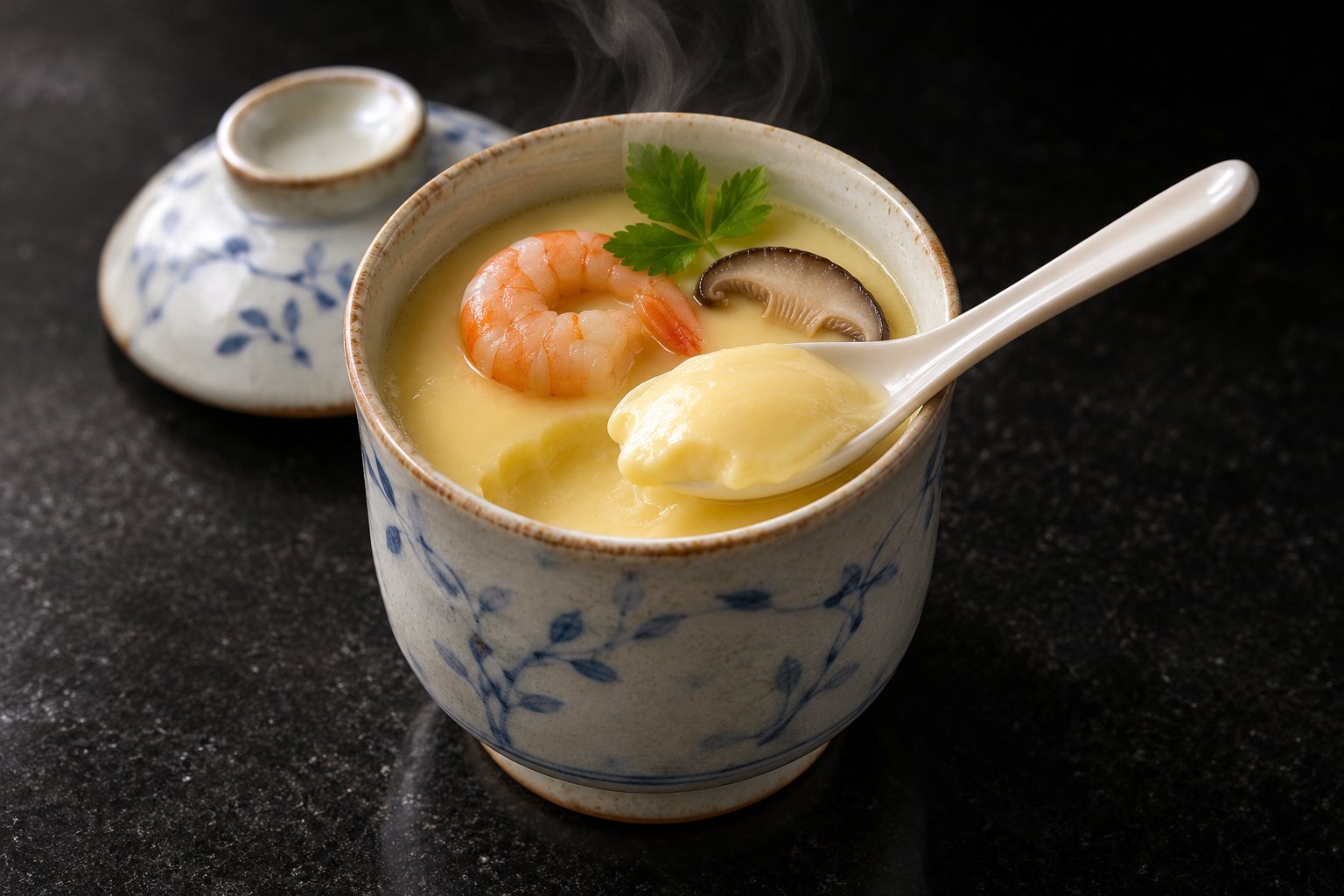
Say it's a dinner at home tonight and you want chawanmushi, the savory egg custard served in a cup. You do not own a steamer. Dashi might not be in the cupboard. You want the texture people call silky, and you want to know what has to happen before the cups can come to the table.
We read three named recipes and pulled out the vessel, the clock, the stock, and the lines each cook uses for that texture. We haven't cooked these versions. Everything practical below comes from the named page and is linked, so you can check it. Cook from the page you choose.
At a glance
How each recipe fits this plan
- No image yet
Marc Matsumoto
The card total is 30 minutes in a pot with about ½ inch of water. He prints a 3:1 stock-to-egg ratio and says any flavorful stock can stand in for dashi. Done at 160 degrees F or above. Serve hot or cold.
Fits your plan Pot, not a basketThermometer on the card Recipe by Marc Matsumoto, No Recipes - No image yet
Namiko Chen
The classic card is a pot, water halfway up the cups, 20 minutes of steaming, and a 50-minute total. She also prints a steamer and an oven. The oven's 25 to 30 minutes are on her Instant Pot page. Best served hot. Prep ahead, then steam just before serving.
Plan around this Oven minutes on the other pageTwo reheat clocks Recipe by Namiko Hirasawa Chen, Just One Cookbook - No image yet
Hiroko Shimbo
Saveur's page heats the oven to 325° and bakes the cups about 30 minutes in a water bath halfway up the ramekins, then about 2 minutes more. The essay says high heat left craters. The dashi is made from dried fish, kombu, and bonito. No packet, no steamer, no hold.
Plan around this Oven onlyDashi is made in the steps Recipe by SAVEUR Editors; essay signed Hiroko Shimbo
Marc Matsumoto
Fits your planPot, not a basketThermometer on the cardFrom Chawanmushi (Japanese Steamed Egg) by Marc Matsumoto, No Recipes. Updated October 23, 2026.
- Card total
- 30 min
- Steam
- About 20 min
- Done
- At least 160 degrees F
- Serve
- Hot or cold
Marc Matsumoto's page was updated October 23, 2026. The card lists 10 minutes prep, 20 minutes cook, and 30 minutes total, for 3 servings. The headnote says the recipe is a framework for this custard “with ingredients you have on hand.” The full line is “a framework for making this savory Japanese steamed egg with ingredients you have on hand.”
The ratio is the part he tells you to remember: “As long as you remember the 3:1 ratio of soup stock to egg, you can make this chawanmushi recipe from any combination of ingredients.” The example under that is 1 ½ cups of stock to ½ cup of egg. The card prints “½ cup egg (about 2 large eggs)” and “1 ½ cup dashi stock.” He writes that chawanmushi was served as a kind of soup, which is why the stock proportion is high. Soy sauce is optional on the page, and he says it will turn the custard brown.
Smooth, in his words, is air and heat. “Taking care not to incorporate air into the custard mixture, and removing any bubbles that float to the surface is the key to making a smooth chawanmushi.” He strains the mixture. The cups sit on a dish towel in the pot: “Steaming the cups on a dish towel in a water bath allows the custard to cook through slowly, giving it a satiny texture.” The method brings “about ½-inch of water” to a boil, sets the towel in the pot so the cups do not touch the bottom, covers the pot, and turns the heat down to a simmer. The FAQ calls that same setup a double boiler. It is not a steamer basket, and the water is not filled halfway up the cups.
The essay says the egg steams for about 20 minutes, “or until the custard reaches a minimum temperature of 160 degrees F (71 C).” The method says to steam “until the custard reaches a temperature of at least 160 degrees F or 71 C.” Both lines are his. He does not print 71.1. When it is done, the essay says, “they can be served hot or cold.” The card repeats: “Chawanmushi can be served hot or cold.” He does not say how long a cup sits out to become cold, and he does not print a refrigerator line.
On the stock, the ingredients section says the traditional broth is dashi from katsuobushi and kombu, and that the custard also works with chicken stock or mushroom stock. The FAQ is wider: “Yes, Chawanmushi can be made with any flavorful soup, such as mushroom, vegetable, or chicken stock.” He says to skim the fat from a meat stock. The card's mix-ins are edamame, shrimp, scallops, and shiitake. Mitsuba and ikura are optional garnishes. He lists chicken, crab, ginkgo nuts, and kamaboko as traditional, and he does not put them in this card. Cups: any heat-proof cup or ramekin. The set he uses holds about 1 cup (240ml). Smaller cups, he writes, can be four or five portions. “Keep in mind that the cooking time will vary depending on the size and thickness of your cups.”
For this plan
Our reading: the 30-minute card fits a same-evening start in a pot, which is this plan if you do not own a steamer. Dashi is what he calls traditional, and the FAQ also names chicken, mushroom, or vegetable stock. Hot or cold is his serving line. He does not time the wait that turns a hot cup cold, and the USDA section does not clear that wait.
Namiko Chen
Plan around thisOven minutes on the other pageTwo reheat clocksFrom Chawanmushi by Namiko Hirasawa Chen, Just One Cookbook. Republished April 25, 2026. The editor's note says the post was first published September 7, 2011, and updated October 2, 2022. Oven minutes and the instant-dashi line are on her Instant Pot Chawanmushi page, updated February 14, 2025.
- Card total
- 50 min
- Steam
- 20 min, or 15
- Water
- 176–194ºF
- Ahead
- Prep, then steam to serve
Namiko Hirasawa Chen's classic card lists 20 minutes prep, 30 minutes cook, and 50 minutes total, for 4 cups of about 200 ml. The opening line says the custard “comes together in about 20 minutes of hands-off steaming.” A highlight reads “Only 20 minutes of steaming—no special equipment needed” The method says “Steam for 20 minutes, or 15 minutes if you omitted the chicken.” Twenty plus thirty is fifty, so the card arithmetic matches itself. The cook field is still longer than the steam line. We are not deciding what the extra ten minutes is. She describes the dish as perfect for dinner parties. That is her description.
The card's vessel is a large pot. Water comes halfway up the sides of the cups. The water is kept “between 176–194ºF (80–90ºC) throughout steaming,” on the lowest heat, with the pot lid slightly ajar. “Do not let the water boil, or the custard will turn rough and pitted instead of silky smooth.” The FAQ uses the same numbers with a different degree sign, 176–194°F, and says a bubbly or spongy custard cooked too fast or too hot. Doneness on this card: a skewer in the center, and clear liquid means it is ready. She also says to tilt the cup and see that the custard is set. There is no internal temperature on this page.
She prints two other vessels, without putting their minutes on this card. “For a steamer, wrap the lid with a kitchen towel to prevent condensation from dripping into the custard. For an oven, place covered cups in a roasting pan with 1 inch of boiling water at 350°F (180°C).” The FAQ says you can use a regular pot, bake in a hot water bath in the oven, or use an Instant Pot. The minutes for those other paths are on the Instant Pot page: a steamer for roughly 18–20 minutes, a stovetop water bath for 18–20 minutes, and the oven for 25–30 minutes at 350ºF. That page says the oven time varies with the oven and the cups. Its stovetop water bath says to cover the pot. It does not say to leave the lid ajar. The classic card does.
The same Instant Pot page disagrees with itself, and with this card, about the skewer. A tip says clear liquid means it is done, and liquid that is not clear needs longer. The overview says if no liquid comes out, it is done. A later step prints “If the custard look set and there is no liquid coming out, it is fully cooked.” The missing “s” is the page's. The classic card is the clear-liquid line. We are not choosing which sentence governs.
The ratio is hers, and it is not Matsumoto's. “Use a 1:2.5 egg-to-dashi ratio – I use this instead of the standard 1:3 for a richer custard.” The method multiplies the egg weight by 2.5. Her example is 150 g of eggs to 375 ml of dashi. The Instant Pot page says “The best ratio for the egg mixture to dashi is about 1 to 2.5 (by volume).” It also says you can adjust later. It does not repeat “standard 1:3.” On the classic page, “Straining removes any unmixed egg whites or lumps for a silky, smooth custard.” Air bubbles, she writes, create a rough texture. Hot dashi will scramble the eggs, so the stock is room temperature or lukewarm. Cold fillings, she writes, can cook unevenly.
For the cupboard: a dashi packet or dashi from scratch. Usukuchi soy sauce keeps the custard pale. Mitsuba or green onion. Ginkgo nuts are optional. Kamaboko can be skipped, and so can the chicken, which shortens the steam to 15 minutes. The Instant Pot page says not to skip dashi, and to use instant dashi powder only in a pinch. On that page, mitsuba can be chives, green onion, or cilantro. Cups can be ramekins, small bowls, or mugs. Thick-walled cups, she writes, do not conduct heat well, and cup size and thickness change the time.
Service: the FAQ says chawanmushi is best served hot, and that you can prepare everything ahead of time and steam just before serving. The method says to serve hot or warm. Leftovers stay in the cups in the refrigerator for up to 2 days. The storage tips say to reheat by steaming 2–3 minutes, and “Avoid the microwave–it will break the custard’s silky texture.” The method's store line says steam for 2 minutes until warmed through. Both clocks are on the classic page. The 2-day hold and the steam reheat are hers. They are not the USDA lines below.
For this plan
Our reading: tonight can be her steam-just-before-serving path if the cups are already filled. The card still says 50 minutes, and she wants the custard hot or warm, not held. If the oven is the appeal, the 25 to 30 minutes live on the other page, and that page's skewer lines do not match this card. A packet covers the dashi maybe. Chicken stock is not a substitute she prints in the recipe.
Hiroko Shimbo
Plan around thisOven onlyDashi is made in the stepsFrom Chawanmushi (Japanese Egg Custard), byline SAVEUR Editors, published May 14, 2013. The essay is signed Hiroko Shimbo, author of Hiroko's American Kitchen (the page prints Andrews McNeel, 2012). We read this page, not the book.
- Oven
- 325°
- Bake
- About 30 min
- Then
- About 2 min
- Ramekins
- Four 6-oz
The page has no card total. It serves 4. The oven line is “Heat oven to 325°.” It does not print the letter F. The cups are four 6-oz ramekins in a 9-by-13-inch baking dish. Boiling water comes halfway up the sides. The custard bakes “until custard is just set, about 30 minutes.” Parsley then cooks on top until slightly wilted, about 2 minutes. The page does not print a steamer, a pot method, a make-ahead, a refrigerator line, or an internal temperature.
The failure she names is heat. “When I first tried to make chawanmushi myself, I cooked it at too high a heat, which left craters on its surface.” The technique she says she learned from her mother is to “keep the water bath simmering, never boiling.” The custard is poured through a fine strainer. She does not print an egg-to-dashi ratio.
The dashi is a step, not a packet. Dried anchovies and kombu are boiled in 1 ½ cups of water, taken out, and bonito flakes steep off the heat for 5 minutes. Before the oven, the page cooks the chicken until opaque, about 3 minutes, and the shrimp until opaque, about 30 seconds. We are not adding those lines into a total she did not print. The 30 minutes are the bake in the 6-oz ramekins she names.
The essay's cupboard is seasonal, and it is not the printed ingredient list. She remembers chicken, shrimp, “gingko nuts, and lily root.” The page spells it gingko. “She made it only in autumn when these last two delicacies appeared in our market.” The recipe as printed uses shiitake, parsley, and lemon zest. It does not include gingko nuts or lily root, and it does not call parsley a stand-in for mitsuba.
For this plan
Our reading: the oven is the whole method here, and about 30 minutes is the bake, not a shopping-to-table total. The dashi is made in the steps. There is no packet and no line for preparing the cups ahead. That is the gap for a weeknight cupboard, not a verdict on the custard.
The short version
For dinner tonight, without a steamer, Marc Matsumoto’s card is the 30-minute pot. He is also the one who says a flavorful stock can stand in for dashi, and that the cups can be served hot or cold. Namiko Hirasawa Chen’s classic card is 50 minutes. She is the one who says to prepare ahead and steam just before serving, and she wants the custard hot. Her oven clock, 25 to 30 minutes, is on a different page. Hiroko Shimbo’s Saveur page is the oven from the start, about 30 minutes in 6-oz ramekins, after a dashi she makes in the steps.
Silky is not one instruction on these pages. Matsumoto ties a smooth custard to a 3:1 stock-to-egg ratio, to getting the air out, and to a slow cook on a towel in the pot. Chen uses 1:2.5 instead of what she calls the standard 1:3, strains the eggs, and says boiling water makes the custard rough and pitted. Shimbo says high heat left craters on the surface, and that the water bath should simmer, never boil. We have not steamed or baked any of them, and we have not taken a temperature.
Where the three pages disagree
The vessel is the first split. Chen’s classic method is a pot with water halfway up the cups, lid ajar, water held at 176–194ºF. Her classic page also names a steamer basket and an oven at 350°F with 1 inch of boiling water, and it does not time either one. The Instant Pot page, same cook, times a steamer and a stovetop bath at roughly 18–20 minutes and the oven at 25–30 minutes at 350ºF. Matsumoto’s pot holds about ½ inch of water, with the cups on a dish towel so they do not touch the bottom. He does not print an oven or a steamer basket. Shimbo’s page is only the oven, at 325°, with boiling water halfway up 6-oz ramekins, about 30 minutes, then about 2 minutes more. Halfway up the cup and 1 inch of water are not the same instruction. Neither is ½ inch of water in the bottom of the pot. Follow one page’s vessel, water line, and clock.
The ratio is the second split. Matsumoto prints 3:1, stock to egg, and says that high proportion is the point. Chen prints 1:2.5 and calls 1:3 the standard she is leaving for a richer custard. Her classic page gets there by multiplying egg weight by 2.5. Her Instant Pot page calls 1 to 2.5 the best ratio by volume. Shimbo does not print a ratio. We are not turning three eggs and her 1 ½ cups of water into one.
What you have to buy is the third split. Matsumoto’s FAQ says mushroom, vegetable, or chicken stock can replace dashi, and that a meat stock should have the fat skimmed. Chen’s classic page says a dashi packet or dashi made from scratch, and her Instant Pot page says not to skip dashi and to use instant powder only in a pinch. She does not print chicken stock as a substitute. Usukuchi soy sauce, on her page, is there to keep the color pale. Mitsuba or green onion is on the classic card. Ginkgo nuts are optional. Kamaboko and chicken can be skipped, and skipping the chicken changes her steam from 20 minutes to 15. Shimbo’s dashi is dried anchovies, kombu, and bonito, steeped 5 minutes, with no packet on the page. The gingko nuts and lily root are in the essay, as autumn market items in her mother’s version. They are not in the printed recipe. Parsley is.
The clock for the table is the fourth split. Matsumoto’s card adds to 30 minutes, and he says the time changes with the size and thickness of the cup. The cups he describes hold about 1 cup. Chen’s card adds to 50 minutes, the steam line is 20, and she says cup size and thickness change the time. Thick-walled cups, she writes, do not conduct heat well. Her FAQ says the custard is best hot, and that you can prepare ahead and steam just before serving. Leftovers, on her page, keep in the cups up to 2 days and reheat by steam, either 2–3 minutes or 2 minutes, depending on which line you read. The microwave, she writes, breaks the silky texture. Shimbo prints no make-ahead and no leftover line. About 30 minutes belongs to the 6-oz ramekins on her page. Matsumoto’s hot-or-cold line and Chen’s 2-day line are not a shared holding plan.
The skewer is not shared either. Chen’s classic page says clear liquid means ready. Her Instant Pot page also says the opposite, that no liquid means done. Matsumoto uses a thermometer, at least 160 degrees F, which he also writes as 71 C. Shimbo says just set, and gives no temperature and no skewer.
Eggs and leftovers, from USDA
Matsumoto is the only one of the three who prints a temperature for the custard. Chen tests the classic cups with a skewer. Shimbo bakes until the custard is just set. Chen’s classic cups include chicken. Shimbo’s page cooks chicken and shrimp until opaque before the bake, and it does not take the custard’s temperature. Matsumoto’s printed mix-ins are edamame, shrimp, scallops, and shiitake. This page does not decide whether any of those cups is cooked.
The USDA Food Safety and Inspection Service’s Safe Minimum Internal Temperature Chart says: “Cook all food to these minimum internal temperatures, as measured with a food thermometer, before removing food from the heat source.” The chart’s row labeled Eggs is 160 degrees F (71.1 degrees C). The row for all poultry, including breasts, legs, thighs, wings, and ground poultry, is 165 degrees F (73.9 degrees C). Fish and shellfish are 145 degrees F (62.8 degrees C). Leftovers are 165 degrees F (73.9 degrees C). The chart also says consumers may choose to cook food to higher temperatures for reasons of personal preference. The page’s last-updated line reads April 14, 2025. Checked October 27, 2026.
Matsumoto’s 160 degrees F matches the number on the Eggs row and not the number on the poultry row. He prints 71 C, not 71.1. Chen and Shimbo do not print a custard temperature at all. The chart is the official pointer. It is not a clearance for a 20-minute steam, a skewer, or a 30-minute bake, and this page will not pick which row applies to a cup that holds egg and chicken, or egg and shrimp.
Chen is the only one who prints a leftover hold: up to 2 days in the cups, then a short steam, and no microwave. The USDA’s Leftovers and Food Safety page says: “Within 2 hours of cooking food or after it is removed from an appliance keeping it warm, leftovers must be refrigerated.” It also says leftovers can be kept in the refrigerator for 3 to 4 days, and: “When reheating leftovers, be sure they reach 165° F as measured with a food thermometer.” That page’s last-updated line reads July 31, 2020. Checked October 27, 2026. Matsumoto says the custard can be served cold and does not say how long it waits. Chen’s steam of 2 minutes, or 2–3 minutes, is not the 165° F line. We are not clearing either page against the USDA page.
“Taking care not to incorporate air into the custard mixture, and removing any bubbles that float to the surface is the key to making a smooth chawanmushi.”
Marc Matsumoto, No Recipes
“Do not let the water boil, or the custard will turn rough and pitted instead of silky smooth.”
Namiko Hirasawa Chen, Just One Cookbook
“When I first tried to make chawanmushi myself, I cooked it at too high a heat, which left craters on its surface.”
SAVEUR Editors; essay signed Hiroko Shimbo
Watch the texture
Related films
Our films are visual inspiration, not demonstrations that a recipe works.

Silky chawanmushi
Long film · Watch on YouTube