

Before you make it · No. 11
French toast for a brunch crowd
Overnight pan, same-morning skillet, or stuffed slices? We read named recipes for the soak, what one pan holds, and what each cook says about serving it hot.
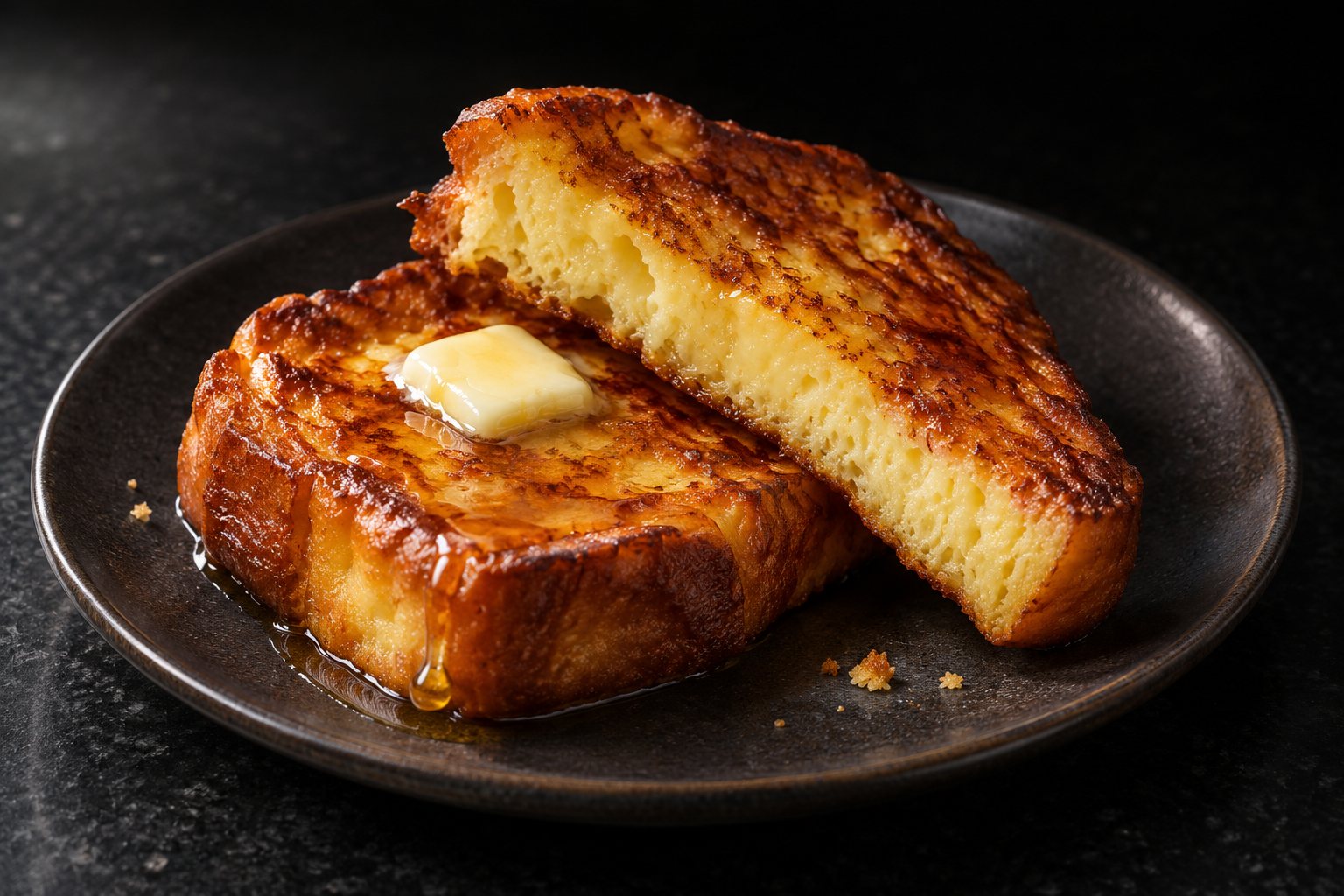
Say brunch is for eight and you have one skillet. You can start the night before. You want the caramelized or stuffed direction, and you want people eating while it is hot, not lined up for the next batch.
We read four named recipes and two more pages that print a skillet count or a warm oven. We haven't cooked any of them. Everything practical below comes from the named page and is linked, so you can check it. Cook from the page you choose.
At a glance
How each recipe fits this plan
- No image yet
Ree Drummond
One 9-by-13-inch pan, not a skillet queue. The card yields 8. She prints an overnight soak and a bake-it-now line. The streusel is what she calls crunchy and caramelized.
Fits your plan Yields 8Overnight or now Recipe by Ree Drummond, The Pioneer Woman - No image yet
Sally McKenney
Stuffed with cream cheese in a 9×13-inch pan, for 12. The card total is 9 hours 25 minutes. She wants a refrigerator soak of at least 3–4 hours, up to 24, and says overnight is best. She calls the bake easier than cooking slices.
Fits your plan Cream cheese in the panAt least 3–4 hours Recipe by Sally McKenney, Sally's Baking Addiction - No image yet
Sarah Jampel
Same-morning skillet toast. Eight slices, two at a time, for 4 servings. Raw sugar on the flip is what she says caramelizes. Finished slices wait on a wire rack in a 200°F oven. The card total is 25 minutes.
Plan around this Two slices a batchServes 4 Recipe by Sarah Jampel, King Arthur Baking - No image yet
Yumna Jawad
Cream-cheese sandwiches in a pan, 6 servings, 12 slices of brioche. The card total is 18 minutes. She says to cook in batches if needed, and to serve hot. She does not print how many sandwiches fit, or an oven to hold them.
Plan around this Serve hotNo holding temperature Recipe by Yumna Jawad, Feel Good Foodie
Ree Drummond
Fits your planYields 8Overnight or nowFrom Baked French Toast by Ree Drummond, The Pioneer Woman. Updated May 6, 2026.
- Card
- 8 servings
- Total on the card
- 1 hr 15 min
- Pan
- 9-by-13-inch
- Bake
- 45 min, or 1 hr or more
Ree Drummond's page was updated May 6, 2026. The card lists 15 minutes prep, 1 hour cook, and 1 hour 15 minutes total, for 8 servings. Fifteen plus sixty is seventy-five. That arithmetic matches the card. It does not include a night in the fridge.
The headnote is the crowd line, in her words: “This dish is somehow even better than classic French toast—and it’s easier than standing over a hot griddle flipping slices of bread.” She calls it perfect for overnight company or a church potluck breakfast. The FAQ answers the timing directly: “The great thing about baked French toast is that you can make it on the spot and bake it right away, or assemble it the night before and let it sit and get even more luscious in the fridge overnight.”
The directions say both things again. Cover the pan and store it in the fridge until needed, overnight preferably. Then: “Or you can make it and bake it right away—it's delicious no matter what!” The apostrophe in that “it's” is straight on the page. Bake at 350°F. The directions say 45 minutes for a softer, bread pudding-like texture, or 1 hour or more for a firmer, crisper texture. A photo step on the same page says 1 hour, not “or more,” for a crispy, caramelized casserole with the inside set. Both clocks are hers. The card's cook field is the 1 hour.
Caramelized, on this page, is the topping and the edges, not a sugar sprinkle on a slice. Uncovered baking “allows the streusel topping to get crunchy and caramelized.” The ingredient notes say the brown sugar in the custard helps caramelize the edges. She does not print a stuffed filling. She does not print a skillet count, because the bread is cubed into the one pan. Day-old crusty sourdough or French bread is what she asks for. Soft sandwich bread, she writes, may break down.
Leftovers, in the FAQ: covered and refrigerated, it will stay good for about three days. A large portion reheats covered with foil in a 350-degree Fahrenheit oven until warmed through, 15 to 20 minutes. She likes to uncover it for the last few minutes. Individual servings can go in the microwave. She also prints a freeze, a thaw overnight, and a 15-to-20-minute reheat. This page is not clearing any of those clocks. The USDA section is the official pointer.
For this plan
Our reading: the yield is the headcount on this plan, the pan is one dish, and the soak can be overnight or skipped. The skillet never has to hold a slice. The caramelized part is the streusel, which is a different thing from a sugar crust on a single slice.
Sally McKenney
Fits your planCream cheese in the panAt least 3–4 hoursFrom Baked Cream Cheese French Toast Casserole by Sally McKenney, Sally's Baking Addiction. Updated October 31, 2022.
- Card
- serves 12
- Prep / cook
- 30 min / 50 min
- Total on the card
- 9 hr 25 min
- Soak
- 3–4 hours to 24
Sally McKenney's page prints Updated: 10/31/2022. The card lists 30 minutes prep, 50 minutes cook, and a total of 9 hours 25 minutes, and the yield line is serves 12. Thirty plus fifty is eighty minutes, not 9 hours 25 minutes. The refrigerator time sits between those steps. We are not deciding which soak length the total is counting.
The opening sentence is the workload line: “A French toast bake is always easier than dipping and cooking individual slices of French toast.” A list on the page calls it easy to prepare and says it feeds a crowd, and calls it a make-ahead brunch option. Those are her descriptions.
The stuffed part is a layer, not a pocket cut into a slice. Cream cheese is beaten with confectioners' sugar and vanilla, spooned over half the bread cubes, then covered with the rest of the cubes. She calls that cream cheese stuffed French toast. The success note says to leave the assembled casserole in the refrigerator anywhere from 3–4 hours to 24 hours. “I find the longer the bread soaks, the tastier the casserole.” The instruction is the same window, and then “Overnight is best.” She does not print a bake-it-the-minute-you-assemble-it line. A staff reply on the page, to a reader who asked if the fridge step is required, says a few hours is how they get the custardy texture. That reply is not the recipe card. The card is the 3–4 hour minimum.
The pan is a 9×13-inch baking pan or any 3- to 4-quart dish. Bake uncovered at 350°F (177°C) for 45–55 minutes, or until golden brown on top. She usually bakes 45 minutes because she likes it softer. A note says the recipe can be halved in an 8-inch or 9-inch pan, with a bake around 30–35 minutes. Half of 12 is not eight. We are not turning that note into a plan for this headcount. The crumb topping goes on just before the oven. She says it adds a crisp-crumbly texture, and she does not call the crumb caramelized.
The bread note asks for day-old crusty bread, cubed and left out uncovered. Challah, brioche, or a French loaf are the ones she names. Flimsy sliced bread, she writes, usually tastes flat and soggy. Leftovers: cover tightly and refrigerate for 2–3 days. The make-ahead note says to reheat leftovers to your liking in the microwave, or covered in a 300°F (149°C) oven until warm throughout, at least 20 minutes. Neither line is a temperature for the food. The USDA section does not clear them.
For this plan
Our reading: this is the stuffed path that still uses one pan, so the skillet limit does not apply. It feeds past eight, and it asks you to start at least 3–4 hours ahead. Same-morning, on her card, is not printed.
Sarah Jampel
Plan around thisTwo slices a batchServes 4From Sourdough French Toast by Sarah Jampel, King Arthur Baking. Updated February 21, 2025.
- Card
- 4 servings
- Hands-on / total
- 20 min / 25 min
- In the skillet
- Two slices
- Warm oven
- 200°F
Sarah Jampel's King Arthur Baking page was updated on February 21, 2025. The card lists 20 minutes hands-on and 25 minutes total, for 4 servings, from eight slices of sourdough cut 1/2 inch thick. The headnote says you don’t need leftover challah or brioche. The custard uses half-and-half rather than milk. A tip says cream, milk, or a mixture of the two can stand in for the half-and-half. Both lines are on the page.
The caramelized crust is optional, and it is a sprinkle, not a streusel. “To take it to the next level, add a sprinkle of raw sugar over the bread before flipping it — the sugar caramelizes and crisps when it hits the hot pan.” The method says to sprinkle the raw sugar, if using, then flip and cook until browned and caramelized on the other side, 1 to 2 minutes. The first side is about 2 minutes. If you use the sugar, wipe the pan between batches so it does not burn.
The soak is the morning of, not a night in the fridge. Working with two slices at a time, soak 1 minute on each side, saturated but not soggy. The skillet is a large nonstick, over medium-high heat. She does not print a width. Two slices, then the rest, is the repeat. Eight slices at two per batch is four trips through the pan. That is arithmetic on her card, not a clock we timed. We are not adding those trips into a new total beside her 25 minutes.
The warm oven is printed before any slice is cooked. Preheat to 200°F. Set a wire rack inside a baking sheet. Transfer the French toast to the rack and keep it warm in the oven. She does not say how long a slice can stay there. She does not print a refrigerator line, a reheat, or an internal temperature. The 200°F is the oven setting. It is not a temperature she measured in the toast.
For this plan
Our reading: this is the caramelized slice, and it is the card whose yield is four, not eight. One skillet is what she uses, two slices at a time, with a 200°F rack for the slices that finish first. Plan on the queue. Her page does not say the slices are stuffed.
The headnote's “don’t” uses a curly apostrophe, and the sentence includes the word leftover. The caramelize sentence uses an em dash.
Yumna Jawad
Plan around thisServe hotNo holding temperatureFrom Stuffed French Toast by Yumna Jawad, Feel Good Foodie. Updated February 18, 2025.
- Card
- 6 servings
- Prep / cook
- 10 min / 8 min
- Total on the card
- 18 min
- Per side
- About 3 to 4 min
Yumna Jawad's page was updated February 18, 2025. The card lists 10 minutes prep, 8 minutes cook, and 18 minutes total, for 6 servings. Ten plus eight is eighteen. The introduction says the dish takes only 20 minutes. Both numbers are on the page. A nutrition line says one serving is one stuffed toast, made from two slices, so the 12 slices of brioche are six sandwiches. She calls it a weekend breakfast and also a special brunch for a larger crew. She does not number that crew. The card's number is 6.
The stuffed part is a sandwich. Whipped cream cheese and pecans go on six slices, and the other six close them. The dunk is about 15–30 seconds on both sides, until the mixture is absorbed. A tip later says brioche needs only 10 to 15 seconds, and denser bread needs longer. Those are two soak clocks on one page. We are not picking one. Fresh bread, she writes, falls apart. Day-old is better. If the loaf is fresh, she says to leave slices out overnight to firm up, or to dry them in a low oven. That overnight line is for the bread, not for a custard soak. Make-ahead, on the card, is the batter, up to 2 days. She does not say to assemble the sandwiches the night before.
The pan line does not give a count. “Place in the heated pan, in batches if needed, and cook on both sides until golden, about 3 to 4 minutes per side.” Three plus three is six, and four plus four is eight, so one sandwich at that pace is about as long as the card's entire 8-minute cook field. She also writes, as its own step, “Heat a griddle and heat the butter in batches on a frying pan over medium heat.” She does not say how many sandwiches that griddle or that frying pan holds. The last step is “Serve hot with maple syrup, if desired.” There is no 200°F rack on this page, and no other holding temperature.
Storage disagrees with itself. The recipe notes say leftovers in an airtight container last about four days in the refrigerator, then a warm skillet until gently warmed through. The question “How Long Will Stuffed French Toast Last in the Fridge?” answers up to three days. She does not recommend freezing this cream-cheese version, because the creamy texture will likely be worsened. That is her texture line, not a safety ruling. Neither day-count is a temperature. The USDA section does not clear three days, four days, or a warm skillet.
For this plan
Our reading: this is the stuffed slice, which is the shape closest to a melting filled bite, and the card stops at six. Batches are “if needed,” and hot is the serve line. She does not print a way to hold the first sandwiches while the last ones cook. That gap is the plan, not a verdict on the filling.
The short version
For eight people and one skillet, the two casseroles are the pages that finish in one pan. Ree Drummond’s card yields 8, in a 9-by-13-inch pan, and she prints both an overnight soak and a bake-right-away line. The caramelized part, in her words, is the streusel. Sally McKenney’s card yields 12, stuffs the pan with cream cheese, and requires at least 3–4 hours in the refrigerator. She says a bake is easier than cooking individual slices.
Sarah Jampel’s card is the caramelized slice: raw sugar on the flip, two slices at a time, a wire rack in a 200°F oven, and a yield of 4. Yumna Jawad’s card is the stuffed sandwich: six of them, batches if needed, serve hot, and no temperature for holding the ones that finish first. America’s Test Kitchen’s extra-crisp page, which does not name a cook, also cooks 2 slices in a 12-inch skillet and holds them in a 200-degree oven, or all at once on an electric griddle. Rosie Alexander prints a warm oven between 175 and 200 degrees F. We have not cooked any of these, and we have not timed a batch.
Overnight soak or the same morning
The long soak belongs to the casseroles, and the two casserole cooks do not agree with each other.
Drummond’s directions prefer overnight and also say you can bake it right away. Her FAQ says the same split: on the spot, or the night before. Her card total of 1 hour 15 minutes matches the 15-minute prep and the 1-hour cook field. It does not grow by a night in the fridge. The softer bake, 45 minutes, is shorter than that cook field. The firmer bake is 1 hour or more in the directions, and 1 hour in the photo step.
McKenney’s window is at least 3–4 hours and up to 24, and overnight is best. She writes that the longer soak tastes better. That “tastier” is her word. The card total of 9 hours 25 minutes is longer than prep plus cook, and shorter than a full day. We are not translating it into a single soak. She does not print Drummond’s bake-it-now sentence.
The skillet pages soak in minutes or seconds, the morning you cook. Jampel: 1 minute on each side, two slices at a time. Jawad: about 15–30 seconds in the instructions, and 10 to 15 seconds for brioche in a tip. Her overnight line is for drying fresh bread, and her make-ahead line is the batter for up to 2 days. America’s Test Kitchen: 20 seconds per side, after the slices have already been dried in a 300-degree oven for about 16 minutes. Alexander’s steps say about 5 seconds per side. Her recipe instruction says about 10 seconds in the wet mix. We are not using either of her soak numbers as the plan. They do not match each other.
None of these pages is a stuffed slice that soaks overnight. McKenney’s overnight is the cubed casserole. Jawad’s sandwiches are cooked after a short dunk.
What one skillet holds
Drummond and McKenney do not ask the skillet to hold French toast. The bread goes into one baking pan. Drummond’s is a 9-by-13-inch pan for 8 servings. McKenney’s is a 9×13-inch pan, or any 3- to 4-quart dish, for 12. One pan is the whole batch. That is why both of them can say the bake is easier than standing over slices. Drummond’s verb is flipping slices on a griddle. McKenney’s is dipping and cooking individual slices. Those are two cooks, on two sites, describing the same kind of work.
Jampel prints the count the plan has to live with if the caramelized slice is the goal. A large nonstick skillet, two slices at a time, eight slices on the card, four servings. She does not print the skillet’s diameter.
America’s Test Kitchen prints a diameter and the same count. The instruction heats ½ tablespoon of butter in a 12-inch skillet and cooks 2 slices, then repeats 2 pieces at a time. The yield is 4, from 8 slices, after one slice is turned into crumbs. The note at the top says the French toast can be cooked all at once on an electric griddle, set to 350 degrees, and that this may take an extra 2 to 3 minutes per side. The griddle is a different tool from the one skillet in this plan. The page’s byline is empty. The recipe data on the page has an empty author list. The visible date is Published on October 27, 2011. We are treating that page as the publisher’s, not as a named cook’s.
Jawad does not print a count. Batches are “if needed.” She names a griddle and a frying pan in the same step and does not say how many of the six sandwiches either one holds. One sandwich at 3 to 4 minutes per side uses about as many minutes as her whole cook field. We are not stretching that 8-minute field across six sandwiches, and we are not inventing a pan that holds all six.
Alexander’s card says 6 servings. Her ingredient note says 12 slices make about 3–4 servings. She does not say how many slices go into the pan at once. We are not using her yield as a capacity claim.
Keeping slices warm
The casseroles do not need a holding oven for a queue, because the pan comes out together. Drummond’s reheat, after the fridge, is a 350-degree Fahrenheit oven. McKenney’s leftover reheat is a microwave, or a covered 300°F oven. Those are leftovers, not a line for slices waiting on the counter during service.
Jampel preheats to 200°F and sets a wire rack in a baking sheet before she cooks. Finished slices go to that rack. She does not print a maximum time.
America’s Test Kitchen dries the bread at 300 degrees, then returns the baking sheet and wire rack to the oven and reduces the temperature to 200 degrees. Cooked slices transfer to that baking sheet. The word on the page is “degrees,” not “°F.” Serve warm. No maximum time.
Alexander’s answer to keeping a large batch warm is a baking sheet with a wire rack, and an oven “between 175 and 200 degrees F.” The dash before “between” is an en dash on the page. Slices stay in a single layer, or barely overlapped, so they don’t get soggy. She does not pick one temperature inside that range.
Jawad’s serve line is hot. She does not print a warm oven.
A 200°F oven setting, a 200-degree setting, and a range of 175 to 200 degrees F are three ways of writing a low oven. They are not a temperature measured in the food. The USDA page below talks about hot food at 140°F or warmer. We are not saying any of these oven dials meets that line.
When the stuffed slice is the long way
Stuffing and caramelizing are not one method on these pages.
Drummond caramelizes a streusel on a casserole. She does not stuff the bread. McKenney stuffs the casserole with cream cheese and does not use the word caramelized for the crumb. Jampel caramelizes raw sugar on a slice and does not stuff it. Jawad stuffs a sandwich and does not print a sugar crust. America’s Test Kitchen sprinkles a breadcrumb mixture on the slice. That is a crust, and the page does not call it caramel. Alexander does not stuff and does not print a sugar sprinkle.
For this plan, the long way is the individual sandwich or the individual caramelized slice, because one skillet cannot be shown, from these pages, to finish eight portions together. Jampel’s own yield is 4. Jawad’s is 6, with batches if needed and no holding temperature. The two cooks who talk about the work of slices, Drummond and McKenney, both send you to one pan instead. McKenney’s pan is already stuffed. Drummond’s pan is already the caramelized topping, on her longer bake.
That is a reading of what the pages ask you to do. It is not a tasting, and it is not a claim that a stuffed slice is worse. If the point of the brunch is the slice with a soft middle, Jampel and Jawad are the pages that cook slices. They are also the pages whose cards stop short of eight, and only Jampel, among those two, prints a rack in a warm oven. Follow one page. Do not mix McKenney’s overnight cubes with Jawad’s sandwiches, or Jampel’s raw sugar with Drummond’s streusel, and expect either card’s clock to survive.
The related film is a YouTube Short. Its title is “that melting French toast bite.” It is visual inspiration. It is not evidence that any recipe on this page works, how many slices fit in a skillet, or how long a slice stays hot.
Eggs and leftovers, from USDA
Every card here is built on eggs and milk or cream. Drummond uses whole eggs, milk, and heavy cream. McKenney uses whole eggs and whole milk, plus cream cheese. Jampel uses whole eggs and half-and-half. Jawad uses whole eggs and milk, plus cream cheese. America’s Test Kitchen uses yolks and warmed milk. Alexander uses whole eggs and milk. None of them prints an internal temperature for the toast or the casserole.
The USDA Food Safety and Inspection Service’s Safe Minimum Internal Temperature Chart says: “Cook all food to these minimum internal temperatures, as measured with a food thermometer, before removing food from the heat source.” For reasons of personal preference, consumers may choose to cook food to higher temperatures. The row labeled Eggs is 160 degrees F (71.1 degrees C). The row labeled Casseroles is 165 degrees F (73.9 degrees C). The row labeled Leftovers is 165 degrees F (73.9 degrees C). The page’s last-updated line reads April 14, 2025. Checked October 27, 2026. This page will not pick the Eggs row or the Casseroles row for a custard-soaked loaf, and it will not treat a 45-minute bake, a golden-brown crust, or 3 to 4 minutes per side as that thermometer.
The USDA’s Leftovers and Food Safety page says hot food must be kept hot at 140°F or warmer. It also says: “Within 2 hours of cooking food or after it is removed from an appliance keeping it warm, leftovers must be refrigerated.” Leftovers can be kept in the refrigerator for 3 to 4 days. “When reheating leftovers, be sure they reach 165° F as measured with a food thermometer.” That page’s last-updated line reads July 31, 2020. Checked October 27, 2026. The degree sign and the space in “165° F” and “140°F” are that page’s. The chart spells the same numbers as “165 degrees F” and does not use the hot-holding sentence. We are quoting each page’s own line.
Drummond’s “about three days” and McKenney’s 2–3 days sit inside the 3-to-4-day sentence and are still their numbers. Jawad prints both about four days and up to three days. Alexander prints 3 days in the fridge. None of those reheats, a 350-degree oven, a 300°F oven, a microwave, a warm skillet, a toaster oven, or an air fryer, is the 165° F line. Jampel and America’s Test Kitchen do not print a refrigerator line at all. The 200°F rack, the 200-degree rack, and Alexander’s 175-to-200-degree oven are dials. The USDA sentence is about the food, and about the moment food leaves an appliance that was keeping it warm. We are not clearing a brunch service against that sentence.
“The great thing about baked French toast is that you can make it on the spot and bake it right away, or assemble it the night before and let it sit and get even more luscious in the fridge overnight.”
Ree Drummond, The Pioneer Woman
“A French toast bake is always easier than dipping and cooking individual slices of French toast.”
Sally McKenney, Sally's Baking Addiction
“To take it to the next level, add a sprinkle of raw sugar over the bread before flipping it — the sugar caramelizes and crisps when it hits the hot pan.”
Sarah Jampel, King Arthur Baking
Watch the texture
Related films
Our films are visual inspiration, not demonstrations that a recipe works.

Melting French toast bite
Short · Watch on YouTube